Kuwait Retail Market Size, Share & Growth Rate
The Kuwait Retail Market was estimated at USD 820 Million in 2025 and is projected to reach USD 1492 Million by 2032, growing at a CAGR of 8.9% from 2026 to 2032. This robust growth is fueled by the affluent consumer base, rising disposable incomes, and the increasing preference for international brands among both Kuwaiti nationals and expatriates. The retail landscape is further enriched by the expansion of e-commerce platforms and a greater focus on luxury offerings, creating an environment ripe for investment and growth.
Kuwait Retail Market Year-wise Growth Rate and Key Drivers
This graph highlights how the Kuwait Retail Market has steadily grown over the years, supported by major growth factors.
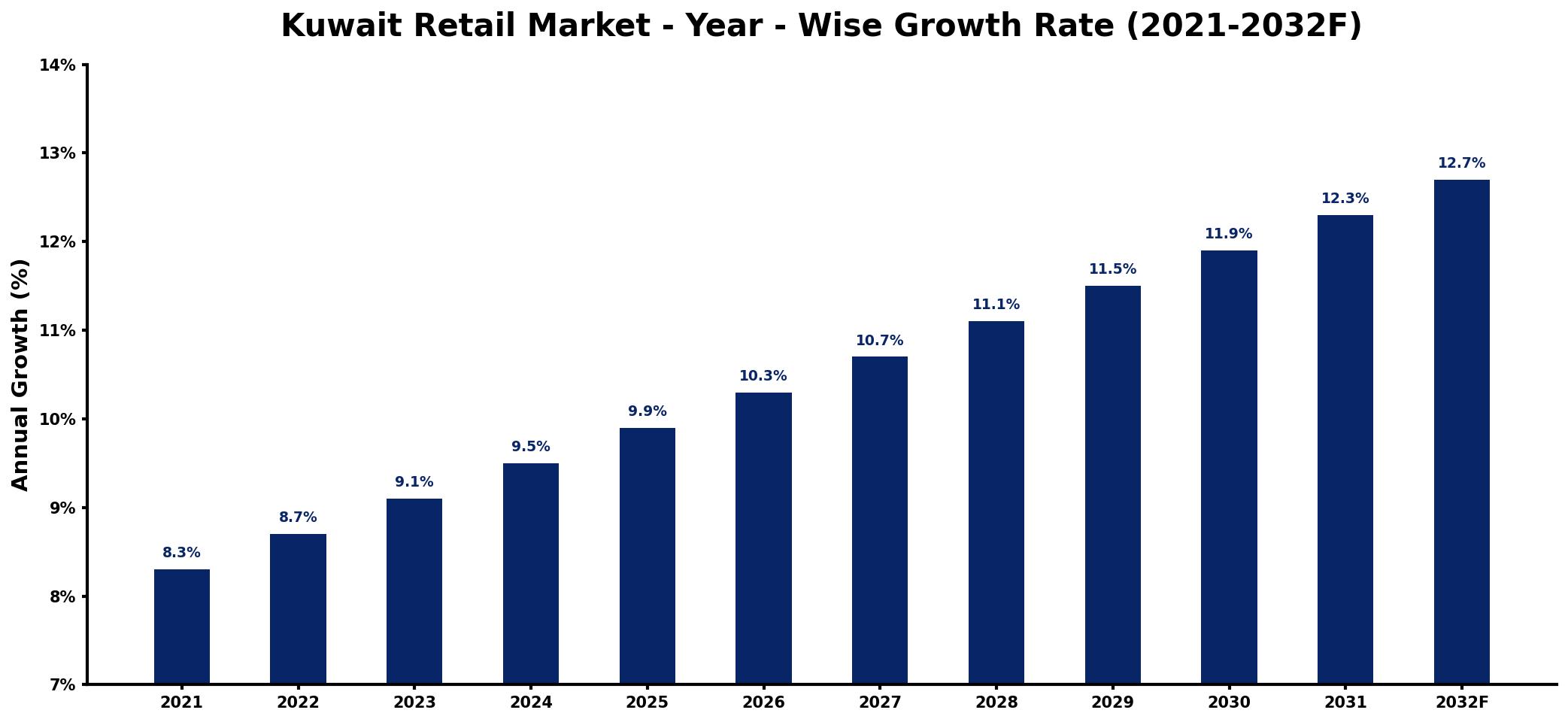
The table below presents the year‑wise growth rates along with the key drivers influencing the market
| Year | Growth Rate | Major Drivers |
| 2021 | 8.3% | Rising consumer spending patterns |
| 2022 | 8.7% | Expansion of online shopping platforms |
| 2023 | 9.1% | Increased disposable income levels |
| 2024 | 9.5% | Growing population and demographics |
| 2025 | 9.9% | Investment in infrastructure development |
| 2026 | 10.3% | Boost in tourism and hospitality |
| 2027 | 10.7% | Emergence of new shopping centers |
| 2028 | 11.1% | Demand for sustainable products |
| 2029 | 11.5% | Technological advancements in logistics |
| 2030 | 11.9% | Growth in e-commerce adoption |
| 2031 | 12.3% | Enhanced marketing strategies implemented |
| 2032 | 12.7% | Increased brand collaborations emerging |
Note: Market size estimations and growth projections presented in this report are based on 6Wresearch's proprietary forecasting methodology, utilizing the latest available industry data, government publications, and primary research inputs.
Kuwait Retail Market Synopsis
Currently, the Kuwait retail market stands as a vibrant hub of consumer activity, driven by significant oil wealth that empowers a discerning consumer class. The dominance of modern shopping malls alongside traditional souks provides a dynamic shopping experience, making it a unique landscape for retailers.
The rising trend of digitalization is transforming how consumers engage with retail, with a notable shift towards e-commerce platforms. As Kuwaitis increasingly embrace online shopping, retail businesses are adapting to meet evolving expectations, paving the way for sustained growth in the sector.
Kuwait Retail Market Key Takeaways
- The market is on a growth trajectory, with a projected size increase from USD 820 Million in 2025 to USD 1492 Million by 2032.
- A significant shift towards e-commerce is reshaping consumer purchasing behavior in the region.
- The luxury segment is thriving, driven by high demand for international brands.
- Environmental consciousness is prompting retailers to offer sustainable and ethically sourced products.
- Government initiatives are facilitating foreign investment and enhancing market accessibility.
Evaluation of Restraints in Kuwait Retail Market
The Kuwait retail market faces several restraints that could hinder growth. Intense competition among both local and international retailers creates a crowded marketplace, which may complicate brand differentiation. Rising operational costs, particularly in terms of rental prices, further strain profit margins. Additionally, the market's dependence on oil revenues introduces volatility in consumer spending patterns, while bureaucratic hurdles can delay the entry and expansion of new players. These factors necessitate a strategic approach for businesses to navigate the complexities of this evolving market.
Kuwait Retail Market Trends
A notable trend in the Kuwait retail market is the increasing consumer inclination toward online shopping, a behavior significantly accelerated by the COVID-19 pandemic. This shift underscores a broader desire for convenience and flexibility in purchasing. Moreover, there is a growing demand for sustainable products, compelling retailers to prioritize eco-friendly practices and product offerings. Lastly, the luxury goods sector continues to flourish as consumers seek high-end brands, reinforcing the market's appeal to international retailers.
Kuwait Retail Market Opportunities
The Kuwait retail market offers lucrative investment opportunities, especially within the luxury segment, fueled by the affluent consumer base. Additionally, the burgeoning e-commerce sector presents a vital avenue for growth, as more consumers turn to digital platforms for their shopping needs. Retailers can also tap into the increasing demand for health and wellness products, as Kuwaiti consumers show a keen interest in organic and health-focused options. Overall, these areas represent significant potential for businesses aiming to establish a strong foothold in Kuwait's retail landscape.
Government Initiatives in the Kuwait Retail Market
The Kuwaiti government has instituted several initiatives aimed at fostering growth in the retail market. A foreign direct investment law facilitates up to 100% foreign ownership in specific sectors, including retail, thereby attracting international players to the market. Regulatory measures requiring retail businesses to secure licenses from the Ministry of Commerce and Industry ensure compliance and fair competition. Additionally, store operating hours are regulated to honor cultural practices, reflecting the government's commitment to upholding local values while promoting economic development.
Future Insights of the Kuwait Retail Market
Looking ahead to 2026-2032, the Kuwait retail market is poised for significant growth. A burgeoning population and rising disposable incomes are expected to drive retail spending. The government's focus on economic diversification and tourism is anticipated to further enhance retail sales. Moreover, as digital shopping continues to evolve, retailers that adapt to these changes will be well-positioned to capture the attention of increasingly tech-savvy consumers. The outlook remains optimistic, though vigilance in addressing competitive pressures and market shifts will be crucial for sustained success.
Kuwait Retail Market Latest Developments (2025 - 2026)
Recent developments in the Kuwait retail sector indicate a shift towards enhanced digital strategies, with several retailers launching innovative online platforms to accommodate the growing trend of e-commerce. Additionally, collaborations between local and international brands are becoming more common as companies seek to expand their market presence. There is also a notable increase in marketing campaigns that emphasize sustainability, aligning with consumer preferences for eco-friendly products. These directions signal a responsive and adaptive retail environment, ready to meet the evolving needs of its customers.
Kuwait Retail Market - Key Attractiveness of the Report
- 10 Years of Market Numbers
- Historical Data Starting from 2022 to 2025
- Base Year: 2025
- Forecast Data until 2032
- Key Performance Indicators Impacting the Market
- Major Upcoming Developments and Projects
Key Highlights of the Report:
- Kuwait Retail Market Outlook
- Market Size of Kuwait Retail Market, 2025
- Forecast of Kuwait Retail Market, 2032
- Historical Data and Forecast of Kuwait Retail Revenues & Volume for the Period 2022-2032F
- Kuwait Retail Market Trend Evolution
- Kuwait Retail Market Drivers and Challenges
- Kuwait Retail Price Trends
- Kuwait Retail Porter's Five Forces
- Kuwait Retail Industry Life Cycle
- Historical Data and Forecast of Kuwait Retail Market Revenues & Volume By Product for the Period 2022-2032F
- Historical Data and Forecast of Kuwait Retail Market Revenues & Volume By Food and Beverages for the Period 2022-2032F
- Historical Data and Forecast of Kuwait Retail Market Revenues & Volume By Personal and Household Care for the Period 2022-2032F
- Historical Data and Forecast of Kuwait Retail Market Revenues & Volume By Apparel for the Period 2022-2032F
- Historical Data and Forecast of Kuwait Retail Market Revenues & Volume By Footwear and Accessories for the Period 2022-2032F
- Historical Data and Forecast of Kuwait Retail Market Revenues & Volume By Furniture for the Period 2022-2032F
- Historical Data and Forecast of Kuwait Retail Market Revenues & Volume By Toys for the Period 2022-2032F
- Historical Data and Forecast of Kuwait Retail Market Revenues & Volume By Electronic and Household Appliances for the Period 2022-2032F
- Historical Data and Forecast of Kuwait Food and Beverages Retail Market Revenues & Volume By Other Products for the Period 2022-2032F
- Historical Data and Forecast of Kuwait Retail Market Revenues & Volume By Distribution Channel for the Period 2022-2032F
- Historical Data and Forecast of Kuwait Retail Market Revenues & Volume By Supermarkets/Hypermarkets for the Period 2022-2032F
- Historical Data and Forecast of Kuwait Retail Market Revenues & Volume By Convenience Stores for the Period 2022-2032F
- Historical Data and Forecast of Kuwait Retail Market Revenues & Volume By Department Stores for the Period 2022-2032F
- Historical Data and Forecast of Kuwait Retail Market Revenues & Volume By Specialty Stores for the Period 2022-2032F
- Historical Data and Forecast of Kuwait Retail Market Revenues & Volume By Online for the Period 2022-2032F
- Historical Data and Forecast of Kuwait Retail Market Revenues & Volume By Other Distribution Channels for the Period 2022-2032F
- Kuwait Retail Import Export Trade Statistics
- Market Opportunity Assessment By Product
- Market Opportunity Assessment By Distribution Channel
- Kuwait Retail Top Companies Market Share
- Kuwait Retail Competitive Benchmarking By Technical and Operational Parameters
- Kuwait Retail Company Profiles
- Kuwait Retail Key Strategic Recommendations






































