Laos Fans and Ventilators Market: Top 5 Importing Countries and Market Competition (HHI) Analysis
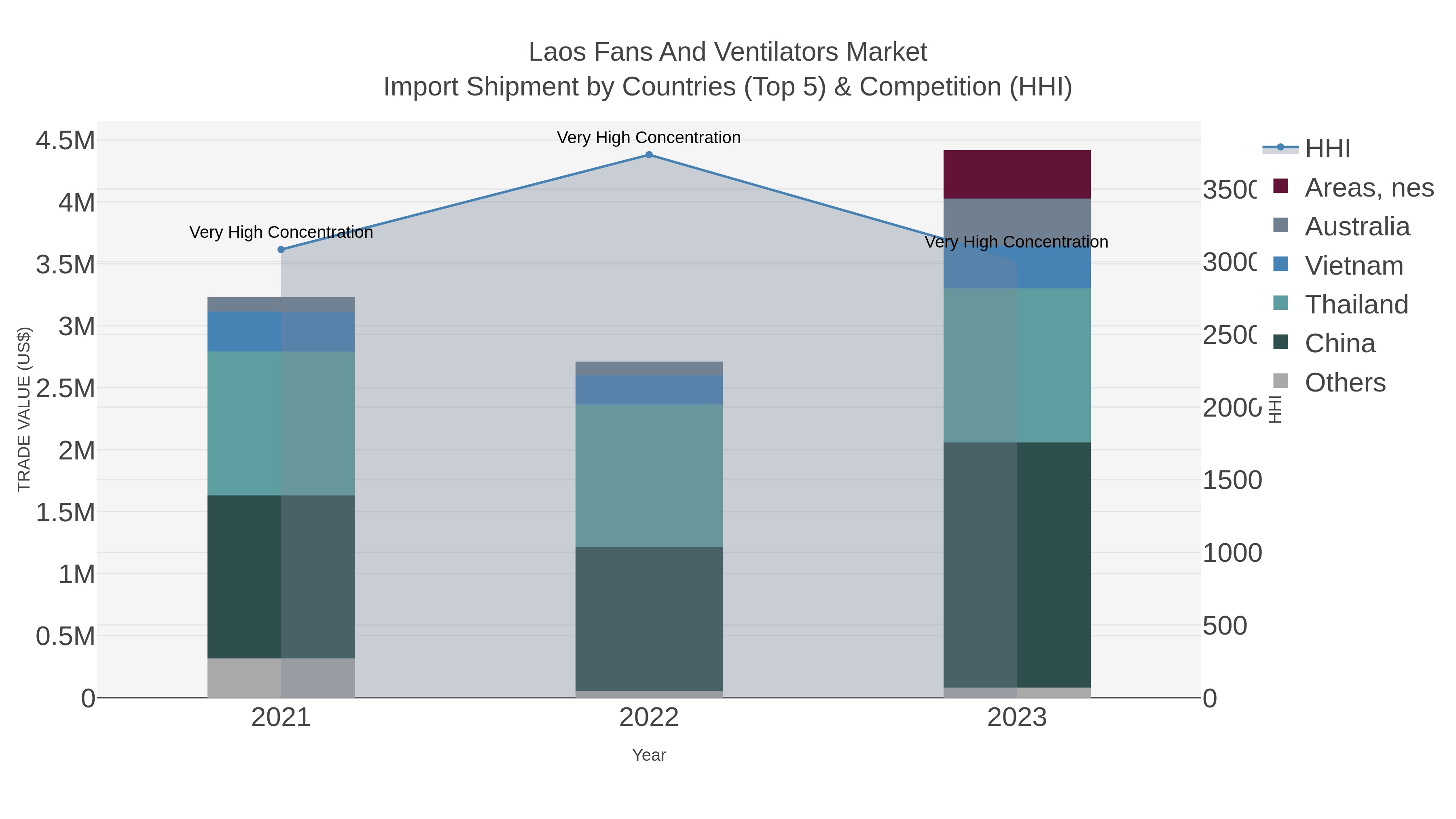
In 2023, Laos continued to see a high concentration of imports in fans and ventilators, with top exporters being China, Thailand, Areas, nes, Australia, and Vietnam. The HHI remained at a very high level, indicating a competitive market landscape. With a remarkable CAGR of 16.94 and a growth rate of 63.0, the import shipments of fans and ventilators to Laos are showing significant expansion, pointing towards a growing demand for these essential products in the country.
Key Highlights of the Report:
- Laos Fans and Ventilators Market Outlook
- Market Size of Laos Fans and Ventilators Market, 2025
- Forecast of Laos Fans and Ventilators Market, 2032
- Historical Data and Forecast of Laos Fans and Ventilators Revenues & Volume for the Period 2022 - 2032F
- Laos Fans and Ventilators Market Trend Evolution
- Laos Fans and Ventilators Market Drivers and Challenges
- Laos Fans and Ventilators Price Trends
- Laos Fans and Ventilators Porter`s Five Forces
- Laos Fans and Ventilators Industry Life Cycle
- Historical Data and Forecast of Laos Fans and Ventilators Market Revenues & Volume By Material for the Period 2022 - 2032F
- Historical Data and Forecast of Laos Fans and Ventilators Market Revenues & Volume By Metal for the Period 2022 - 2032F
- Historical Data and Forecast of Laos Fans and Ventilators Market Revenues & Volume By Composite for the Period 2022 - 2032F
- Historical Data and Forecast of Laos Fans and Ventilators Market Revenues & Volume By Rubber for the Period 2022 - 2032F
- Historical Data and Forecast of Laos Fans and Ventilators Market Revenues & Volume By Plastic for the Period 2022 - 2032F
- Historical Data and Forecast of Laos Fans and Ventilators Market Revenues & Volume By Application for the Period 2022 - 2032F
- Historical Data and Forecast of Laos Fans and Ventilators Market Revenues & Volume By Interior for the Period 2022 - 2032F
- Historical Data and Forecast of Laos Fans and Ventilators Market Revenues & Volume By Exterior for the Period 2022 - 2032F
- Historical Data and Forecast of Laos Fans and Ventilators Market Revenues & Volume By Structural for the Period 2022 - 2032F
- Historical Data and Forecast of Laos Fans and Ventilators Market Revenues & Volume By Powertrain for the Period 2022 - 2032F
- Historical Data and Forecast of Laos Fans and Ventilators Market Revenues & Volume By Vehicle Types for the Period 2022 - 2032F
- Historical Data and Forecast of Laos Fans and Ventilators Market Revenues & Volume By Passenger Vehicles for the Period 2022 - 2032F
- Historical Data and Forecast of Laos Fans and Ventilators Market Revenues & Volume By Light Commercial Vehicles for the Period 2022 - 2032F
- Historical Data and Forecast of Laos Fans and Ventilators Market Revenues & Volume By Heavy Commercial Vehicles for the Period 2022 - 2032F
- Laos Fans and Ventilators Import Export Trade Statistics
- Market Opportunity Assessment By Material
- Market Opportunity Assessment By Application
- Market Opportunity Assessment By Vehicle Types
- Laos Fans and Ventilators Top Companies Market Share
- Laos Fans and Ventilators Competitive Benchmarking By Technical and Operational Parameters
- Laos Fans and Ventilators Company Profiles
- Laos Fans and Ventilators Key Strategic Recommendations






































