Latin America Toys & Games Market Size, Share & Growth Rate
The Latin America Toys & Games Market was estimated at USD 589 Million in 2025 and is projected to reach USD 836 Million by 2032, growing at a CAGR of 5.1% from 2026 to 2032. This upward trajectory is being fueled by the expansion of licensing agreements and a resurgence in consumer confidence, particularly in Brazil and Mexico. Additionally, improved economic conditions and the rising popularity of both traditional and innovative gaming options are contributing to this robust growth.
Latin America Toys & Games Market Year-wise Growth Rate and Key Drivers
This graph highlights how the Latin America Toys & Games Market has steadily grown over the years, supported by major growth factors.
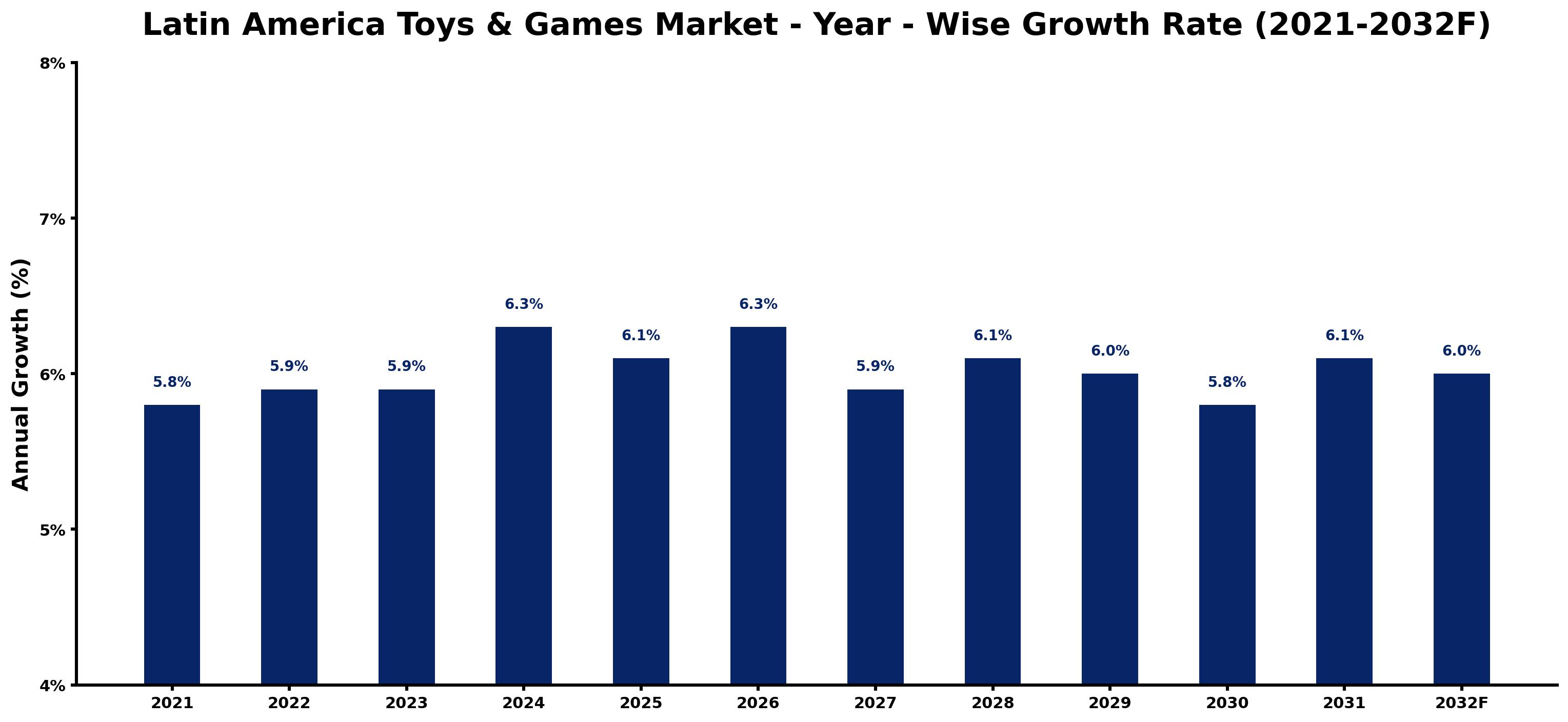
The table below presents the year‑wise growth rates along with the key drivers influencing the market
| Year | Growth Rate | Major Drivers |
| 2021 | 5.8% | Growing urbanization and commercial development |
| 2022 | 5.9% | Rising electricity demand across industries |
| 2023 | 5.9% | Increasing smart city development projects |
| 2024 | 6.3% | Government infrastructure modernization initiatives |
| 2025 | 6.1% | Increasing industrial infrastructure investments |
| 2026 | 6.3% | Growing urbanization and commercial development |
| 2027 | 5.9% | Expansion of commercial construction activities |
| 2028 | 6.1% | Expansion of manufacturing activities |
| 2029 | 6.0% | Government infrastructure modernization initiatives |
| 2030 | 5.8% | Rapid growth in telecom and data center sectors |
| 2031 | 6.1% | Increasing industrial automation investments |
| 2032 | 6.0% | Expansion of commercial construction activities |
Note - Market size estimations and growth projections presented in this report are based on 6Wresearch’s advanced forecasting approach, validated with industry datasets as of June 2026.
Latin America Toys & Games Market Synopsis
The Latin America Toys & Games Market is characterized by a dynamic interplay of traditional and digital entertainment options. In 2018, Brazil emerged as the market leader, but Mexico is rapidly gaining ground, highlighting a shift in consumer preferences that reflect changing demographics and purchasing power.
The market offers various segments, including games and puzzles, outdoor and sports toys, and video games, catering to different age groups and consumer interests. As economic stability improves across the region, companies are finding opportunities in both online and offline channels to enhance their reach and improve sales performance.
Latin America Toys & Games Market Key Takeaways
- The market is experiencing a revival, with traditional toys and games gaining traction alongside digital alternatives.
- Brazil remains the dominant force, while Mexico is emerging as a vital player in the toys and games sector.
- Key growth drivers include improved economic conditions, rising unit prices, and increased licensing activities.
- Distribution channels are diversifying, with significant growth in online sales complemented by traditional retail methods.
- Stakeholders can anticipate future growth opportunities, particularly in regions where consumer spending is on the rise.
Evaluation of Restraints in Latin America Toys & Games Market
Despite the positive outlook, several restraints are affecting the Latin America Toys & Games Market. Economic volatility in certain areas continues to pose challenges, limiting consumer discretionary spending. Additionally, competition from digital gaming platforms can overshadow traditional toy sales, necessitating innovation and strategic marketing to maintain consumer interest. Supply chain disruptions, particularly those affecting the import of raw materials, also contribute to market challenges, potentially impacting pricing and availability.
Latin America Toys & Games Market Trends
Emerging trends in the Latin America Toys & Games Market reveal a significant shift toward sustainability and eco-friendly products. Consumers are becoming increasingly conscious of environmental impacts, driving demand for toys made from renewable materials. Furthermore, the integration of technology in traditional toys, such as augmented reality features, is gaining traction. Social media also plays a critical role in shaping consumer preferences, where influencers are actively promoting various products and trends.
Latin America Toys & Games Market Opportunities
Opportunities within the Latin America Toys & Games Market abound, particularly in expanding e-commerce platforms which can facilitate greater access to a wider audience. Additionally, the increasing popularity of interactive and educational toys presents avenues for growth as parents prioritize developmental benefits. Companies that leverage localized marketing strategies can effectively cater to regional preferences, allowing them to capture untapped market segments.
Government Initiatives in the Latin America Toys & Games Market
Government initiatives across Latin America are increasingly focusing on promoting the local manufacturing of toys and games. Various programs aim to support small to medium-sized enterprises in the toy industry, providing funding and resources to enhance production capabilities. Additionally, public campaigns emphasizing the importance of play and education are encouraging parents to invest in toys that support learning and development, further stimulating market growth.
Future Insights of the Latin America Toys & Games Market
Looking ahead to the period from 2026 to 2032, the Latin America Toys & Games Market is poised for continued expansion. As technological advancements reshape consumer expectations, the integration of tech-enabled toys will become more prevalent. Additionally, with ongoing improvements in economic conditions, a larger consumer base is likely to seek diverse and innovative products. Stakeholders are advised to remain agile, adapting their strategies to align with evolving consumer demands and market dynamics.
Latin America Toys & Games Market Latest Developments (May 2025 - June 2026)
Recent developments in the Latin America Toys & Games Market indicate a renewed focus on digital platforms and enhanced customer engagement through interactive experiences. Companies are exploring collaborations with tech firms to create toys that offer educational content and immersive play. Meanwhile, traditional retailers are adapting to changing consumer behavior by enhancing their online presence and integrating omnichannel strategies to provide seamless shopping experiences.
Latin America Toys & Games Market - Key Attractiveness of the Report
- 10 Years of Market Numbers
- Historical Data Starting from 2022 to 2025
- Base Year: 2025
- Forecast Data until 2032
- Key Performance Indicators Impacting the Market
- Major Upcoming Developments and Projects






































