Latvia Alternative Building Materials Market Top 5 Importing Countries and Market Competition (HHI) Analysis
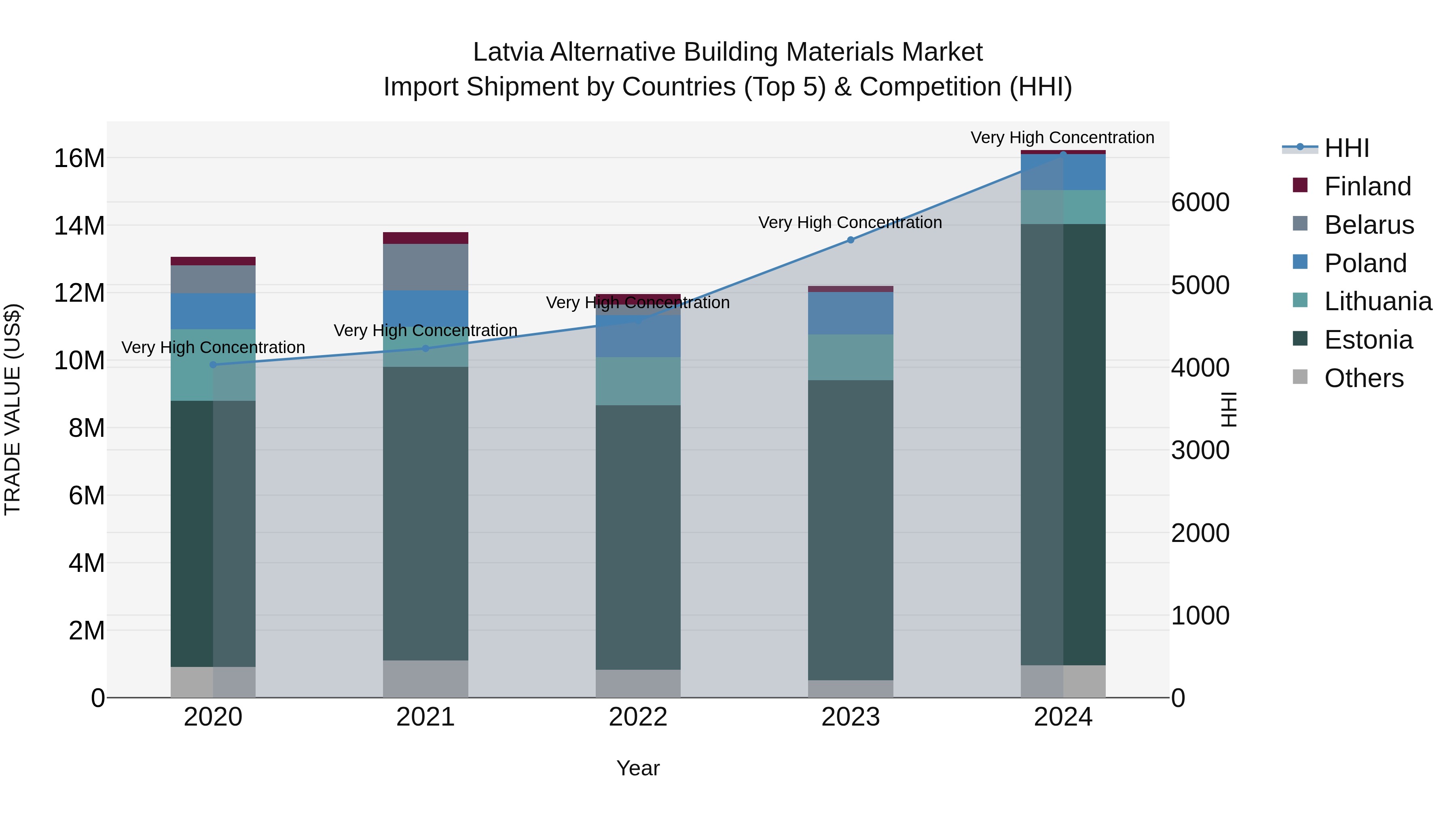
Latvia`s import shipments of alternative building materials in 2024 continued to be dominated by neighboring countries such as Estonia, Poland, Lithuania, and Germany, with Denmark also making a significant contribution. The high Herfindahl-Hirschman Index (HHI) indicates a concentrated market, suggesting strong competition among the top exporting countries. The compound annual growth rate (CAGR) from 2020 to 2024 stood at a healthy 5.56%, reflecting steady growth in demand for alternative building materials. Furthermore, the impressive growth rate of 32.94% from 2023 to 2024 signals a notable surge in import activity within the sector.
Key Highlights of the Report:
- Latvia Alternative Building Materials Market Outlook
- Market Size of Latvia Alternative Building Materials Market, 2025
- Forecast of Latvia Alternative Building Materials Market, 2032
- Historical Data and Forecast of Latvia Alternative Building Materials Revenues & Volume for the Period 2022 - 2032F
- Latvia Alternative Building Materials Market Trend Evolution
- Latvia Alternative Building Materials Market Drivers and Challenges
- Latvia Alternative Building Materials Price Trends
- Latvia Alternative Building Materials Porter`s Five Forces
- Latvia Alternative Building Materials Industry Life Cycle
- Historical Data and Forecast of Latvia Alternative Building Materials Market Revenues & Volume By Material for the Period 2022 - 2032F
- Historical Data and Forecast of Latvia Alternative Building Materials Market Revenues & Volume By Bamboo for the Period 2022 - 2032F
- Historical Data and Forecast of Latvia Alternative Building Materials Market Revenues & Volume By Recycled Plastic for the Period 2022 - 2032F
- Historical Data and Forecast of Latvia Alternative Building Materials Market Revenues & Volume By Wood for the Period 2022 - 2032F
- Historical Data and Forecast of Latvia Alternative Building Materials Market Revenues & Volume By Others for the Period 2022 - 2032F
- Historical Data and Forecast of Latvia Alternative Building Materials Market Revenues & Volume By End User for the Period 2022 - 2032F
- Historical Data and Forecast of Latvia Alternative Building Materials Market Revenues & Volume By Residential for the Period 2022 - 2032F
- Historical Data and Forecast of Latvia Alternative Building Materials Market Revenues & Volume By Non-residential for the Period 2022 - 2032F
- Historical Data and Forecast of Latvia Alternative Building Materials Market Revenues & Volume By Application for the Period 2022 - 2032F
- Historical Data and Forecast of Latvia Alternative Building Materials Market Revenues & Volume By Construction for the Period 2022 - 2032F
- Historical Data and Forecast of Latvia Alternative Building Materials Market Revenues & Volume By Furniture for the Period 2022 - 2032F
- Historical Data and Forecast of Latvia Alternative Building Materials Market Revenues & Volume By Flooring for the Period 2022 - 2032F
- Latvia Alternative Building Materials Import Export Trade Statistics
- Market Opportunity Assessment By Material
- Market Opportunity Assessment By End User
- Market Opportunity Assessment By Application
- Latvia Alternative Building Materials Top Companies Market Share
- Latvia Alternative Building Materials Competitive Benchmarking By Technical and Operational Parameters
- Latvia Alternative Building Materials Company Profiles
- Latvia Alternative Building Materials Key Strategic Recommendations






































