Latvia Aluminium Market Size (2020-2030)
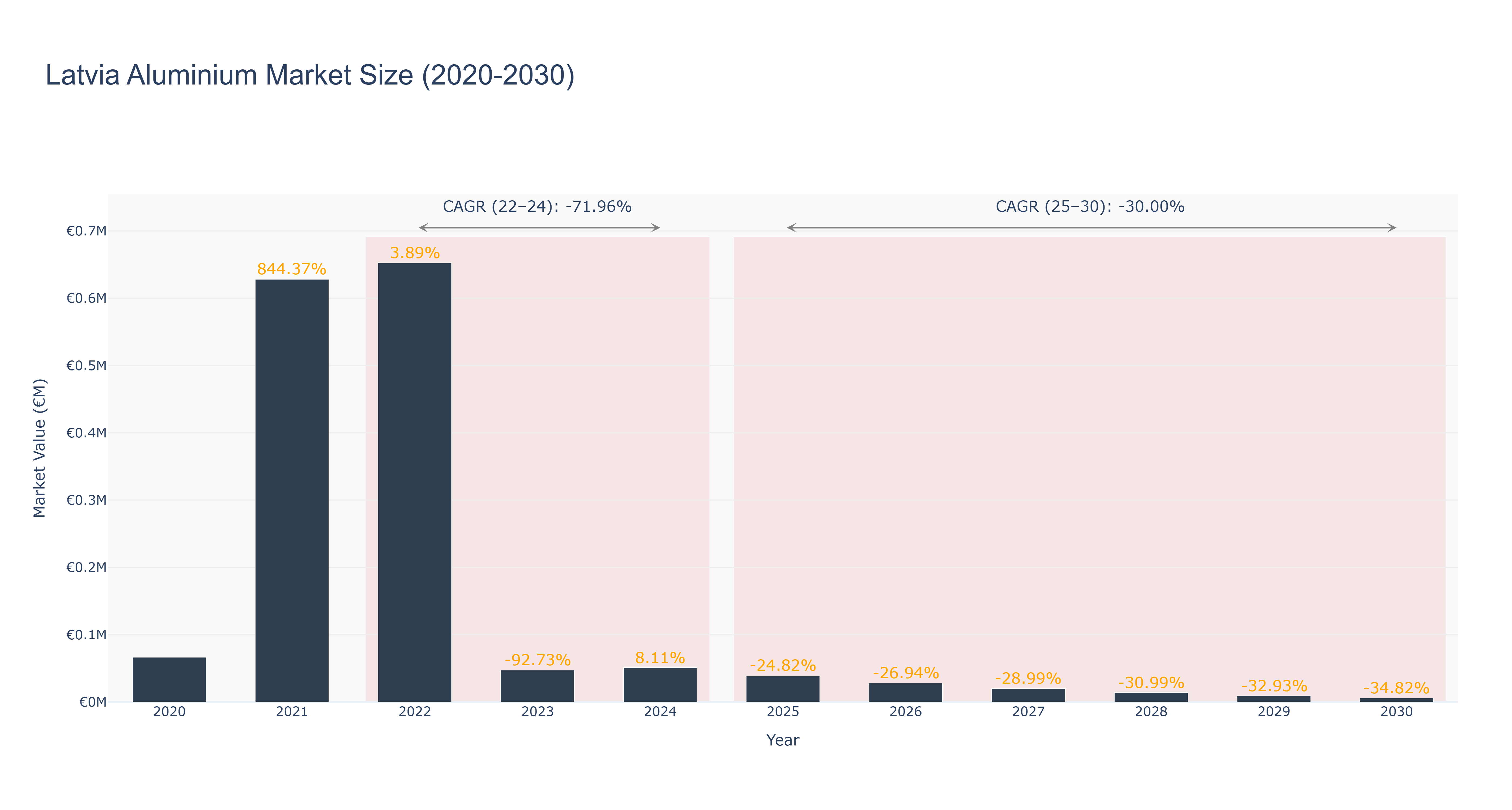
Latvia Aluminium Market has experienced fluctuations in market size over the years. The peak market size of €0.65 million was observed in 2022, followed by a sharp decline to €0.05 million in 2023. The market continued to shrink to €0.03 million in 2026, with a projected decrease to €0.01 million by 2030. The CAGR for the period 2022-24 was -71.96%, indicating a significant downturn, while the CAGR for 2025-30 is forecasted at -30.0%. The market's decline can be attributed to global economic challenges, oversupply in the aluminium market, and changing consumer preferences towards sustainable materials. Looking ahead, Latvia's aluminium market is focusing on enhancing sustainability practices and investing in advanced technologies to improve efficiency and reduce environmental impact. Future developments include collaborations with renewable energy providers to power aluminium production sustainably.
Latvia Aluminium Market: Production & Trade Performance (2019-2025)
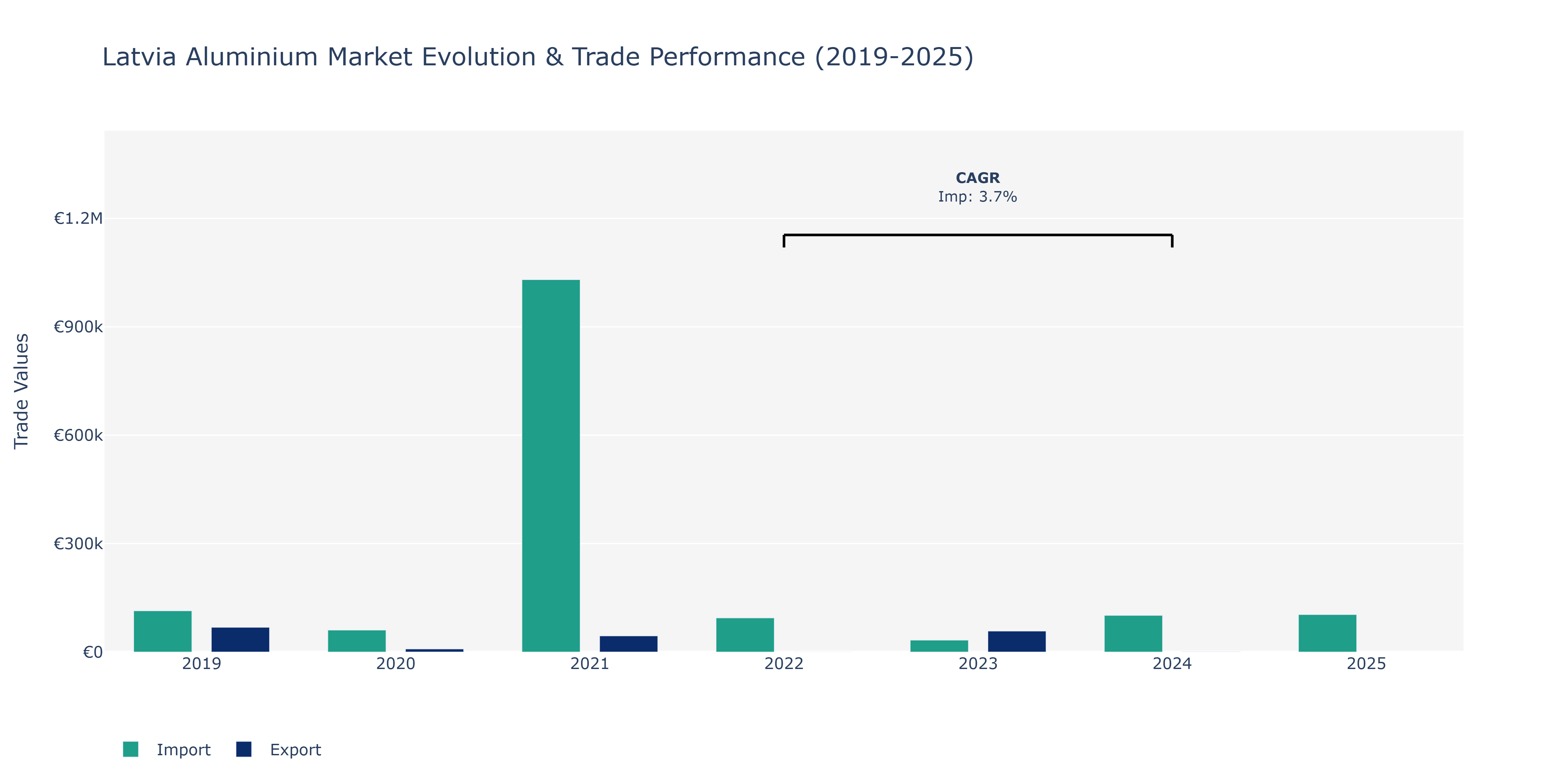
In the Latvia Aluminium Market, exports and imports displayed notable fluctuations over the years. In 2019, both exports and imports were at their peak values, with exports at €68.41 thousand and imports at €114.2 thousand. However, in 2020, a substantial decline was observed in both exports, dropping to €8.52 thousand, and imports, decreasing to €60.76 thousand. The market witnessed a significant recovery in 2021, with exports rising to €44.79 thousand and imports surging to €1.03 million, indicating a growing demand for aluminium products. In 2023, exports increased to €58.07 thousand while imports decreased to €33.05 thousand. Interestingly, 2024 saw a sharp decline in exports to €0.77 million, contrasting with a peak in imports at €101.48 thousand. The trend suggests a potential shift in market dynamics, possibly influenced by global economic conditions and trade policies impacting aluminium flows into Latvia. The consistent growth in imports, especially evident with a 3.67% CAGR from 2022 to 2024, could signify increasing domestic consumption or industrial activities requiring aluminium inputs, aligning with the broader industry trends indicating a rising demand for lightweight and durable materials in various sectors.
Key Highlights of the Report:
- Latvia Aluminium Market Outlook
- Market Size of Latvia Aluminium Market, 2024
- Forecast of Latvia Aluminium Market, 2031
- Historical Data and Forecast of Latvia Aluminium Revenues & Volume for the Period 2021-2031
- Latvia Aluminium Market Trend Evolution
- Latvia Aluminium Market Drivers and Challenges
- Latvia Aluminium Price Trends
- Latvia Aluminium Porter`s Five Forces
- Latvia Aluminium Industry Life Cycle
- Historical Data and Forecast of Latvia Aluminium Market Revenues & Volume By End-Use for the Period 2021-2031
- Historical Data and Forecast of Latvia Aluminium Market Revenues & Volume By Construction for the Period 2021-2031
- Historical Data and Forecast of Latvia Aluminium Market Revenues & Volume By Transportation for the Period 2021-2031
- Historical Data and Forecast of Latvia Aluminium Market Revenues & Volume By Packaging for the Period 2021-2031
- Historical Data and Forecast of Latvia Aluminium Market Revenues & Volume By Electrical for the Period 2021-2031
- Historical Data and Forecast of Latvia Aluminium Market Revenues & Volume By Consumer Durables for the Period 2021-2031
- Historical Data and Forecast of Latvia Aluminium Market Revenues & Volume By Machinery & Equipment for the Period 2021-2031
- Historical Data and Forecast of Latvia Aluminium Market Revenues & Volume By Others for the Period 2021-2031
- Latvia Aluminium Import Export Trade Statistics
- Market Opportunity Assessment By End-Use
- Latvia Aluminium Top Companies Market Share
- Latvia Aluminium Competitive Benchmarking By Technical and Operational Parameters
- Latvia Aluminium Company Profiles
- Latvia Aluminium Key Strategic Recommendations






































