Latvia Electric Vehicle Market Top 5 Importing Countries and Market Competition (HHI) Analysis
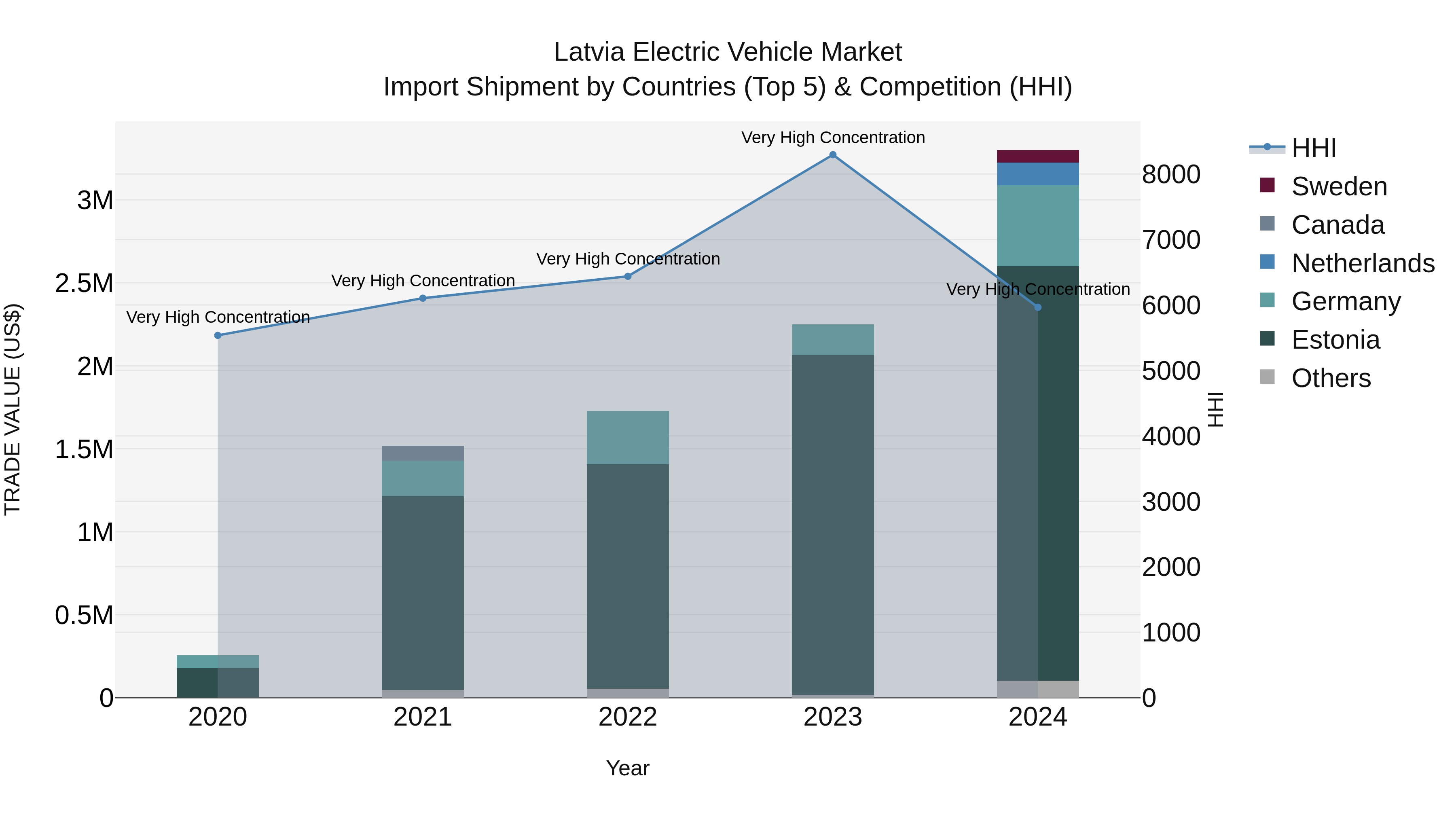
In 2024, Latvia saw a significant increase in electric vehicle import shipments, with top exporting countries being Estonia, Germany, Netherlands, Sweden, and Austria. The market remains highly concentrated, as indicated by the high Herfindahl-Hirschman Index (HHI). The compound annual growth rate (CAGR) from 2020 to 2024 is an impressive 89.5%, showcasing the rapid expansion of the electric vehicle market in Latvia. Additionally, the growth rate from 2023 to 2024 is a notable 46.66%, indicating sustained momentum in the importation of electric vehicles into the country.
Latvia Export Potential Assessment For Electric Vehicle Market (Values in USD Thousand)
Key Highlights of the Report:
- Latvia Electric Vehicle Market Outlook
- Market Size of Latvia Electric Vehicle Market, 2025
- Forecast of Latvia Electric Vehicle Market, 2032
- Historical Data and Forecast of Latvia Electric Vehicle Revenues & Volume for the Period 2022 - 2032F
- Latvia Electric Vehicle Market Trend Evolution
- Latvia Electric Vehicle Market Drivers and Challenges
- Latvia Electric Vehicle Price Trends
- Latvia Electric Vehicle Porter`s Five Forces
- Latvia Electric Vehicle Industry Life Cycle
- Historical Data and Forecast of Latvia Electric Vehicle Market Revenues & Volume By Propulsion for the Period 2022 - 2032F
- Historical Data and Forecast of Latvia Electric Vehicle Market Revenues & Volume By BEV for the Period 2022 - 2032F
- Historical Data and Forecast of Latvia Electric Vehicle Market Revenues & Volume By PHEV for the Period 2022 - 2032F
- Historical Data and Forecast of Latvia Electric Vehicle Market Revenues & Volume By FCEV for the Period 2022 - 2032F
- Historical Data and Forecast of Latvia Electric Vehicle Market Revenues & Volume By Vehicle Drive Type for the Period 2022 - 2032F
- Historical Data and Forecast of Latvia Electric Vehicle Market Revenues & Volume By FWD for the Period 2022 - 2032F
- Historical Data and Forecast of Latvia Electric Vehicle Market Revenues & Volume By RWD for the Period 2022 - 2032F
- Historical Data and Forecast of Latvia Electric Vehicle Market Revenues & Volume By AWD for the Period 2022 - 2032F
- Historical Data and Forecast of Latvia Electric Vehicle Market Revenues & Volume By Vehicle Top Speed for the Period 2022 - 2032F
- Historical Data and Forecast of Latvia Electric Vehicle Market Revenues & Volume By <125 mph for the Period 2022 - 2032F
- Historical Data and Forecast of Latvia Electric Vehicle Market Revenues & Volume By >125 mph for the Period 2022 - 2032F
- Latvia Electric Vehicle Import Export Trade Statistics
- Market Opportunity Assessment By Propulsion
- Market Opportunity Assessment By Vehicle Drive Type
- Market Opportunity Assessment By Vehicle Top Speed
- Latvia Electric Vehicle Top Companies Market Share
- Latvia Electric Vehicle Competitive Benchmarking By Technical and Operational Parameters
- Latvia Electric Vehicle Company Profiles
- Latvia Electric Vehicle Key Strategic Recommendations






































