Latvia Sunglasses Market Size (2020-2030)
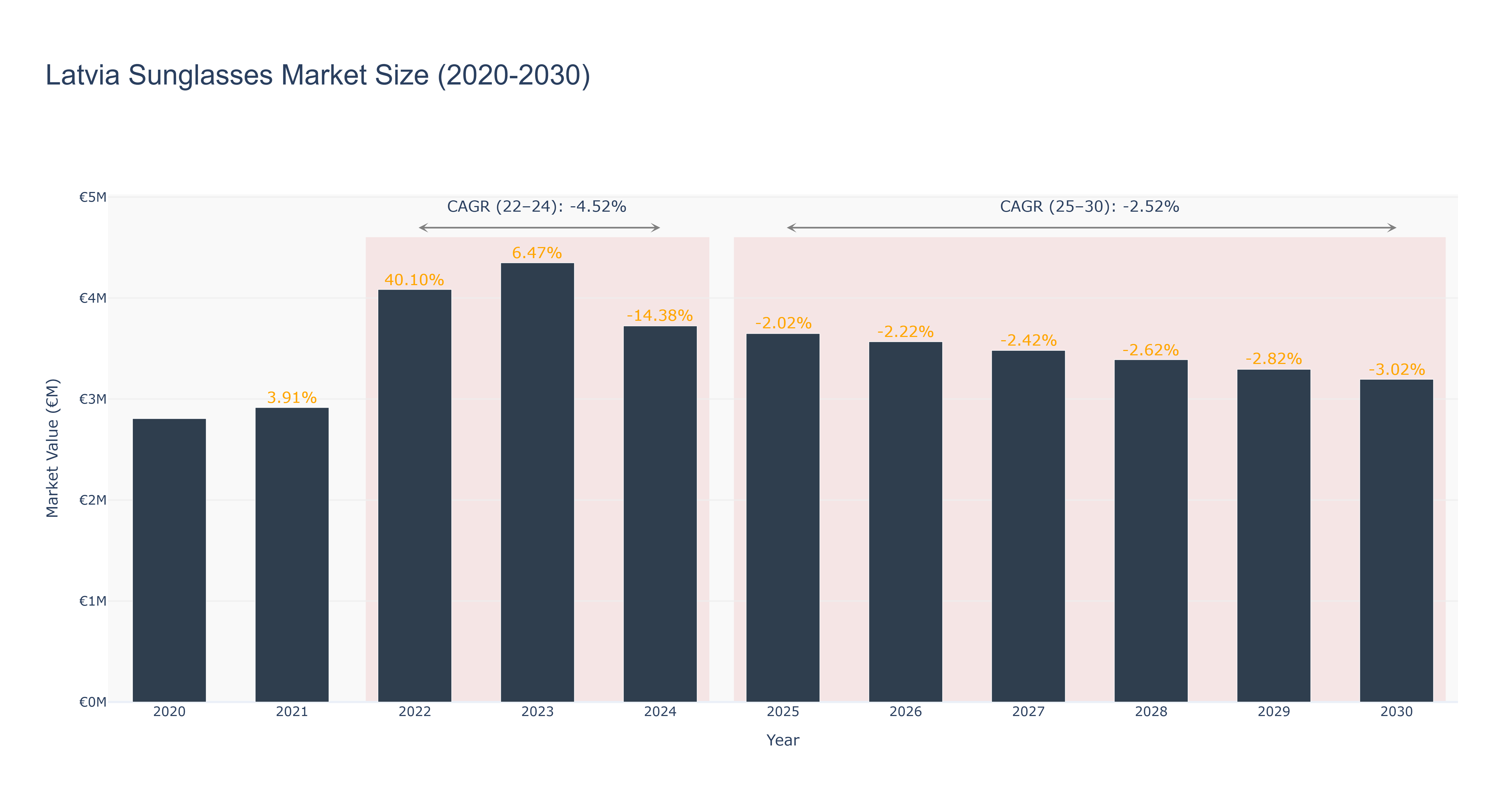
Latvia Sunglasses Market experienced a peak market size of €4.35 million in 2023. The actual market size declined from €2.81 million in 2020 to €3.72 million in 2024. The forecasted market size is expected to decrease from €3.65 million in 2025 to €3.19 million in 2030, with a CAGR of -2.52% for the period 2025-30. The market saw a significant drop in size due to changing consumer preferences and economic uncertainties. Looking ahead, Latvia's sunglasses market is focusing on sustainable eyewear production to align with green initiatives and cater to environmentally conscious consumers. Additionally, collaborations with fashion influencers for exclusive product lines are expected to drive market growth in the coming years, emphasizing the importance of brand partnerships in the competitive eyewear sector.
Latvia Sunglasses Market: Production & Trade Performance (2019-2025)
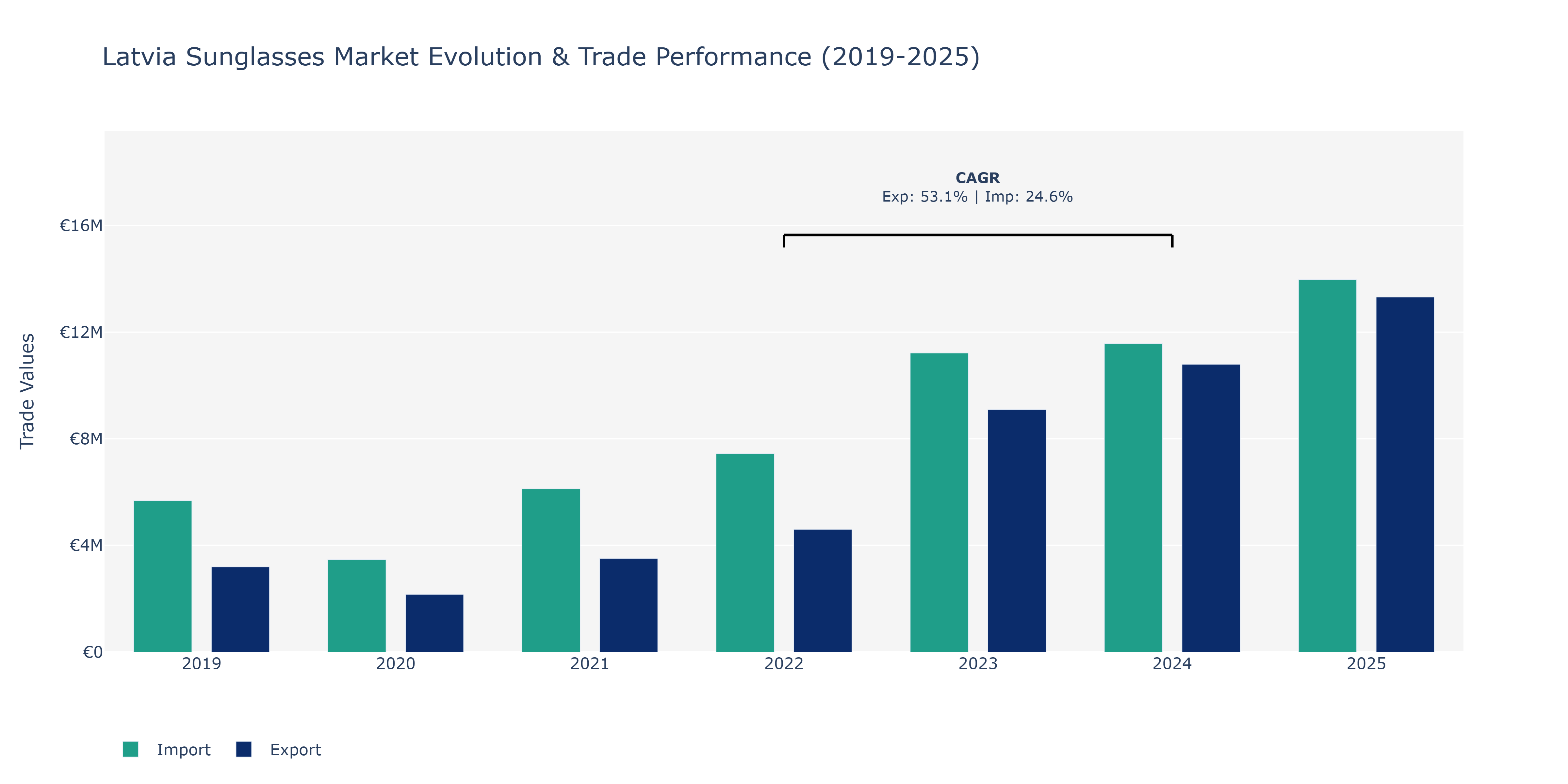
In the Latvia Sunglasses Market, exports and imports show notable shifts over the years. In 2019, exports amounted to €3.2 million, while imports stood at €5.68 million, reflecting a significant trade imbalance. The year 2020 witnessed a considerable decrease in both exports and imports, with exports at €2.16 million and imports at €3.47 million, possibly due to global economic uncertainties impacting consumer spending. However, starting in 2021, a positive trajectory emerged with exports rising to €3.51 million and imports to €6.12 million, indicating a recovery in market demand. Notably, by 2025, exports surged to €13.32 million and imports to €13.97 million, reaching peak levels, potentially driven by increased consumer awareness of UV protection and fashion trends. The impressive exports CAGR of 53.15% from 2022 to 2024 suggests growing international market penetration, while the imports CAGR of 24.62% indicates expanding domestic consumption and market competitiveness. These trends align with the global eyewear industry's shift towards sustainable and stylish eyewear options, driving Latvia's market growth.
Key Highlights of the Report:
- Latvia Sunglasses Market Outlook
- Market Size of Latvia Sunglasses Market, 2025
- Forecast of Latvia Sunglasses Market, 2032
- Historical Data and Forecast of Latvia Sunglasses Revenues & Volume for the Period 2022 - 2032F
- Latvia Sunglasses Market Trend Evolution
- Latvia Sunglasses Market Drivers and Challenges
- Latvia Sunglasses Price Trends
- Latvia Sunglasses Porter`s Five Forces
- Latvia Sunglasses Industry Life Cycle
- Historical Data and Forecast of Latvia Sunglasses Market Revenues & Volume By Product Type for the Period 2022 - 2032F
- Historical Data and Forecast of Latvia Sunglasses Market Revenues & Volume By Polarized for the Period 2022 - 2032F
- Historical Data and Forecast of Latvia Sunglasses Market Revenues & Volume By Non-polarized for the Period 2022 - 2032F
- Historical Data and Forecast of Latvia Sunglasses Market Revenues & Volume By End-Users for the Period 2022 - 2032F
- Historical Data and Forecast of Latvia Sunglasses Market Revenues & Volume By Women for the Period 2022 - 2032F
- Historical Data and Forecast of Latvia Sunglasses Market Revenues & Volume By Men for the Period 2022 - 2032F
- Historical Data and Forecast of Latvia Sunglasses Market Revenues & Volume By Unisex for the Period 2022 - 2032F
- Historical Data and Forecast of Latvia Sunglasses Market Revenues & Volume By Distribution Channel for the Period 2022 - 2032F
- Historical Data and Forecast of Latvia Sunglasses Market Revenues & Volume By Online for the Period 2022 - 2032F
- Historical Data and Forecast of Latvia Sunglasses Market Revenues & Volume By Offline for the Period 2022 - 2032F
- Latvia Sunglasses Import Export Trade Statistics
- Market Opportunity Assessment By Product Type
- Market Opportunity Assessment By End-Users
- Market Opportunity Assessment By Distribution Channel
- Latvia Sunglasses Top Companies Market Share
- Latvia Sunglasses Competitive Benchmarking By Technical and Operational Parameters
- Latvia Sunglasses Company Profiles
- Latvia Sunglasses Key Strategic Recommendations






































