Liberia Packaged Water Market: Top 5 Importing Countries and Market Competition (HHI) Analysis
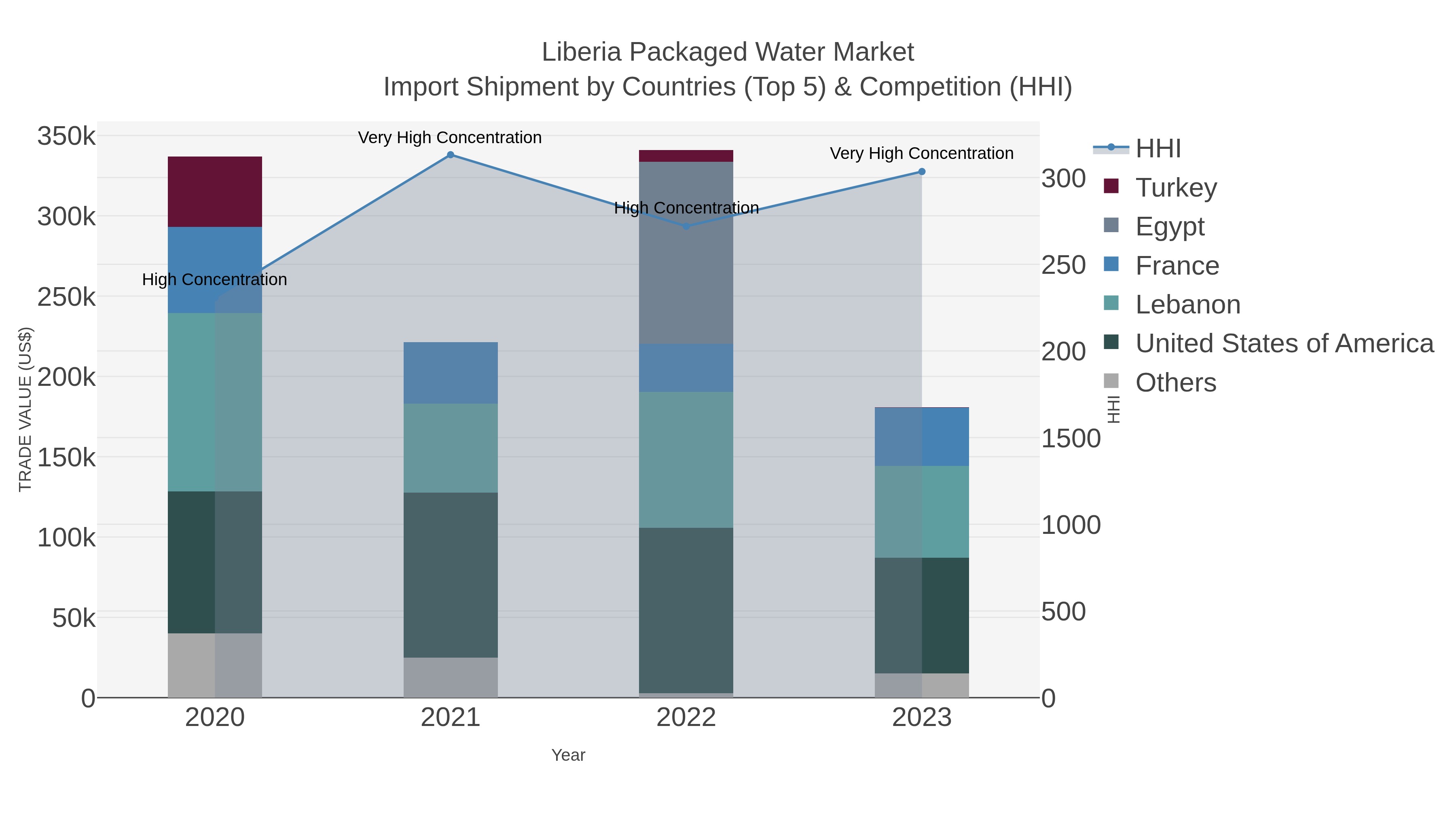
The packaged water import market in Liberia experienced a shift in concentration in 2023, with a notable increase in the Herfindahl-Hirschman Index (HHI) indicating very high concentration among top exporters. The top suppliers to Liberia were the United States of America, Lebanon, France, Cyprus, and the United Arab Emirates. Despite a negative compound annual growth rate (CAGR) of -18.73% and a steep decline in the growth rate of -46.94%, these key exporters continue to play a significant role in meeting Liberia`s packaged water demand.
Liberia Packaged water Market Overview
The Liberia packaged water market is experiencing steady growth driven by increasing awareness of the importance of clean and safe drinking water. The market is characterized by a mix of local and international brands offering a variety of packaging sizes to cater to different consumer needs. Key factors influencing market growth include population growth, urbanization, and rising disposable incomes leading to higher demand for convenient, hygienic water options. The market is also witnessing competition among players to improve distribution networks, enhance product quality, and engage in marketing initiatives to capture a larger market share. Government initiatives to improve access to clean water in rural areas are further expected to drive market growth in the coming years.
Liberia Packaged water Market Trends and Opportunities
In the Liberia packaged water market, there is a growing trend towards healthier lifestyles and increased awareness of the importance of clean drinking water. Consumers are seeking convenient and safe hydration options, driving the demand for packaged water. Opportunities exist for companies to innovate with sustainable packaging solutions, such as eco-friendly materials and refillable options, to appeal to environmentally conscious consumers. Additionally, expanding distribution channels, especially in rural areas, can help tap into new market segments. Collaboration with government bodies to improve water infrastructure and promote safe drinking water practices can also be a key opportunity for packaged water companies in Liberia. Overall, the market is poised for growth as consumer preferences shift towards healthier and more sustainable options.
Liberia Packaged water Market Challenges
In the Liberia packaged water market, several challenges are faced by companies operating in the industry. These challenges include issues related to water quality and safety standards, as ensuring the purity and safety of the water is crucial for consumer trust and regulatory compliance. Additionally, the market faces competition from various brands, leading to price wars and the need for effective marketing strategies to differentiate products. Infrastructure limitations, such as unreliable electricity supply and transportation constraints, also pose challenges in distribution and production processes. Furthermore, fluctuating raw material costs and changing consumer preferences add complexity to the market dynamics. Overcoming these challenges requires companies to invest in quality control measures, innovative marketing tactics, and efficient supply chain management to stay competitive in the Liberia packaged water market.
Liberia Packaged water Market Drivers
The Liberia Packaged water market is primarily driven by factors such as increasing urbanization, growth in population, rising disposable incomes, and changing consumer preferences towards convenient and safe drinking water options. With improvements in distribution and packaging technologies, packaged water has become more accessible and affordable, leading to a surge in demand. Additionally, the growing awareness about the importance of clean drinking water for health and hygiene purposes is also fueling market growth. The convenience of on-the-go hydration, especially in urban areas where access to safe drinking water may be limited, is further propelling the demand for packaged water products in Liberia. Overall, these drivers are expected to continue to support the growth of the packaged water market in Liberia in the foreseeable future.
Liberia Packaged water Market Government Policy
The Liberian government has implemented regulations to govern the packaged water market, aiming to ensure consumer safety and product quality. The Ministry of Health and the National Public Health Institute of Liberia oversee the sector, enforcing standards for production facilities, labeling requirements, and water quality testing. Additionally, the government has established guidelines for packaging materials to prevent contamination and ensure hygiene standards are met. These policies play a crucial role in safeguarding public health and promoting trust in the packaged water industry in Liberia, contributing to the overall growth and sustainability of the market.
Liberia Packaged water Market Future Outlook
The future outlook for the Liberia Packaged water market appears promising, driven by factors such as increasing awareness about health and hydration, improving disposable income levels, and the growing trend towards convenience products. As consumers prioritize safe and convenient drinking water options, the demand for packaged water is expected to rise steadily. Additionally, the government`s focus on improving access to clean drinking water, coupled with the expanding retail sector, is likely to further boost market growth. Market players can capitalize on this opportunity by offering innovative packaging solutions, promoting sustainable practices, and expanding distribution networks to reach a wider consumer base. Overall, the Liberia Packaged water market is poised for expansion and offers significant growth potential in the coming years.
Key Highlights of the Report:
- Liberia Packaged water Market Outlook
- Market Size of Liberia Packaged water Market, 2024
- Forecast of Liberia Packaged water Market, 2031
- Historical Data and Forecast of Liberia Packaged water Revenues & Volume for the Period 2021- 2031
- Liberia Packaged water Market Trend Evolution
- Liberia Packaged water Market Drivers and Challenges
- Liberia Packaged water Price Trends
- Liberia Packaged water Porter's Five Forces
- Liberia Packaged water Industry Life Cycle
- Historical Data and Forecast of Liberia Packaged water Market Revenues & Volume By Product for the Period 2021- 2031
- Historical Data and Forecast of Liberia Packaged water Market Revenues & Volume By Still for the Period 2021- 2031
- Historical Data and Forecast of Liberia Packaged water Market Revenues & Volume By Carbonated for the Period 2021- 2031
- Historical Data and Forecast of Liberia Packaged water Market Revenues & Volume By Flavored for the Period 2021- 2031
- Historical Data and Forecast of Liberia Packaged water Market Revenues & Volume By Functional for the Period 2021- 2031
- Liberia Packaged water Import Export Trade Statistics
- Market Opportunity Assessment By Product
- Liberia Packaged water Top Companies Market Share
- Liberia Packaged water Competitive Benchmarking By Technical and Operational Parameters
- Liberia Packaged water Company Profiles
- Liberia Packaged water Key Strategic Recommendations






































