Lithuania Deodorants and Anti-perspirant Products Market Top 5 Importing Countries and Market Competition (HHI) Analysis
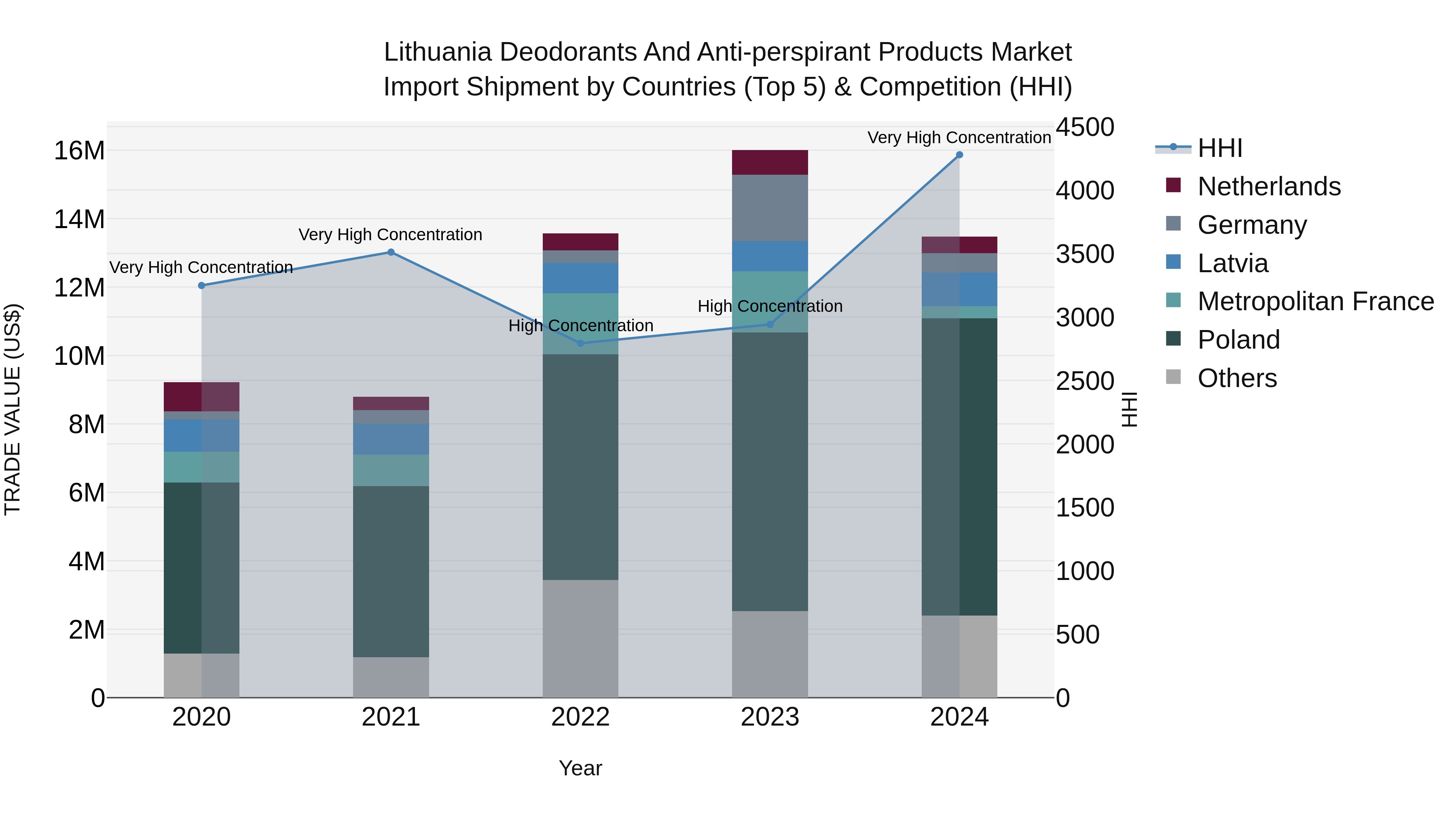
The Lithuanian market for deodorants and anti-perspirant products continues to be dominated by key exporters such as Poland, Latvia, Germany, Spain, and the Netherlands. The market concentration, as measured by the Herfindahl-Hirschman Index (HHI), significantly increased from 2023 to 2024, indicating a high level of market concentration. Despite a negative growth rate in 2024 compared to the previous year, the compound annual growth rate (CAGR) from 2020 to 2024 remains positive at 9.95%, suggesting a steady overall expansion in the market for deodorant and anti-perspirant products in Lithuania.
Key Highlights of the Report:
- Lithuania Deodorants and Anti-Perspirant Products Market Outlook
- Market Size of Lithuania Deodorants and Anti-Perspirant Products Market, 2025
- Forecast of Lithuania Deodorants and Anti-Perspirant Products Market, 2032
- Historical Data and Forecast of Lithuania Deodorants and Anti-Perspirant Products Revenues & Volume for the Period 2022 - 2032F
- Lithuania Deodorants and Anti-Perspirant Products Market Trend Evolution
- Lithuania Deodorants and Anti-Perspirant Products Market Drivers and Challenges
- Lithuania Deodorants and Anti-Perspirant Products Price Trends
- Lithuania Deodorants and Anti-Perspirant Products Porter`s Five Forces
- Lithuania Deodorants and Anti-Perspirant Products Industry Life Cycle
- Historical Data and Forecast of Lithuania Deodorants and Anti-Perspirant Products Market Revenues & Volume By Function for the Period 2022 - 2032F
- Historical Data and Forecast of Lithuania Deodorants and Anti-Perspirant Products Market Revenues & Volume By Aerosol Spray for the Period 2022 - 2032F
- Historical Data and Forecast of Lithuania Deodorants and Anti-Perspirant Products Market Revenues & Volume By Cream for the Period 2022 - 2032F
- Historical Data and Forecast of Lithuania Deodorants and Anti-Perspirant Products Market Revenues & Volume By Roll-On for the Period 2022 - 2032F
- Historical Data and Forecast of Lithuania Deodorants and Anti-Perspirant Products Market Revenues & Volume By Gel for the Period 2022 - 2032F
- Historical Data and Forecast of Lithuania Deodorants and Anti-Perspirant Products Market Revenues & Volume By Ingredient for the Period 2022 - 2032F
- Historical Data and Forecast of Lithuania Deodorants and Anti-Perspirant Products Market Revenues & Volume By Alcohol for the Period 2022 - 2032F
- Historical Data and Forecast of Lithuania Deodorants and Anti-Perspirant Products Market Revenues & Volume By Antimicrobials for the Period 2022 - 2032F
- Historical Data and Forecast of Lithuania Deodorants and Anti-Perspirant Products Market Revenues & Volume By Conditioner and Moisturizer for the Period 2022 - 2032F
- Historical Data and Forecast of Lithuania Deodorants and Anti-Perspirant Products Market Revenues & Volume By Fragrances for the Period 2022 - 2032F
- Historical Data and Forecast of Lithuania Deodorants and Anti-Perspirant Products Market Revenues & Volume By Paraben and Propellants for the Period 2022 - 2032F
- Historical Data and Forecast of Lithuania Deodorants and Anti-Perspirant Products Market Revenues & Volume By Others for the Period 2022 - 2032F
- Lithuania Deodorants and Anti-Perspirant Products Import Export Trade Statistics
- Market Opportunity Assessment By Function
- Market Opportunity Assessment By Ingredient
- Lithuania Deodorants and Anti-Perspirant Products Top Companies Market Share
- Lithuania Deodorants and Anti-Perspirant Products Competitive Benchmarking By Technical and Operational Parameters
- Lithuania Deodorants and Anti-Perspirant Products Company Profiles
- Lithuania Deodorants and Anti-Perspirant Products Key Strategic Recommendations






































