Lithuania Edible Beans Market Top 5 Importing Countries and Market Competition (HHI) Analysis
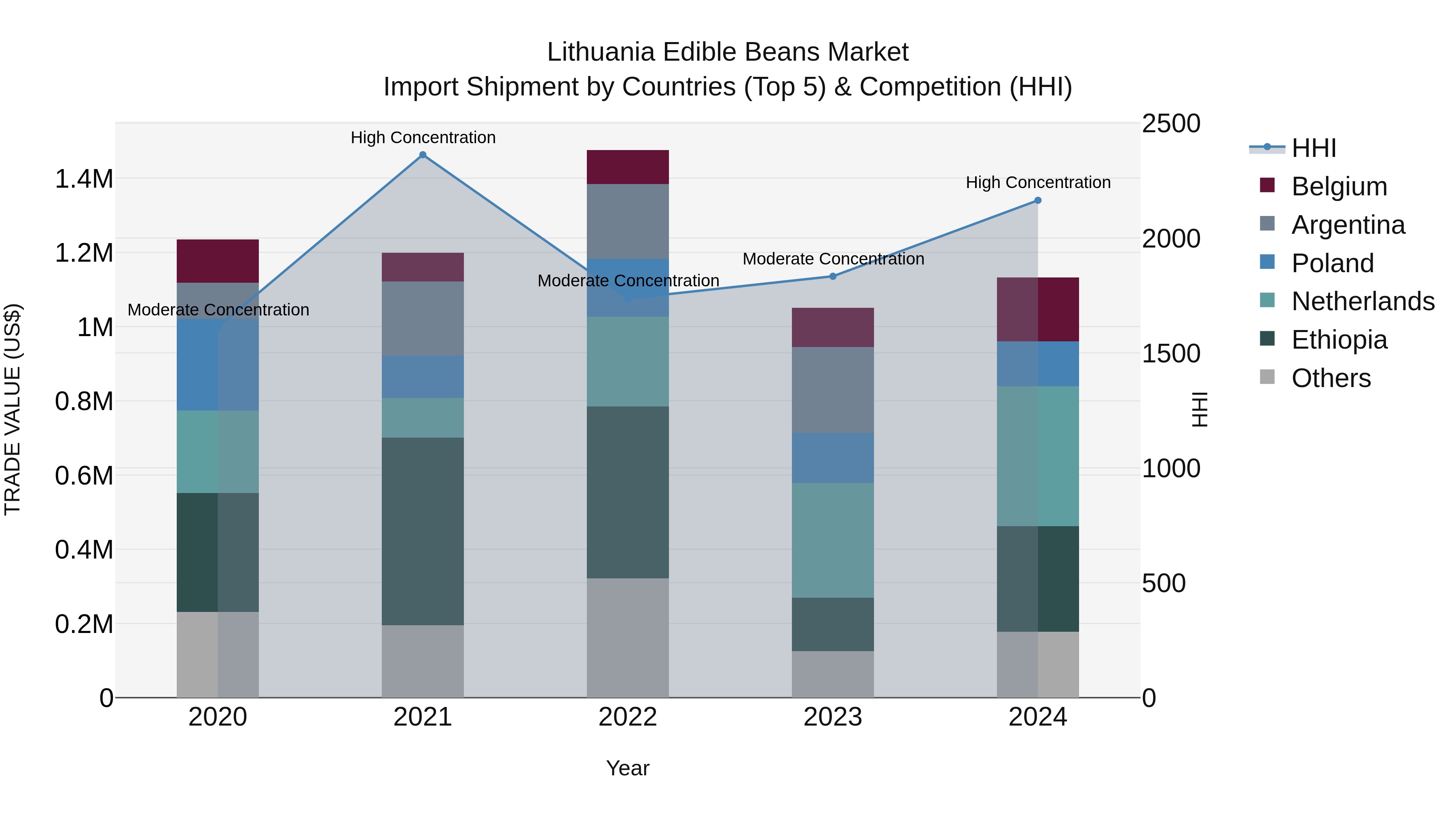
Lithuania`s edible beans import market saw a shift in concentration levels in 2024, moving from moderate to high concentration. The top countries exporting to Lithuania, such as the Netherlands, Ethiopia, and Belgium, have maintained their strong presence. Despite a negative compound annual growth rate (CAGR) from 2020 to 2024, there was a notable growth rate of 7.79% from 2023 to 2024. This indicates potential opportunities and evolving dynamics in the Lithuanian edible beans import market, suggesting a changing landscape that importers and stakeholders should closely monitor.
Key Highlights of the Report:
- Lithuania Edible Beans Market Outlook
- Market Size of Lithuania Edible Beans Market, 2025
- Forecast of Lithuania Edible Beans Market, 2032
- Historical Data and Forecast of Lithuania Edible Beans Revenues & Volume for the Period 2022 - 2032F
- Lithuania Edible Beans Market Trend Evolution
- Lithuania Edible Beans Market Drivers and Challenges
- Lithuania Edible Beans Price Trends
- Lithuania Edible Beans Porter`s Five Forces
- Lithuania Edible Beans Industry Life Cycle
- Historical Data and Forecast of Lithuania Edible Beans Market Revenues & Volume By Product Type for the Period 2022 - 2032F
- Historical Data and Forecast of Lithuania Edible Beans Market Revenues & Volume By Pinto Beans for the Period 2022 - 2032F
- Historical Data and Forecast of Lithuania Edible Beans Market Revenues & Volume By Navy Beans for the Period 2022 - 2032F
- Historical Data and Forecast of Lithuania Edible Beans Market Revenues & Volume By Great Northern Beans for the Period 2022 - 2032F
- Historical Data and Forecast of Lithuania Edible Beans Market Revenues & Volume By Red Kidney Beans for the Period 2022 - 2032F
- Historical Data and Forecast of Lithuania Edible Beans Market Revenues & Volume By Black Beans for the Period 2022 - 2032F
- Historical Data and Forecast of Lithuania Edible Beans Market Revenues & Volume By Yellow Beans for the Period 2022 - 2032F
- Historical Data and Forecast of Lithuania Edible Beans Market Revenues & Volume By Others for the Period 2022 - 2032F
- Historical Data and Forecast of Lithuania Edible Beans Market Revenues & Volume By Distribution Channel for the Period 2022 - 2032F
- Historical Data and Forecast of Lithuania Edible Beans Market Revenues & Volume By Supermarket/Hypermarket for the Period 2022 - 2032F
- Historical Data and Forecast of Lithuania Edible Beans Market Revenues & Volume By Online Stores for the Period 2022 - 2032F
- Historical Data and Forecast of Lithuania Edible Beans Market Revenues & Volume By Specialty Stores for the Period 2022 - 2032F
- Historical Data and Forecast of Lithuania Edible Beans Market Revenues & Volume By Other for the Period 2022 - 2032F
- Historical Data and Forecast of Lithuania Edible Beans Market Revenues & Volume By Application for the Period 2022 - 2032F
- Historical Data and Forecast of Lithuania Edible Beans Market Revenues & Volume By Household for the Period 2022 - 2032F
- Historical Data and Forecast of Lithuania Edible Beans Market Revenues & Volume By Restaurants for the Period 2022 - 2032F
- Historical Data and Forecast of Lithuania Edible Beans Market Revenues & Volume By Others for the Period 2022 - 2032F
- Lithuania Edible Beans Import Export Trade Statistics
- Market Opportunity Assessment By Product Type
- Market Opportunity Assessment By Distribution Channel
- Market Opportunity Assessment By Application
- Lithuania Edible Beans Top Companies Market Share
- Lithuania Edible Beans Competitive Benchmarking By Technical and Operational Parameters
- Lithuania Edible Beans Company Profiles
- Lithuania Edible Beans Key Strategic Recommendations






































