Lithuania Imitation Jewelry Market Size (2020-2030)
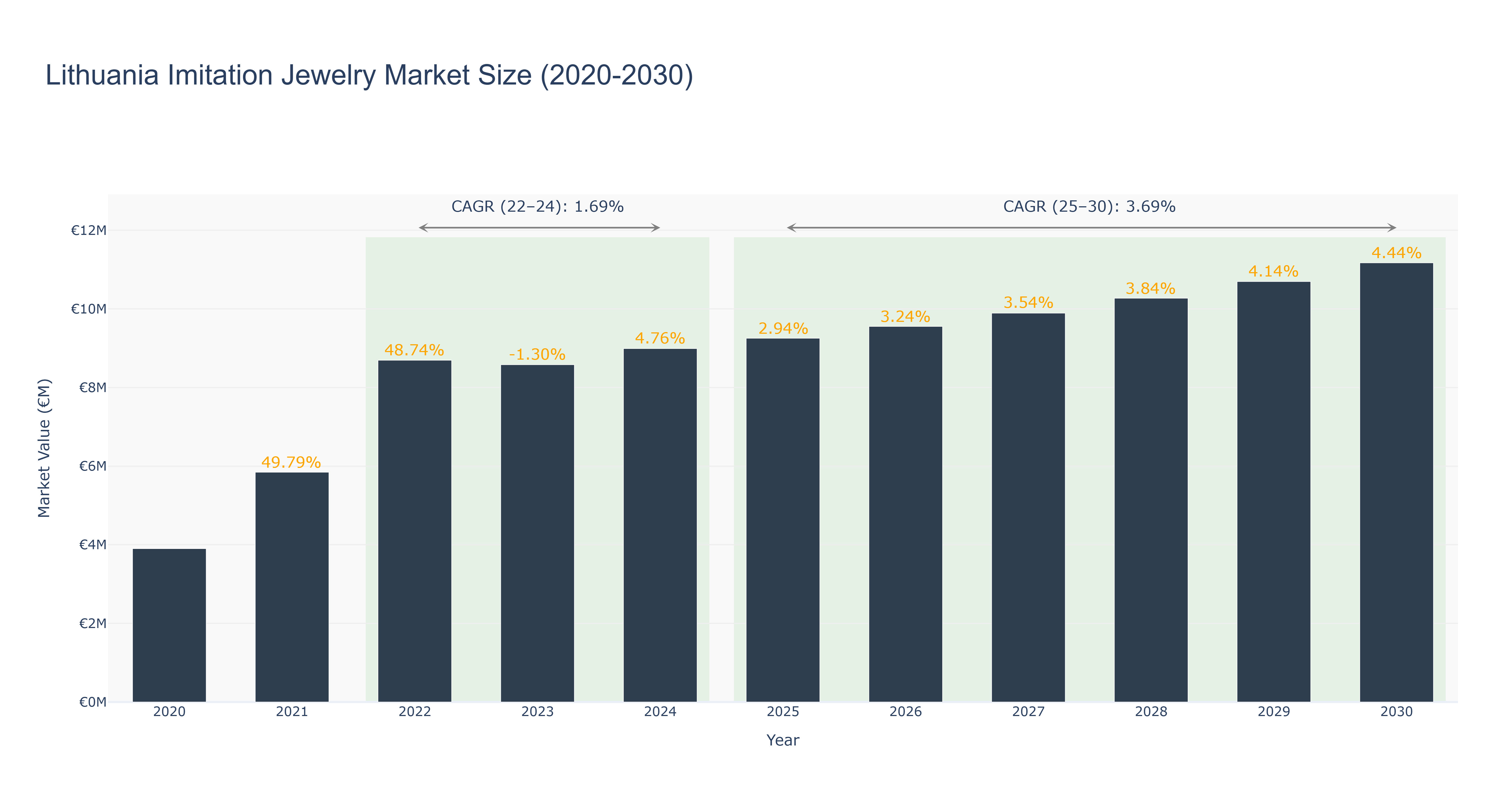
The Lithuania Imitation Jewelry Market has shown steady growth over the years, with a peak market size of €11.17 million in 2030. From 2020 to 2024, the market size increased from €3.90 million to €8.99 million, driven by increasing consumer demand and expanding product offerings. However, in 2023, there was a slight decline due to market saturation and economic uncertainties. Forecasted market size from 2025 to 2030 is expected to continue growing, with a CAGR of 3.68%. The recent CAGR (2022-24) was 1.69%, indicating a moderate growth phase. Looking ahead, the market is poised for further expansion, with upcoming projects focusing on innovative designs and sustainable materials to attract eco-conscious consumers. The industry drivers include changing fashion trends, rising disposable incomes, and a growing preference for affordable luxury items.
Lithuania Imitation Jewelry Market: Production & Trade Performance (2019-2025)
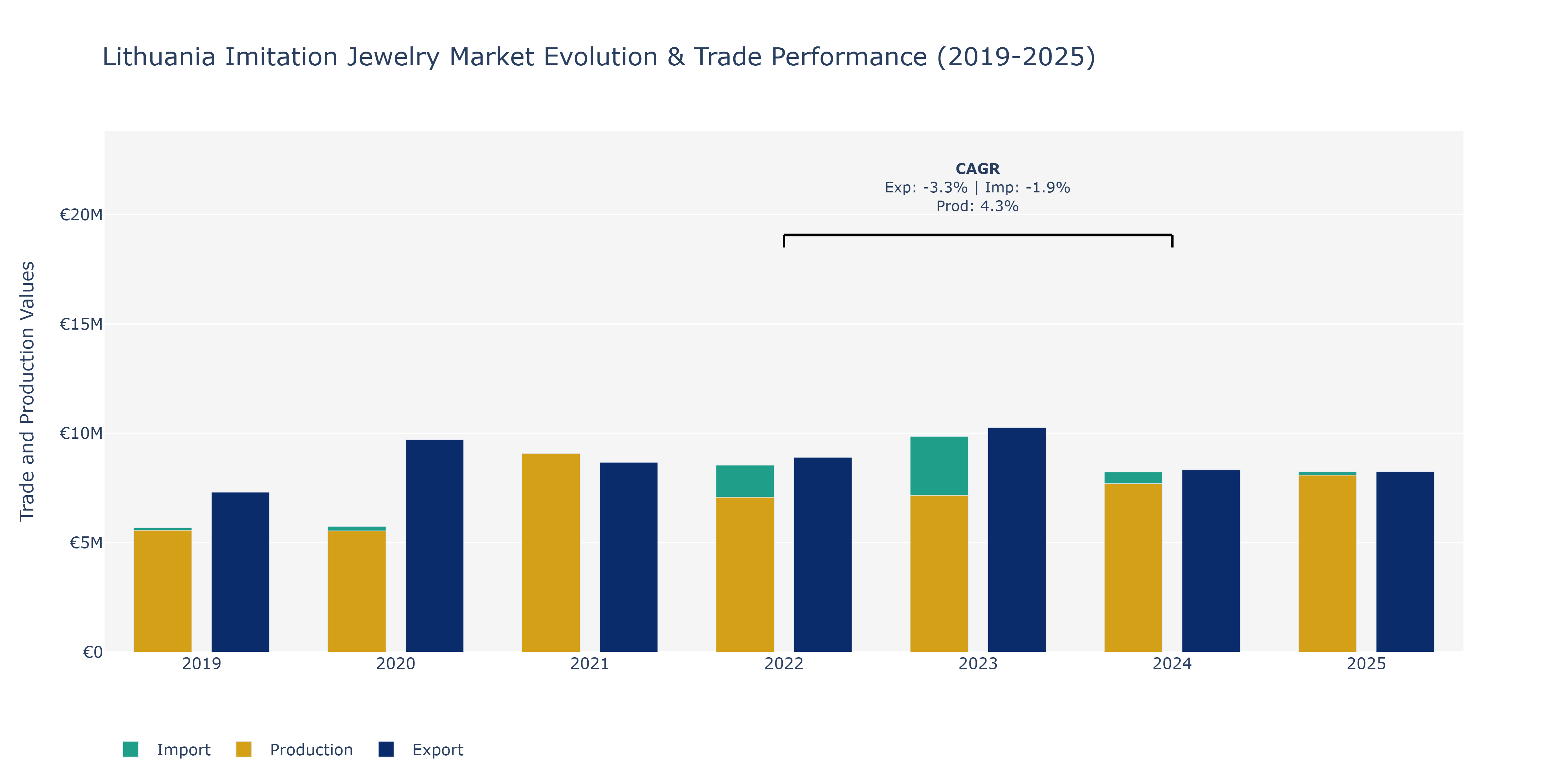
The Lithuania Imitation Jewelry Market witnessed notable fluctuations in Exports, Imports, and Production over the years. In 2019, Exports stood at €7.31 million and showed a slight increase in 2020 to €9.71 million before experiencing a decline in 2021 to €8.68 million. However, a recovery was observed in 2023, reaching €10.26 million, only to decrease again in 2024 to €8.33 million. Imports followed a similar pattern, with a peak in 2023 at €9.86 million. Production, on the other hand, increased steadily from €5.57 million in 2019 to €8.09 million in 2025. These fluctuations can be attributed to changing consumer preferences, economic factors affecting disposable income, and global supply chain disruptions. The decline in Exports and Imports in certain years may reflect shifts in international trade agreements or currency fluctuations impacting pricing competitiveness. The consistent growth in Production indicates a potential increase in domestic demand or advancements in manufacturing technologies contributing to efficiency and output.
Key Highlights of the Report:
- Lithuania Imitation Jewelry Market Outlook
- Market Size of Lithuania Imitation Jewelry Market, 2025
- Forecast of Lithuania Imitation Jewelry Market, 2032
- Historical Data and Forecast of Lithuania Imitation Jewelry Revenues & Volume for the Period 2022 - 2032F
- Lithuania Imitation Jewelry Market Trend Evolution
- Lithuania Imitation Jewelry Market Drivers and Challenges
- Lithuania Imitation Jewelry Price Trends
- Lithuania Imitation Jewelry Porter`s Five Forces
- Lithuania Imitation Jewelry Industry Life Cycle
- Historical Data and Forecast of Lithuania Imitation Jewelry Market Revenues & Volume By Product Type for the Period 2022 - 2032F
- Historical Data and Forecast of Lithuania Imitation Jewelry Market Revenues & Volume By Necklaces & Chains for the Period 2022 - 2032F
- Historical Data and Forecast of Lithuania Imitation Jewelry Market Revenues & Volume By Earrings for the Period 2022 - 2032F
- Historical Data and Forecast of Lithuania Imitation Jewelry Market Revenues & Volume By Rings for the Period 2022 - 2032F
- Historical Data and Forecast of Lithuania Imitation Jewelry Market Revenues & Volume By Bracelets for the Period 2022 - 2032F
- Historical Data and Forecast of Lithuania Imitation Jewelry Market Revenues & Volume By Cufflinks & Studs for the Period 2022 - 2032F
- Historical Data and Forecast of Lithuania Imitation Jewelry Market Revenues & Volume By End-User for the Period 2022 - 2032F
- Historical Data and Forecast of Lithuania Imitation Jewelry Market Revenues & Volume By Men for the Period 2022 - 2032F
- Historical Data and Forecast of Lithuania Imitation Jewelry Market Revenues & Volume By Women for the Period 2022 - 2032F
- Historical Data and Forecast of Lithuania Imitation Jewelry Market Revenues & Volume By Unisex for the Period 2022 - 2032F
- Historical Data and Forecast of Lithuania Imitation Jewelry Market Revenues & Volume By Distribution Channel for the Period 2022 - 2032F
- Historical Data and Forecast of Lithuania Imitation Jewelry Market Revenues & Volume By Store Based for the Period 2022 - 2032F
- Historical Data and Forecast of Lithuania Imitation Jewelry Market Revenues & Volume By Non Store Based for the Period 2022 - 2032F
- Lithuania Imitation Jewelry Import Export Trade Statistics
- Market Opportunity Assessment By Product Type
- Market Opportunity Assessment By End-User
- Market Opportunity Assessment By Distribution Channel
- Lithuania Imitation Jewelry Top Companies Market Share
- Lithuania Imitation Jewelry Competitive Benchmarking By Technical and Operational Parameters
- Lithuania Imitation Jewelry Company Profiles
- Lithuania Imitation Jewelry Key Strategic Recommendations






































