Lithuania Polyethylene Market Size (2020-2030)
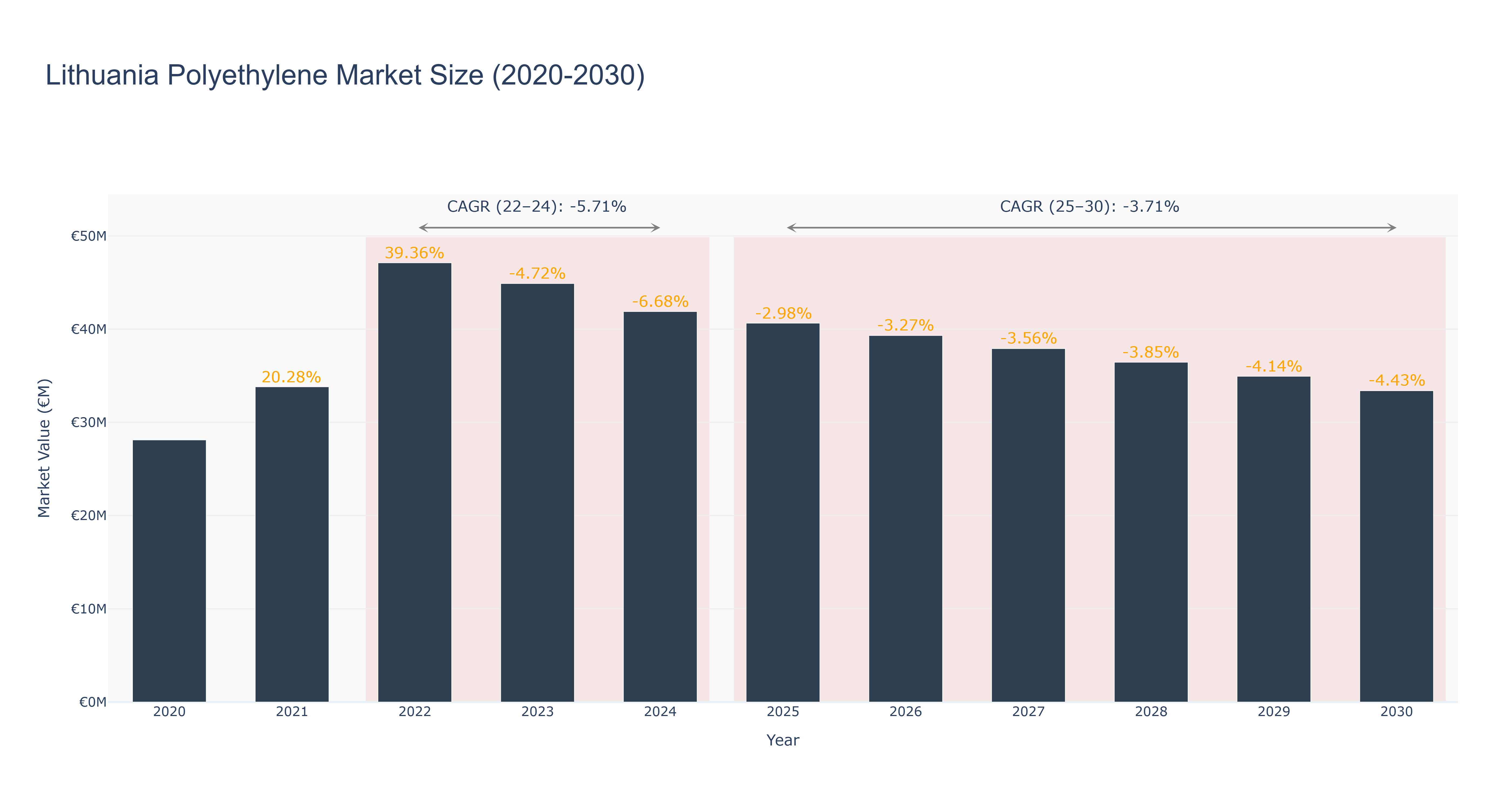
The Lithuania Polyethylene Market experienced substantial growth from 2020 to 2022, reaching a peak market size of €47.11 million in 2022, driven by increased demand across packaging and construction sectors. However, the market faced a downturn in 2023 and 2024, with actual sizes of €44.89 million and €41.89 million, respectively, reflecting a negative CAGR of -5.71% for the 2022-2024 period. This decline can be attributed to global supply chain disruptions and fluctuating raw material prices. Looking ahead, the forecasted period from 2025 to 2030 indicates a continuing contraction, with projected market sizes decreasing from €40.64 million in 2025 to €33.39 million by 2030, reflecting a CAGR of -3.71%. Industry challenges, including environmental regulations and competition from alternative materials, are likely to impede growth. Despite these hurdles, advancements in recycling technologies and potential investments in sustainable practices may offer some resilience to the market.
Lithuania Polyethylene Market: Production & Trade Performance (2019-2025)
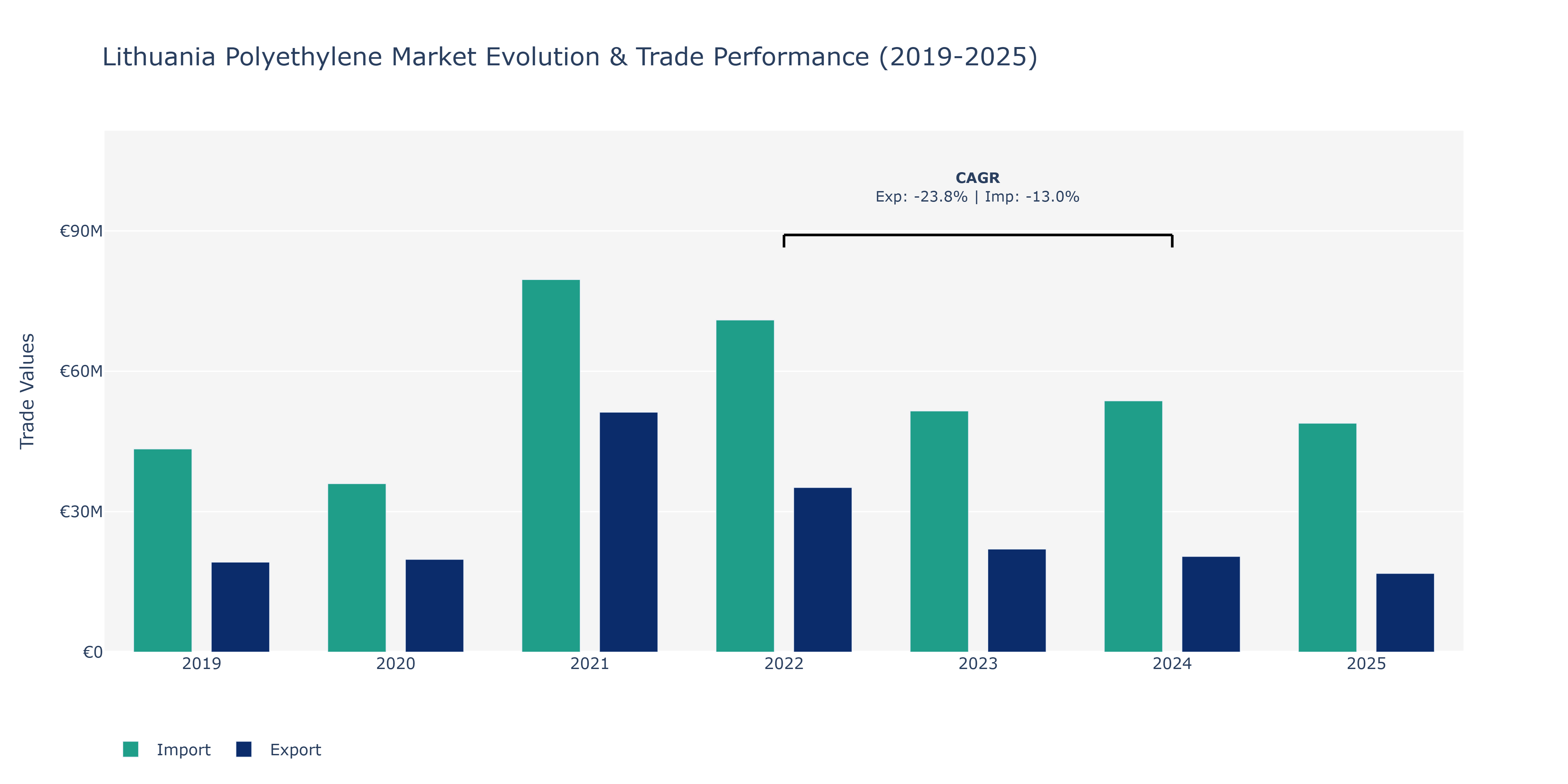
The Lithuania Polyethylene Market experienced fluctuating trends in both exports and imports over the analyzed period. In 2019, exports stood at €19.2 million and imports at €43.38 million. The following year witnessed a slight increase in exports to €19.79 million, while imports decreased to €35.96 million, possibly due to changing global demand patterns. A significant surge occurred in 2021, with exports soaring to €51.24 million and imports reaching €79.58 million, reflecting a substantial shift in market dynamics or potentially increased production capabilities. However, both exports and imports declined in 2022, potentially indicating global economic challenges impacting trade flows. The market saw a further decrease in 2023, with exports at €21.99 million and imports at €51.5 million, possibly influenced by regulatory changes or geopolitical factors. By 2024, exports and imports remained relatively stable, hinting at market stabilization or adaptation to new trading conditions. The decline in CAGR for both exports (-23.78%) and imports (-13.02%) from 2022 to 2024 could be attributed to industry-specific challenges, such as fluctuating raw material prices or evolving trade agreements. As the polyethylene market closely follows global economic trends, any shifts in demand, supply chains, or regulatory environments could significantly impact Lithuania's trade activities in the sector.
Key Highlights of the Report:
- Lithuania Polyethylene Market Outlook
- Market Size of Lithuania PolyethyleneMarket, 2025
- Forecast of Lithuania PolyethyleneMarket, 2032
- Historical Data and Forecast of Lithuania PolyethyleneRevenues & Volume for the Period 2022 - 2032F
- Lithuania Polyethylene Market Trend Evolution
- Lithuania Polyethylene Market Drivers and Challenges
- Lithuania PolyethylenePrice Trends
- Lithuania PolyethylenePorter`s Five Forces
- Lithuania PolyethyleneIndustry Life Cycle
- Historical Data and Forecast of Lithuania Polyethylene Market Revenues & Volume By Type for the Period 2022 - 2032F
- Historical Data and Forecast of Lithuania Polyethylene Market Revenues & Volume By LDPE for the Period 2022 - 2032F
- Historical Data and Forecast of Lithuania Polyethylene Market Revenues & Volume By MDPE for the Period 2022 - 2032F
- Historical Data and Forecast of Lithuania Polyethylene Market Revenues & Volume By HDPE for the Period 2022 - 2032F
- Historical Data and Forecast of Lithuania Polyethylene Market Revenues & Volume By End-User for the Period 2022 - 2032F
- Historical Data and Forecast of Lithuania Polyethylene Market Revenues & Volume By Packaging for the Period 2022 - 2032F
- Historical Data and Forecast of Lithuania Polyethylene Market Revenues & Volume By Construction for the Period 2022 - 2032F
- Historical Data and Forecast of Lithuania Polyethylene Market Revenues & Volume By Automotive for the Period 2022 - 2032F
- Historical Data and Forecast of Lithuania Polyethylene Market Revenues & Volume By Electrical & Electronics for the Period 2022 - 2032F
- Historical Data and Forecast of Lithuania Polyethylene Market Revenues & Volume By Household Applications for the Period 2022 - 2032F
- Historical Data and Forecast of Lithuania Polyethylene Market Revenues & Volume By Others for the Period 2022 - 2032F
- Historical Data and Forecast of Lithuania Polyethylene Market Revenues & Volume By Technology for the Period 2022 - 2032F
- Historical Data and Forecast of Lithuania Polyethylene Market Revenues & Volume By Films & Sheets Extrusion for the Period 2022 - 2032F
- Historical Data and Forecast of Lithuania Polyethylene Market Revenues & Volume By Pipe Extrusion for the Period 2022 - 2032F
- Historical Data and Forecast of Lithuania Polyethylene Market Revenues & Volume By Injection Molding for the Period 2022 - 2032F
- Historical Data and Forecast of Lithuania Polyethylene Market Revenues & Volume By Blow Molding for the Period 2022 - 2032F
- Historical Data and Forecast of Lithuania Polyethylene Market Revenues & Volume By Others for the Period 2022 - 2032F
- Lithuania PolyethyleneImport Export Trade Statistics
- Market Opportunity Assessment By Type
- Market Opportunity Assessment By End-User
- Market Opportunity Assessment By Technology
- Lithuania PolyethyleneTop Companies Market Share
- Lithuania PolyethyleneCompetitive Benchmarking By Technical and Operational Parameters
- Lithuania PolyethyleneCompany Profiles
- Lithuania PolyethyleneKey Strategic Recommendations






































