Luxembourg Smart Thermostat Market Size (2020-2030)
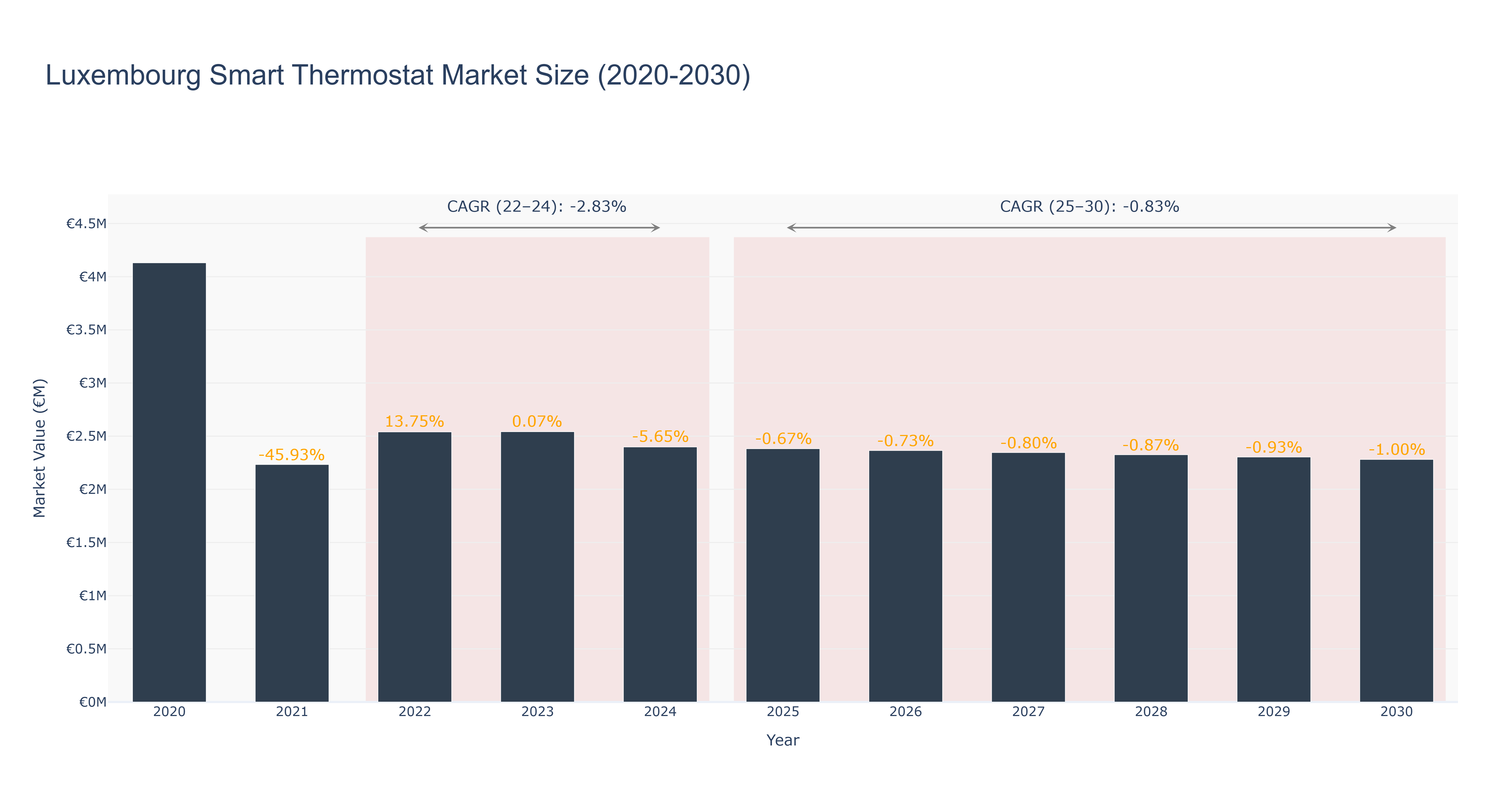
Luxembourg Smart Thermostat Market has experienced a decline in market size from €4.13 million in 2020 to €2.40 million in 2024, with a negative growth trend. The forecasted market size from 2025 to 2030 is expected to continue decreasing, with a CAGR of -0.83% from 2025 to 2030. The peak market size was observed in 2020. The downward trend can be attributed to market saturation, technological advancements leading to lower prices, and changing consumer preferences. Despite the decline, ongoing initiatives to enhance energy efficiency and sustainability in buildings are expected to drive demand for smart thermostats in Luxembourg. Future developments may focus on integrating smart thermostat technology with smart home systems for enhanced automation and energy savings, catering to the growing environmental consciousness among consumers.
Luxembourg Smart Thermostat Market: Production & Trade Performance (2019-2025)
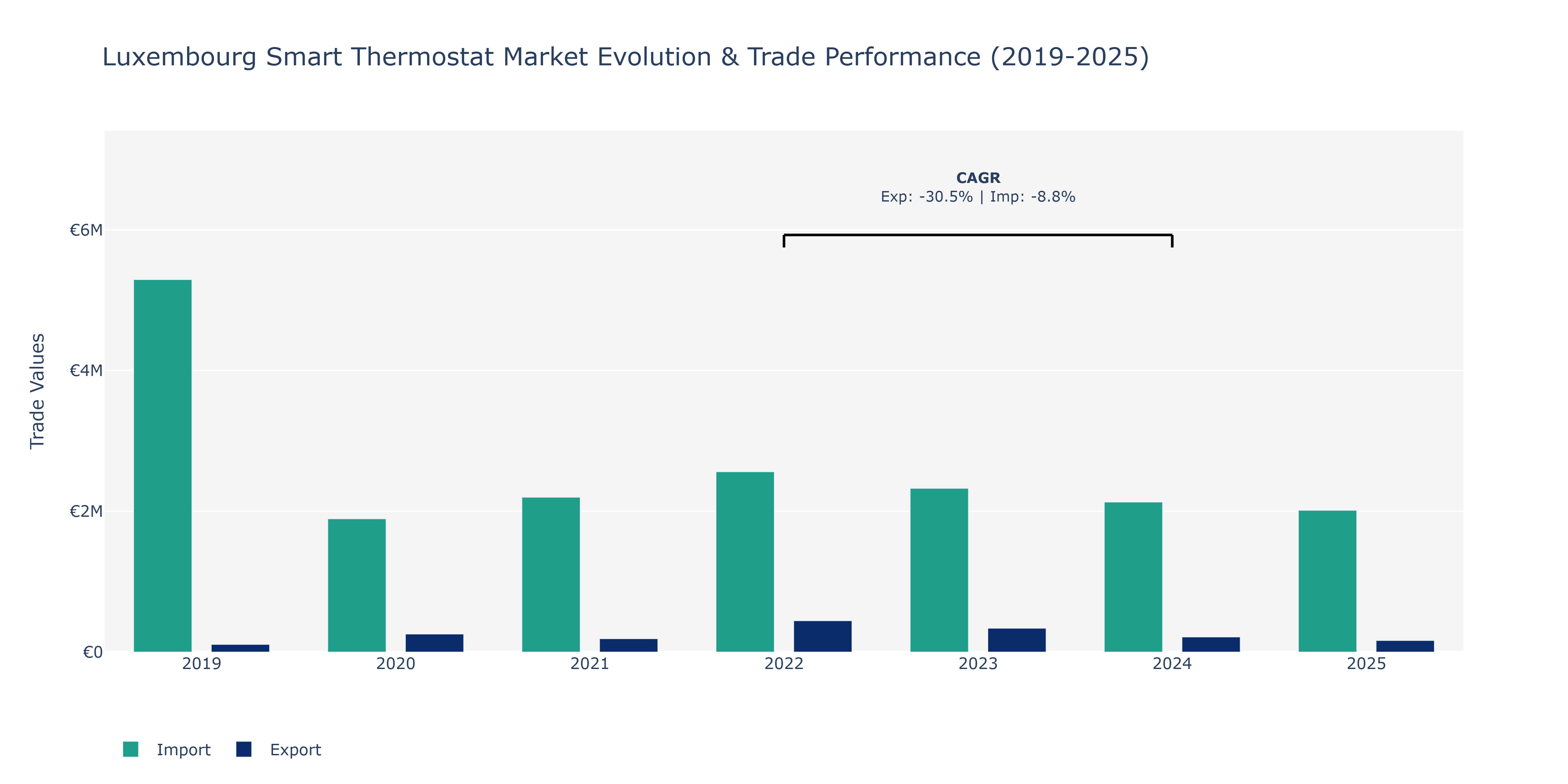
Over the examined period, Luxembourg's Smart Thermostat Market witnessed varying trends in both Exports and Imports. In 2019, Imports notably exceeded Exports, highlighting a reliance on overseas products. The subsequent years displayed a reversal, with Exports surpassing Imports in 2020. This trend continued until 2023, where Exports peaked at €444.1 thousand, reflecting a strategic shift towards promoting local products. However, a notable decline in 2024 and 2025 for both Exports and Imports suggests potential market saturation or evolving consumer preferences. The decrease in Imports could indicate increasing local production capabilities or shifting global trade dynamics impacting foreign acquisitions. Luxembourg's focus on sustainability and energy efficiency could be driving the demand for Smart Thermostats, supporting the uptick in Exports. The negative CAGR for both Exports and Imports reflects market corrections or adjustments aligning with the global economic landscape, emphasizing the need for market players to adapt to changing conditions.
Key Highlights of the Report:
- Luxembourg Smart Thermostat Market Outlook
- Market Size of Luxembourg Smart Thermostat Market, 2025
- Forecast of Luxembourg Smart Thermostat Market, 2032
- Historical Data and Forecast of Luxembourg Smart Thermostat Revenues & Volume for the Period 2022-2032F
- Luxembourg Smart Thermostat Market Trend Evolution
- Luxembourg Smart Thermostat Market Drivers and Challenges
- Luxembourg Smart Thermostat Price Trends
- Luxembourg Smart Thermostat Porter`s Five Forces
- Luxembourg Smart Thermostat Industry Life Cycle
- Historical Data and Forecast of Luxembourg Smart Thermostat Market Revenues & Volume By Type for the Period 2022-2032F
- Historical Data and Forecast of Luxembourg Smart Thermostat Market Revenues & Volume By Wireless for the Period 2022-2032F
- Historical Data and Forecast of Luxembourg Smart Thermostat Market Revenues & Volume By Wireless for the Period 2022-2032F
- Historical Data and Forecast of Luxembourg Smart Thermostat Market Revenues & Volume By End-User Vertical for the Period 2022-2032F
- Historical Data and Forecast of Luxembourg Smart Thermostat Market Revenues & Volume By Residential for the Period 2022-2032F
- Historical Data and Forecast of Luxembourg Smart Thermostat Market Revenues & Volume By Commercial for the Period 2022-2032F
- Luxembourg Smart Thermostat Import Export Trade Statistics
- Market Opportunity Assessment By Type
- Market Opportunity Assessment By End-User Vertical
- Luxembourg Smart Thermostat Top Companies Market Share
- Luxembourg Smart Thermostat Competitive Benchmarking By Technical and Operational Parameters
- Luxembourg Smart Thermostat Company Profiles
- Luxembourg Smart Thermostat Key Strategic Recommendations






































