Malaysia 3D Animation Market Size & Growth Rate (2026-2032)
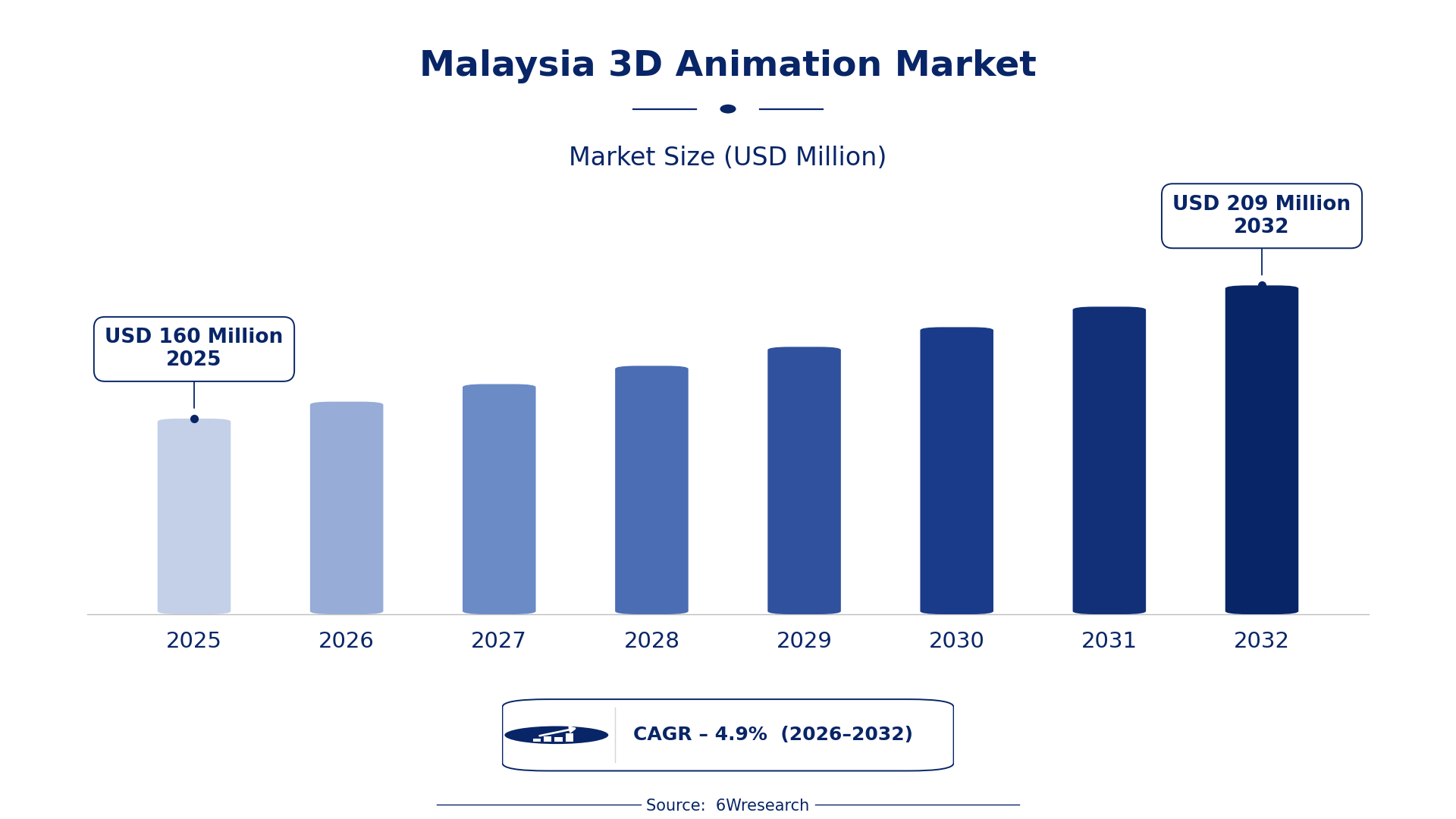
The Malaysia 3D Animation Market was estimated at USD 160 Million in 2025 and is projected to reach USD 209 Million by 2032, growing at a CAGR of 4.9% from 2026 to 2032.
Malaysia 3D Animation Market Synopsis
The Malaysia 3D Animation market is currently thriving, driven by a blend of local creativity and international demand. Animation services are increasingly sought after across various sectors, with gaming, advertising, and film production leading the charge. This vibrant landscape is characterized by skilled professionals who are helping to elevate Malaysia's standing in the global animation arena.
As augmented reality (AR) and virtual reality (VR) technologies gain traction, the appetite for high-quality 3D animations grows. The adaptability of local studios during challenging periods, such as the pandemic, has further solidified their role in the industry. This resilience showcases the potential for future growth, as the market continues to evolve.
Malaysia 3D Animation Market Year-wise Growth Rate and Key Drivers
This graph illustrates the annual growth rates of the Malaysia 3D Animation Market from 2021 to 2032, highlighting a steady upward trajectory and projected expansion over the forecast period.
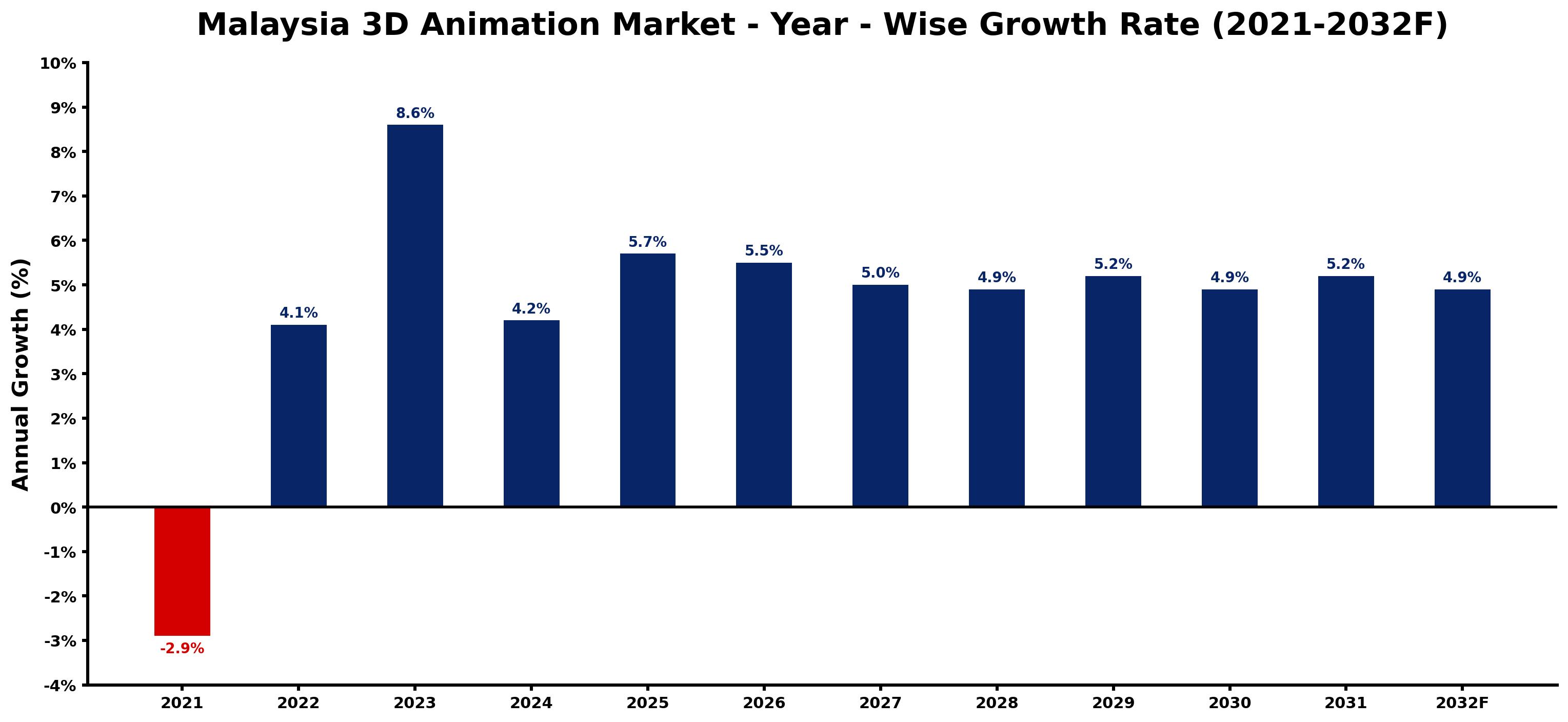
The table below presents the year‑wise growth rates along with the key drivers influencing the market
| Year | Growth Rate | Major Drivers |
| 2021 | -2.9% | Impact of MCO on entertainment and production sectors. |
| 2022 | 4.1% | Increased government support for creative industries funding. |
| 2023 | 8.6% | Growing interest in virtual reality experiences by entertainment brands. |
| 2024 | 4.2% | Rise in mobile game development among local startups. |
| 2025 | 5.7% | Demand for augmented reality in retail applications. |
| 2026 | 5.5% | Investment in animation technology through Malaysia’s Creative Industry Policy. |
| 2027 | 5.0% | Surge in educational content production for online learning. |
| 2028 | 4.9% | Local festivals celebrating animation attracting international collaborations. |
| 2029 | 5.2% | Growing social media content creation enhancing animation usage. |
| 2030 | 4.9% | Increased localization efforts for foreign content in Malaysia. |
| 2031 | 5.2% | Popularity of animated advertisements among local brands. |
| 2032 | 4.9% | Cultural exports boosting demand for Malaysian animation. |
Note: Market size estimations and growth projections presented in this report are based on 6Wresearch's proprietary forecasting methodology, utilizing the latest available industry data, government publications, and primary research inputs.
Malaysia 3D Animation Market Key Takeaways
Below are some of the specific key takeaways from the market, including:
- The market is witnessing a surge in demand for 3D animation across entertainment, education, and healthcare.
- Augmented reality and virtual reality applications are becoming significant drivers of animation services.
- There is a notable challenge in sourcing and training skilled talent to meet industry demands.
- Intellectual property protection remains a crucial concern for local animation studios.
- Collaboration between local studios and international firms is increasingly common, enhancing market visibility.
Evaluation of Restraints in Malaysia 3D Animation Market
Despite its growth, the Malaysia 3D Animation market faces several restraints. One of the most pressing issues is the shortage of skilled talent, which hampers the ability to meet rising demand. Continuous training is essential to ensure that professionals stay abreast of rapidly evolving technologies. on top of that, balancing quality output with production costs remains a persistent challenge for many studios. Intellectual property concerns also pose significant risks, as safeguarding creative content is vital for maintaining industry integrity.
Malaysia 3D Animation Market Trends
Several trends are shaping the Malaysia 3D Animation market. The integration of AR and VR in various applications is one of the most notable developments, pushing the boundaries of traditional animation. on top of that, there is a growing emphasis on producing culturally relevant content that resonates with local and regional audiences. As businesses increasingly recognize the value of engaging visual content, more sectors are adopting 3D animation, expanding its reach beyond entertainment into fields like education and healthcare.
Malaysia 3D Animation Market Opportunities
Opportunities for growth in the Malaysia 3D Animation market are abundant. The increasing demand for interactive content in gaming and immersive experiences in advertising presents a significant avenue for expansion. on top of that, collaboration with educational institutions can cultivate a new generation of talent, addressing the skills gap in the industry. There is also potential for partnerships with international firms, which can enhance local capabilities and provide access to larger markets.
Government Initiatives in the Malaysia 3D Animation Market
The Malaysian government plays a crucial role in fostering a supportive environment for the 3D Animation market. With initiatives focused on enhancing digital infrastructure and creative industries, the regulatory framework is becoming increasingly conducive to growth. The government is prioritizing policies that encourage innovation and attract investment in the creative sector, which is vital for sustaining the momentum of the animation industry.
- A recently launched program aimed at providing funding and resources for local animation studios is set to enhance production capabilities.
- A current initiative is underway to establish a national digital infrastructure upgrade, improving connectivity for animation firms across the country.
- Planned regulatory reforms are expected to simplify the process for intellectual property registration, addressing concerns of content protection.
- The government is currently developing a public-private partnership framework to promote collaboration between educational institutions and industry players.
- Upcoming workshops and training programs are being organized to develop local talent in advanced animation technologies.
Future Insights of the Malaysia 3D Animation Market
Looking ahead to 2026-2032, the Malaysia 3D Animation market is expected to thrive, driven by technological advancements and increasing demand across various sectors. The integration of cutting-edge tools and platforms will enhance creative output and streamline production processes. With the government’s support and a growing talent pool, the market has the potential to solidify its position as a regional leader in animation.
Malaysia 3D Animation Market Latest Developments
In the past year, the Malaysia 3D Animation market has seen several key developments that highlight its dynamic nature. As studios adapt to changing consumer preferences and technological advancements, the emphasis on quality and innovation has intensified.
- A major technology vendor introduced a new animation software suite in early 2025, designed to enhance productivity for local studios.
- An initiative that began in late 2024 to promote collaboration among regional animation studios is currently ongoing, aiming to foster creative synergies.
- A new partnership between local universities and animation studios was established in Q2 2025, focusing on curriculum development to align education with industry needs.
- A rollout expected to begin in mid-2026 will focus on expanding VR applications for educational content across Malaysian schools.
- The establishment of a regional animation festival is planned for late 2026, intended to showcase local talent and attract international attention.
Malaysia 3D Animation Market - Key Attractiveness of the Report
- 10 Years of Market Numbers
- Historical Data Starting from 2022 to 2025
- Base Year: 2025
- Forecast Data until 2032
- Key Performance Indicators Impacting the Market
- Major Upcoming Developments and Projects
Key Highlights of the Report:
- Malaysia 3D Animation Market Outlook
- Market Size of Malaysia 3D Animation Market, 2025
- Forecast of Malaysia 3D Animation Market, 2032
- Historical Data and Forecast of Malaysia 3D Animation Revenues & Volume for the Period 2022-2032F
- Malaysia 3D Animation Market Trend Evolution
- Malaysia 3D Animation Market Drivers and Challenges
- Malaysia 3D Animation Price Trends
- Malaysia 3D Animation Porter's Five Forces
- Malaysia 3D Animation Industry Life Cycle
- Historical Data and Forecast of Malaysia 3D Animation Market Revenues & Volume By Technology for the Period 2022-2032F
- Historical Data and Forecast of Malaysia 3D Animation Market Revenues & Volume By 3D Modeling for the Period 2022-2032F
- Historical Data and Forecast of Malaysia 3D Animation Market Revenues & Volume By Motion Graphics for the Period 2022-2032F
- Historical Data and Forecast of Malaysia 3D Animation Market Revenues & Volume By 3D Rendering for the Period 2022-2032F
- Historical Data and Forecast of Malaysia 3D Animation Market Revenues & Volume By Visual Effects for the Period 2022-2032F
- Historical Data and Forecast of Malaysia 3D Animation Market Revenues & Volume By Service for the Period 2022-2032F
- Historical Data and Forecast of Malaysia 3D Animation Market Revenues & Volume By Consulting for the Period 2022-2032F
- Historical Data and Forecast of Malaysia 3D Animation Market Revenues & Volume By Support and Maintenance for the Period 2022-2032F
- Historical Data and Forecast of Malaysia 3D Animation Market Revenues & Volume By Integration and Deployment for the Period 2022-2032F
- Historical Data and Forecast of Malaysia 3D Animation Market Revenues & Volume By Education and Training for the Period 2022-2032F
- Historical Data and Forecast of Malaysia 3D Animation Market Revenues & Volume By Vertical for the Period 2022-2032F
- Historical Data and Forecast of Malaysia 3D Animation Market Revenues & Volume By Media and Entertainment for the Period 2022-2032F
- Historical Data and Forecast of Malaysia 3D Animation Market Revenues & Volume By Construction and Architecture for the Period 2022-2032F
- Historical Data and Forecast of Malaysia 3D Animation Market Revenues & Volume By Healthcare and Lifesciences for the Period 2022-2032F
- Historical Data and Forecast of Malaysia 3D Animation Market Revenues & Volume By Manufacturing for the Period 2022-2032F
- Historical Data and Forecast of Malaysia 3D Animation Market Revenues & Volume By Education and Academia for the Period 2022-2032F
- Historical Data and Forecast of Malaysia 3D Animation Market Revenues & Volume By Others for the Period 2022-2032F
- Historical Data and Forecast of Malaysia 3D Animation Market Revenues & Volume By Deployment for the Period 2022-2032F
- Historical Data and Forecast of Malaysia 3D Animation Market Revenues & Volume By On-Premises for the Period 2022-2032F
- Historical Data and Forecast of Malaysia 3D Animation Market Revenues & Volume By On-Demand for the Period 2022-2032F
- Malaysia 3D Animation Import Export Trade Statistics
- Market Opportunity Assessment By Technology
- Market Opportunity Assessment By Service
- Market Opportunity Assessment By Vertical
- Market Opportunity Assessment By Deployment
- Malaysia 3D Animation Top Companies Market Share
- Malaysia 3D Animation Competitive Benchmarking By Technical and Operational Parameters
- Malaysia 3D Animation Company Profiles
- Malaysia 3D Animation Key Strategic Recommendations






































