Malaysia Artificial Intelligence (AI) Market Size & Growth Rate (2026-2032)
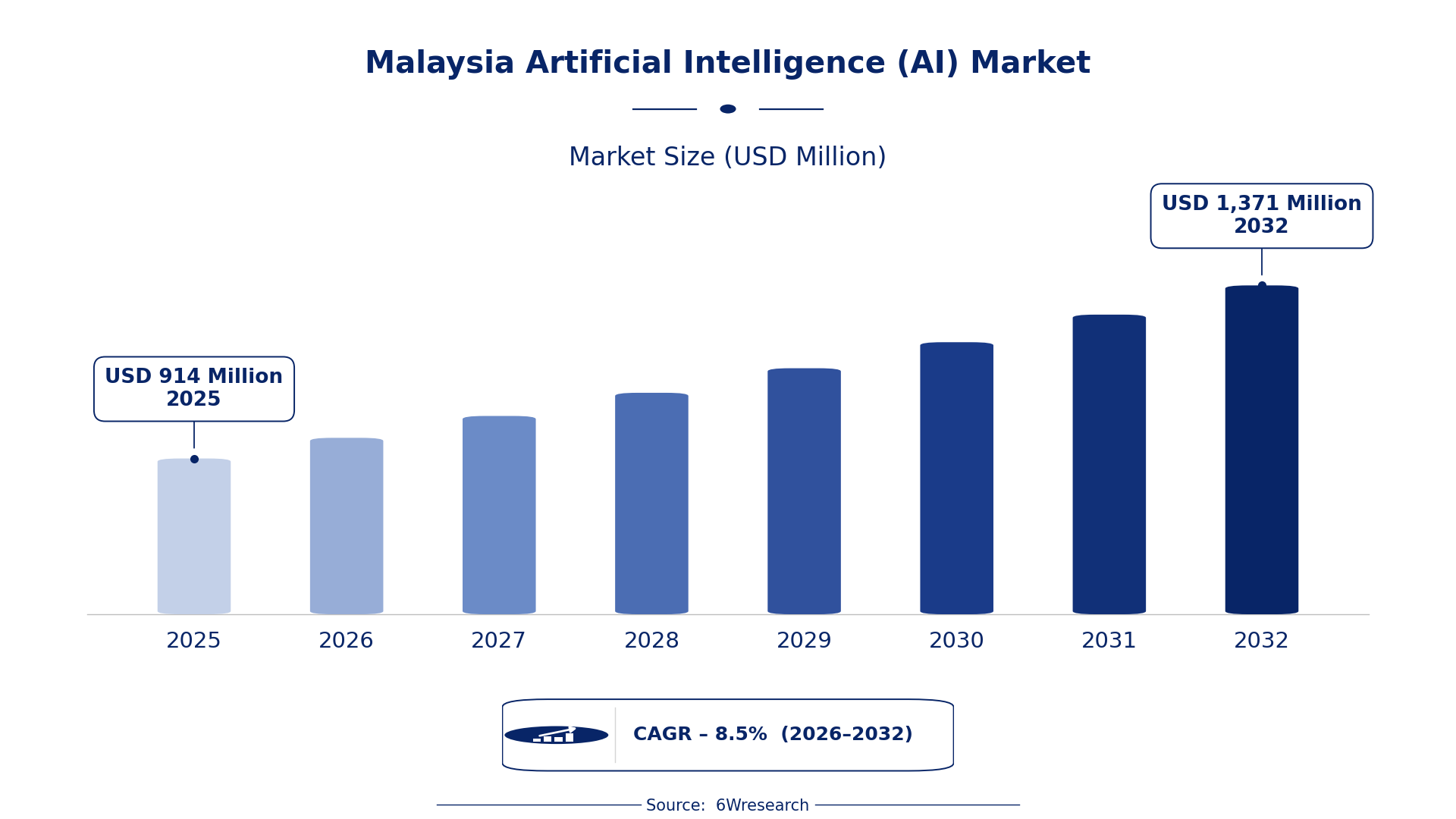
The Malaysia Artificial Intelligence (AI) Market was estimated at USD 914 Million in 2025 and is projected to reach USD 1371 Million by 2032, growing at a CAGR of 8.5% from 2026 to 2032.
Malaysia Artificial Intelligence (AI) Market Synopsis
The push for digital transformation in various sectors is driving the demand for AI solutions in Malaysia. Industries such as finance, healthcare, and manufacturing are increasingly adopting AI technologies to enhance operational efficiency and customer engagement.
AI applications are revolutionizing traditional processes, from automating customer service interactions through chatbots to predictive maintenance in manufacturing. This adoption not only boosts productivity but also significantly improves decision-making across different sectors.
Malaysia Artificial Intelligence (AI) Market Year-wise Growth Rate and Key Drivers
This graph illustrates the annual growth rates of the Malaysia Artificial Intelligence (AI) Market from 2021 to 2032, highlighting a steady upward trajectory and projected expansion over the forecast period.
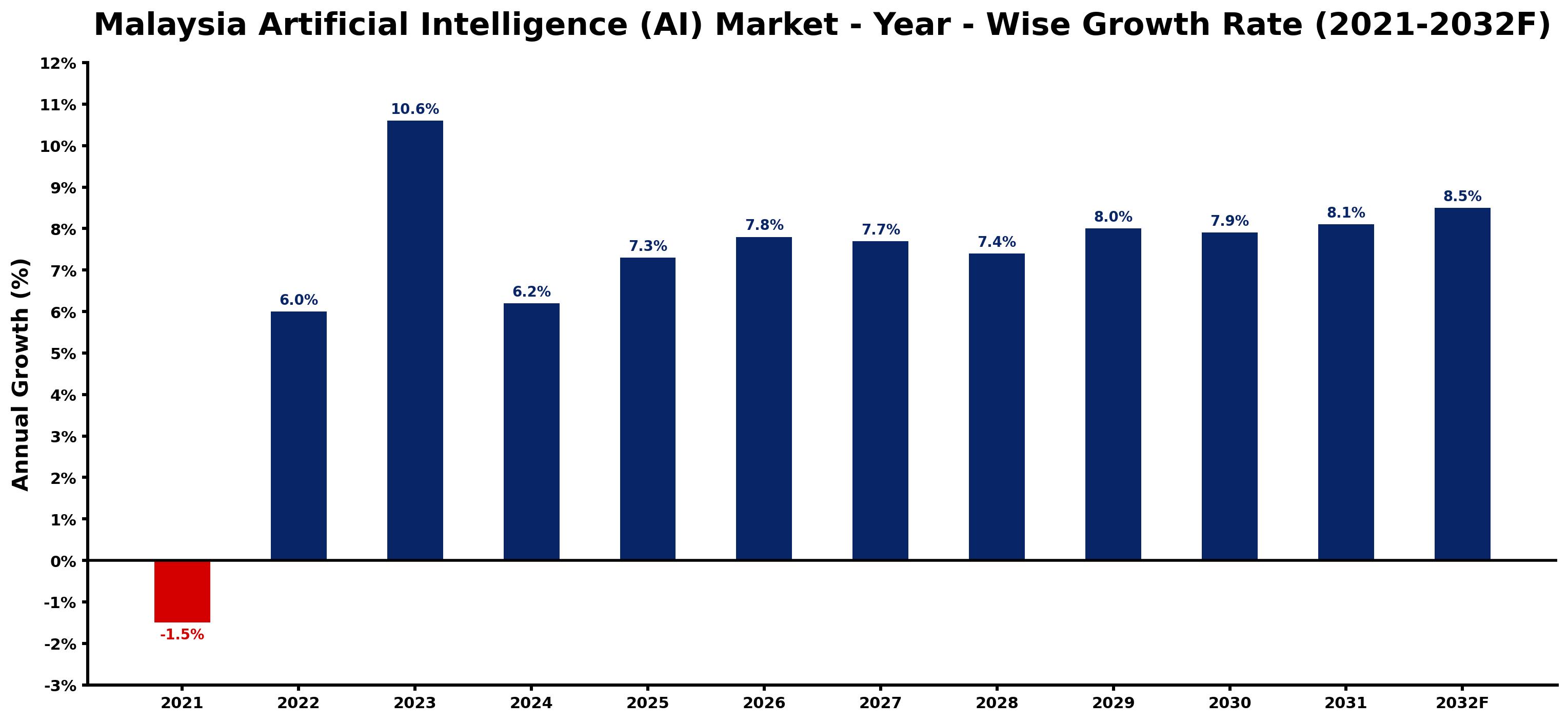
The table below presents the year‑wise growth rates along with the key drivers influencing the market
| Year | Growth Rate | Major Drivers |
| 2021 | -1.5% | Delayed implementation of Malaysia's National AI Framework policies. |
| 2022 | 6.0% | National AI Framework promoting technology adoption in Malaysia |
| 2023 | 10.6% | Increased investment in AI research by Malaysian universities |
| 2024 | 6.2% | Government funding for AI startups and innovation hubs |
| 2025 | 7.3% | Rise in AI application for agriculture efficiency |
| 2026 | 7.8% | Demand for AI-driven solutions in healthcare sector |
| 2027 | 7.7% | Growth in AI integration within local manufacturing processes |
| 2028 | 7.4% | Partnerships with tech giants for AI capability development |
| 2029 | 8.0% | Greater focus on AI in national education programs |
| 2030 | 7.9% | Adoption of AI technologies in logistics optimization |
| 2031 | 8.1% | Increasing public sector AI initiatives for administrative efficiency |
| 2032 | 8.5% | AI-driven digital transformation in Malaysian SMEs |
Note: Market size estimations and growth projections presented in this report are based on 6Wresearch's proprietary forecasting methodology, utilizing the latest available industry data, government publications, and primary research inputs.
Malaysia Artificial Intelligence (AI) Market Key Takeaways
Below are some of the specific key takeaways from the market, including:
- The Malaysia AI market is experiencing robust growth, driven by widespread adoption across multiple sectors.
- Government initiatives are actively supporting AI research and development to foster innovation.
- Challenges such as a shortage of skilled professionals and data privacy concerns need to be addressed.
- AI is being utilized for applications like predictive analytics, enhancing customer experiences and operational efficiencies.
- COVID-19 has accelerated AI adoption, particularly in healthcare and life sciences.
Evaluation of Restraints in Malaysia Artificial Intelligence (AI) Market
The growth of the Malaysia AI market is stifled by a lack of skilled professionals in the field. The deficit of qualified data scientists and AI specialists hampers innovation and the deployment of effective solutions. Additionally, concerns regarding data privacy and security regulations create hesitancy among businesses and consumers alike, posing a significant barrier to wider AI adoption.
Malaysia Artificial Intelligence (AI) Market Trends
A notable trend is the increasing integration of AI in customer service, where chatbots and virtual assistants are becoming commonplace. on top of that, there is a growing emphasis on ethical AI practices, as organizations seek to align their technologies with societal values and regulations. The rise of data-driven decision-making is also shaping how businesses utilize AI, with a focus on predictive analytics for strategic planning.
Malaysia Artificial Intelligence (AI) Market Opportunities
Opportunities abound in the AI market for companies willing to invest in research and development. The healthcare sector, in particular, presents significant potential, with applications in diagnostics and patient care systems. on top of that, the increasing interest in AI-driven automation across various industries offers avenues for businesses to enhance efficiency and reduce operational costs.
Government Initiatives in the Malaysia Artificial Intelligence (AI) Market
Government policy is actively shaping the Malaysia Artificial Intelligence (AI) Market through a variety of initiatives aimed at fostering technological advancement. With a focus on bolstering the local AI ecosystem, public sector priorities include enhancing research capabilities and facilitating collaborations between industry and academia.
- A recently completed initiative involved a national AI strategy launched to enhance research and development capabilities within Malaysia's universities.
- Currently ongoing is a public-private partnership program aimed at integrating AI into smart city developments across major urban areas.
- Upcoming plans include a regulatory framework scheduled for introduction in 2026, which will outline data privacy measures specifically for AI applications.
- The government is also promoting AI education programs to cultivate a skilled workforce, expected to begin in early 2026.
- A recent initiative aimed at boosting AI startups with funding and mentorship is now underway, targeting innovative solutions in various sectors.
Future Insights of the Malaysia Artificial Intelligence (AI) Market
Looking ahead to 2026-2032, the Malaysia AI market is set for substantial expansion as businesses continue to recognize the benefits of AI technology. The focus will likely shift towards more sophisticated applications, such as AI in cybersecurity and advanced analytics. As the government strengthens its support for AI initiatives, collaborations between tech companies and educational institutions will play a crucial role in driving innovation and developing local expertise.
Malaysia Artificial Intelligence (AI) Market Latest Developments
In the past year, the Malaysia Artificial Intelligence (AI) Market has seen a surge in activity, with numerous developments indicating a growing commitment to AI technologies. Organizations across various sectors are intensifying their efforts to incorporate AI into their operations, reflecting an increasing understanding of its strategic importance.
- A major technology vendor launched a new AI-powered analytics platform in Q1 2025, designed to enhance data-driven decision-making for businesses.
- In early 2025, a regional operator initiated a project to implement AI solutions for supply chain optimization, improving operational efficiencies across their network.
- Currently ongoing is a partnership between several universities and private firms aimed at developing AI applications for healthcare diagnostics, which began in mid-2025.
- An initiative expected to commence by late 2025 will focus on integrating AI into educational curricula, preparing students for future careers in technology.
- A recent collaboration between tech startups and government bodies was announced in Q3 2025, aimed at fostering innovation in AI solutions for smart city initiatives.
Malaysia Artificial Intelligence (AI) Market - Key Attractiveness of the Report
- 10 Years of Market Numbers
- Historical Data Starting from 2022 to 2025
- Base Year: 2025
- Forecast Data until 2032
- Key Performance Indicators Impacting the Market
- Major Upcoming Developments and Projects
Key Highlights of the Report:
- Malaysia Artificial Intelligence (AI) Market Outlook
- Market Size of Malaysia Artificial Intelligence (AI) Market, 2025
- Forecast of Malaysia Artificial Intelligence (AI) Market, 2032
- Historical Data and Forecast of Malaysia Artificial Intelligence (AI) Revenues & Volume for the Period 2022-2032F
- Malaysia Artificial Intelligence (AI) Market Trend Evolution
- Malaysia Artificial Intelligence (AI) Market Drivers and Challenges
- Malaysia Artificial Intelligence (AI) Price Trends
- Malaysia Artificial Intelligence (AI) Porter's Five Forces
- Malaysia Artificial Intelligence (AI) Industry Life Cycle
- Historical Data and Forecast of Malaysia Artificial Intelligence (AI) Market Revenues & Volume By Offering for the Period 2022-2032F
- Historical Data and Forecast of Malaysia Artificial Intelligence (AI) Market Revenues & Volume By Hardware for the Period 2022-2032F
- Historical Data and Forecast of Malaysia Artificial Intelligence (AI) Market Revenues & Volume By Software for the Period 2022-2032F
- Historical Data and Forecast of Malaysia Artificial Intelligence (AI) Market Revenues & Volume By Services for the Period 2022-2032F
- Historical Data and Forecast of Malaysia Artificial Intelligence (AI) Market Revenues & Volume By Technology for the Period 2022-2032F
- Historical Data and Forecast of Malaysia Artificial Intelligence (AI) Market Revenues & Volume By Machine Learning for the Period 2022-2032F
- Historical Data and Forecast of Malaysia Artificial Intelligence (AI) Market Revenues & Volume By Natural Language Processing for the Period 2022-2032F
- Historical Data and Forecast of Malaysia Artificial Intelligence (AI) Market Revenues & Volume By Context-Aware Computing for the Period 2022-2032F
- Historical Data and Forecast of Malaysia Artificial Intelligence (AI) Market Revenues & Volume By Computer Vision for the Period 2022-2032F
- Historical Data and Forecast of Malaysia Artificial Intelligence (AI) Market Revenues & Volume By Business Function for the Period 2022-2032F
- Historical Data and Forecast of Malaysia Artificial Intelligence (AI) Market Revenues & Volume By Finance for the Period 2022-2032F
- Historical Data and Forecast of Malaysia Artificial Intelligence (AI) Market Revenues & Volume By Security for the Period 2022-2032F
- Historical Data and Forecast of Malaysia Artificial Intelligence (AI) Market Revenues & Volume By Human Resources for the Period 2022-2032F
- Historical Data and Forecast of Malaysia Artificial Intelligence (AI) Market Revenues & Volume By Law for the Period 2022-2032F
- Historical Data and Forecast of Malaysia Artificial Intelligence (AI) Market Revenues & Volume By Marketing and Sales for the Period 2022-2032F
- Historical Data and Forecast of Malaysia Artificial Intelligence (AI) Market Revenues & Volume By Other Business Function (IT operations) for the Period 2022-2032F
- Historical Data and Forecast of Malaysia Artificial Intelligence (AI) Market Revenues & Volume By Deployment Mode for the Period 2022-2032F
- Historical Data and Forecast of Malaysia Artificial Intelligence (AI) Market Revenues & Volume By On-premises for the Period 2022-2032F
- Historical Data and Forecast of Malaysia Artificial Intelligence (AI) Market Revenues & Volume By Cloud for the Period 2022-2032F
- Historical Data and Forecast of Malaysia Artificial Intelligence (AI) Market Revenues & Volume By Organization Size for the Period 2022-2032F
- Historical Data and Forecast of Malaysia Artificial Intelligence (AI) Market Revenues & Volume By Large Enterprises for the Period 2022-2032F
- Historical Data and Forecast of Malaysia Artificial Intelligence (AI) Market Revenues & Volume By SMEs for the Period 2022-2032F
- Historical Data and Forecast of Malaysia Artificial Intelligence (AI) Market Revenues & Volume By Verticals for the Period 2022-2032F
- Historical Data and Forecast of Malaysia Artificial Intelligence (AI) Market Revenues & Volume By BFSI for the Period 2022-2032F
- Historical Data and Forecast of Malaysia Artificial Intelligence (AI) Market Revenues & Volume By IT/ ITES for the Period 2022-2032F
- Historical Data and Forecast of Malaysia Artificial Intelligence (AI) Market Revenues & Volume By Telecommunication for the Period 2022-2032F
- Historical Data and Forecast of Malaysia Artificial Intelligence (AI) Market Revenues & Volume By Government and Defense for the Period 2022-2032F
- Historical Data and Forecast of Malaysia Artificial Intelligence (AI) Market Revenues & Volume By Manufacturing for the Period 2022-2032F
- Historical Data and Forecast of Malaysia Artificial Intelligence (AI) Market Revenues & Volume By Healthcare and Lifesciences for the Period 2022-2032F
- Historical Data and Forecast of Malaysia Artificial Intelligence (AI) Market Revenues & Volume By Retail and Ecommerce for the Period 2022-2032F
- Historical Data and Forecast of Malaysia Artificial Intelligence (AI) Market Revenues & Volume By Automotive, Transportation & Logistics for the Period 2022-2032F
- Malaysia Artificial Intelligence (AI) Import Export Trade Statistics
- Market Opportunity Assessment By Offering
- Market Opportunity Assessment By Technology
- Market Opportunity Assessment By Business Function
- Market Opportunity Assessment By Deployment Mode
- Market Opportunity Assessment By Organization Size
- Market Opportunity Assessment By Verticals
- Malaysia Artificial Intelligence (AI) Top Companies Market Share
- Malaysia Artificial Intelligence (AI) Competitive Benchmarking By Technical and Operational Parameters
- Malaysia Artificial Intelligence (AI) Company Profiles
- Malaysia Artificial Intelligence (AI) Key Strategic Recommendations






































