Malaysia Automotive Wheel Rims Market Size, Share & Growth Rate
The Malaysia Automotive Wheel Rims Market was estimated at USD 471 Million in 2025 and is projected to reach USD 612 Million by 2032, growing at a CAGR of 3.8% from 2026 to 2032. This upward trajectory is propelled by a significant rise in vehicle ownership across the country, coupled with a burgeoning demand for personalized vehicle aesthetics. Additionally, the shift towards larger and more efficient alloy wheels reflects a consumer preference that intertwines style with performance.
Malaysia Automotive Wheel Rims Market Growth Rate Analysis (2021-2032)
The Malaysian automotive wheel rims market experienced a decline of 2.6% in 2021, primarily due to supply chain disruptions and reduced vehicle production amid the pandemic. However, recovery commenced in 2022 with a growth of 4.3%, driven by increasing consumer demand and government initiatives aimed at revitalizing the automotive sector. This positive momentum accelerated to 8.7% in 2023, as manufacturers adopted advanced technologies and focused on sustainability, responding to evolving consumer preferences. Growth is projected to continue, stabilizing at around 4.3% in 2024 and gradually increasing to 5.6% by 2026. Investments in digitalization and infrastructure enhancements further support this upward trend, creating a more resilient market landscape.
Malaysia Automotive Wheel Rims Market Year-wise Growth Rate and Key Drivers
This graph highlights how the Malaysia Automotive Wheel Rims Market has steadily grown over the past five years, supported by major growth factors.
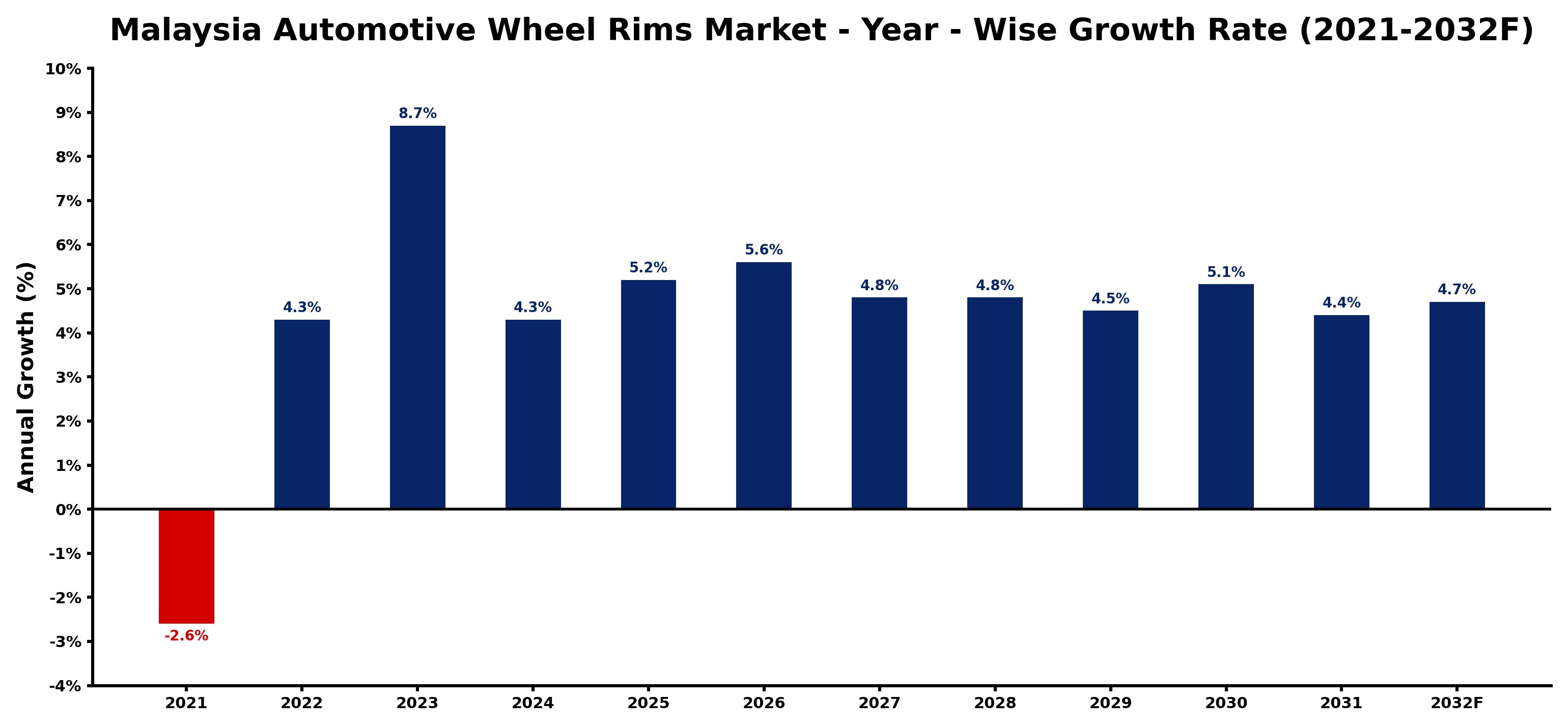
The table below presents the year‑wise growth rates along with the key drivers influencing the market
| Year | Growth Rate | Major Drivers |
| 2021 | -2.6% | Supply chain disruptions limited production |
| 2022 | 4.3% | Electric vehicle market expanded rapidly |
| 2023 | 8.7% | Consumer preference shifted towards quality |
| 2024 | 4.3% | Automotive industry recovery gained momentum |
| 2025 | 5.2% | Technological advancements enhanced manufacturing |
| 2026 | 5.6% | Sustainability trends influenced purchasing decisions |
| 2027 | 4.8% | Export opportunities increased significantly |
| 2028 | 4.8% | Customization options attracted new customers |
| 2029 | 4.5% | Collaborations with automakers strengthened market |
| 2030 | 5.1% | Digital marketing strategies improved outreach |
| 2031 | 4.4% | Aftermarket services gained consumer interest |
| 2032 | 4.7% | Innovative designs captured consumer attention |
Note - Market size estimations and growth projections presented in this report are based on 6Wresearch’s advanced forecasting approach, validated with industry datasets as of June 2026.
Malaysia Automotive Wheel Rims Market Synopsis
A pivotal force shaping the Malaysia Automotive Wheel Rims Market is the increasing inclination toward vehicle customization. Consumers are no longer satisfied with standard offerings; instead, they seek unique designs that express their personal style and enhance vehicle aesthetics. This trend is compounded by a growing fascination with larger alloy wheels that not only elevate the visual appeal but also promise better handling and fuel efficiency.
Moreover, the rise of e-commerce platforms in Malaysia has transformed the purchasing landscape for automotive wheel rims. Consumers now have access to a diverse array of options online, making it easier to explore custom designs and sizes, thus expanding the market significantly. The confluence of these factors positions the market for substantial growth in the coming years.
Malaysia Automotive Wheel Rims Market Key Takeaways
- Strong growth is driven by increasing vehicle ownership and consumer demand for customization.
- Emergence of e-commerce channels is reshaping how consumers purchase wheel rims.
- Shifts in consumer preferences towards larger, alloy wheels are enhancing market dynamics.
- Manufacturers face challenges balancing aesthetics, performance, and material efficiency.
- The industry is gradually recovering post-COVID-19, with innovations in lightweight materials.
Evaluation of Restraints in Malaysia Automotive Wheel Rims Market
While the Malaysia Automotive Wheel Rims Market shows promising growth potential, several constraints impede its overall expansion. One significant restraint is the intricate balance between aesthetics and functionality that manufacturers must achieve. As consumer preferences evolve, they increasingly demand wheels that not only look appealing but also enhance vehicle performance and fuel efficiency. This requires continuous investment in research and development, which can strain production budgets and resources. Additionally, the fluctuating costs of raw materials pose a challenge, complicating pricing strategies and impacting profit margins across the sector.
Malaysia Automotive Wheel Rims Market Trends
A notable trend in the Malaysia Automotive Wheel Rims Market is the rising interest in sustainable and eco-friendly manufacturing practices. With consumers becoming more environmentally conscious, companies are increasingly exploring recyclable materials and energy-efficient production techniques. Furthermore, the integration of advanced technologies like 3D printing in wheel rim production is gaining traction, allowing for intricate designs and rapid prototyping, which caters to the growing demand for customization.
Malaysia Automotive Wheel Rims Market Opportunities
Significant opportunities lie within the growing e-commerce sector and the increasing demand for custom products. As online retail becomes more mainstream, manufacturers can tap into a wider customer base by offering their products through digital platforms. Additionally, partnering with automotive customization shops presents avenues for collaboration, enabling players to innovate and expand their reach. The trend toward lightweight and durable wheel rim materials also offers manufacturers a chance to differentiate themselves in a competitive market.
Government Initiatives in the Malaysia Automotive Wheel Rims Market
The Malaysian government is actively promoting the automotive sector through various initiatives aimed at enhancing production capabilities and fostering innovation. Policies that encourage local manufacturing and investment in green technology are shaping a favorable environment for industry growth. Public spending on infrastructure projects, which boost vehicle sales, further supports the automotive market, creating a ripple effect that positively impacts the demand for automotive wheel rims.
Future Insights of the Malaysia Automotive Wheel Rims Market
Looking ahead to 2026-2032, the Malaysia Automotive Wheel Rims Market is poised for robust growth, driven by technological advancements and evolving consumer preferences. Innovations in design and material sciences will likely dominate, allowing manufacturers to produce products that meet both aesthetic desires and performance needs. As vehicle ownership continues to increase and e-commerce plays a more significant role, the market is expected to adapt quickly, ensuring a dynamic landscape where companies can thrive.
Malaysia Automotive Wheel Rims Market Latest Developments (May 2025 - June 2026)
Recent developments in the Malaysia Automotive Wheel Rims Market indicate a stronger focus on lightweight materials and sustainability. Companies are beginning to implement eco-friendly practices in manufacturing processes, aligning with global trends towards environmental responsibility. Additionally, the rise of collaborations between wheel manufacturers and vehicle customizers has become more prevalent, aiming to provide consumers with bespoke designs that reflect their unique styles.
Malaysia Automotive Wheel Rims Market - Key Attractiveness of the Report
- 10 Years of Market Numbers
- Historical Data Starting from 2022 to 2025
- Base Year: 2025
- Forecast Data until 2032
- Key Performance Indicators Impacting the Market
- Major Upcoming Developments and Projects
Key Highlights of the Report:
- Malaysia Automotive Wheel Rims Market Outlook
- Market Size of Malaysia Automotive Wheel Rims Market, 2025
- Forecast of Malaysia Automotive Wheel Rims Market, 2032F
- Historical Data and Forecast of Malaysia Automotive Wheel Rims Revenues & Volume for the Period 2022-2032F
- Malaysia Automotive Wheel Rims Market Trend Evolution
- Malaysia Automotive Wheel Rims Market Drivers and Challenges
- Malaysia Automotive Wheel Rims Price Trends
- Malaysia Automotive Wheel Rims Porter's Five Forces
- Malaysia Automotive Wheel Rims Industry Life Cycle
- Historical Data and Forecast of Malaysia Automotive Wheel Rims Market Revenues & Volume By Material Type for the Period 2022-2032F
- Historical Data and Forecast of Malaysia Automotive Wheel Rims Market Revenues & Volume By Alloy for the Period 2022-2032F
- Historical Data and Forecast of Malaysia Automotive Wheel Rims Market Revenues & Volume By Steel for the Period 2022-2032F
- Historical Data and Forecast of Malaysia Automotive Wheel Rims Market Revenues & Volume By Carbon Fiber for the Period 2022-2032F
- Historical Data and Forecast of Malaysia Automotive Wheel Rims Market Revenues & Volume By Sales Channel for the Period 2022-2032F
- Historical Data and Forecast of Malaysia Automotive Wheel Rims Market Revenues & Volume By OEM for the Period 2022-2032F
- Historical Data and Forecast of Malaysia Automotive Wheel Rims Market Revenues & Volume By Aftermarket for the Period 2022-2032F
- Historical Data and Forecast of Malaysia Automotive Wheel Rims Market Revenues & Volume By Vehicle Type for the Period 2022-2032F
- Historical Data and Forecast of Malaysia Automotive Wheel Rims Market Revenues & Volume By Passenger Cars for the Period 2022-2032F
- Historical Data and Forecast of Malaysia Automotive Wheel Rims Market Revenues & Volume By Commercial Vehicles for the Period 2022-2032F
- Malaysia Automotive Wheel Rims Import Export Trade Statistics
- Market Opportunity Assessment By Material Type
- Market Opportunity Assessment By Sales Channel
- Market Opportunity Assessment By Vehicle Type
- Malaysia Automotive Wheel Rims Top Companies Market Share
- Malaysia Automotive Wheel Rims Competitive Benchmarking By Technical and Operational Parameters
- Malaysia Automotive Wheel Rims Company Profiles
- Malaysia Automotive Wheel Rims Key Strategic Recommendations






































