Malaysia Barium Oxide Market Size, Share & Growth Rate
The Malaysia Barium Oxide Market was estimated at USD 233 Million in 2025 and is projected to reach USD 304 Million by 2032, growing at a CAGR of 3.9% from 2026 to 2032. This upward trajectory is primarily fueled by heightened demand in the ceramics and glass sectors, driven by the rapid urbanization trends across Southeast Asia. Additionally, the increasing adoption of barium oxide in electronics further solidifies its growth potential within Malaysia's dynamic market landscape.
Malaysia Barium Oxide Market Year-wise Growth Rate and Key Drivers
This graph highlights how the Malaysia Barium Oxide Market has steadily grown over the years, supported by major growth factors.
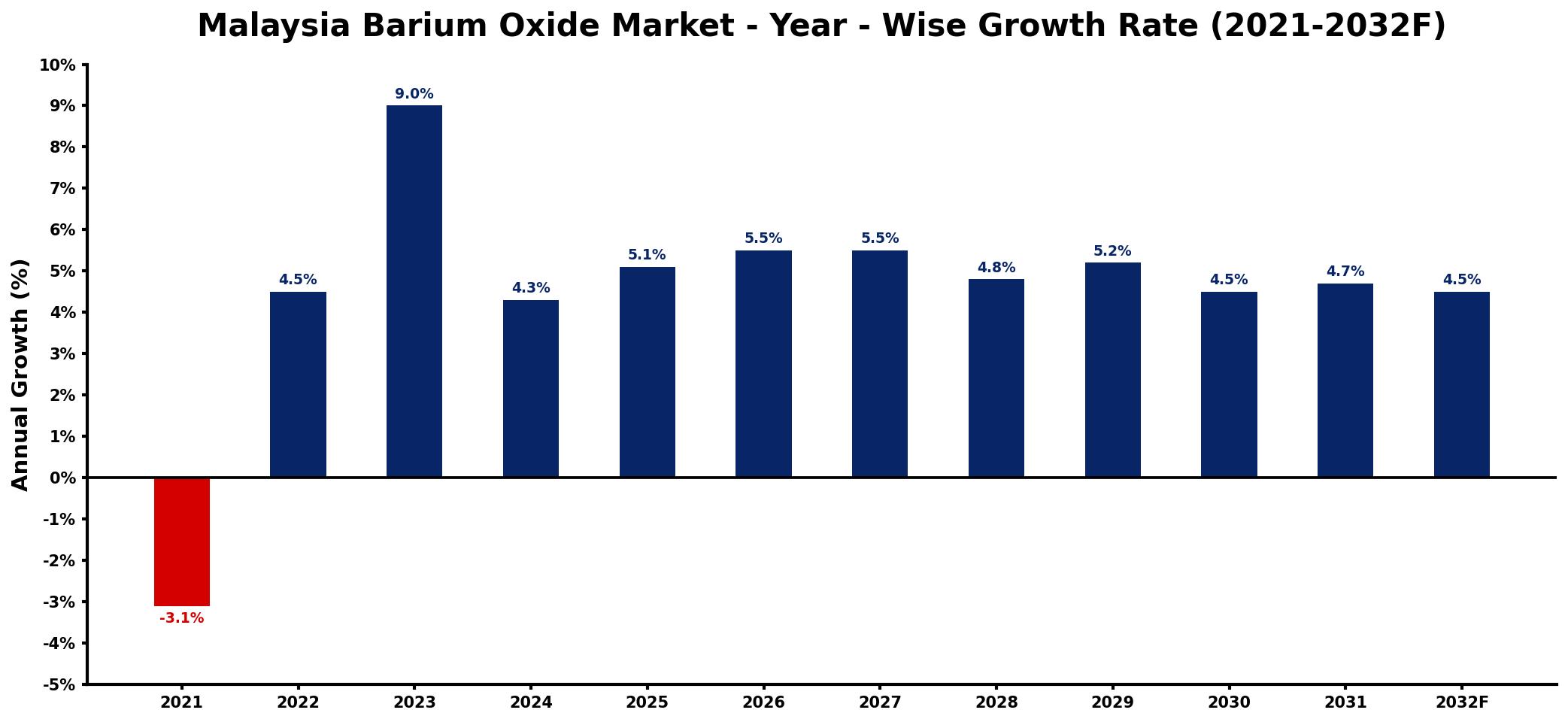
The table below presents the year‑wise growth rates along with the key drivers influencing the market
| Year | Growth Rate | Major Drivers |
| 2021 | -3.1% | decrease in industrial applications |
| 2022 | 4.5% | growth in construction sector demand |
| 2023 | 9.0% | rise in chemical manufacturing investments |
| 2024 | 4.3% | expansion of electronics market usage |
| 2025 | 5.1% | increase in energy storage solutions |
| 2026 | 5.5% | growing demand from automotive industry |
| 2027 | 5.5% | development of renewable energy projects |
| 2028 | 4.8% | surge in pharmaceuticals production needs |
| 2029 | 5.2% | enhanced agricultural sector utilization |
| 2030 | 4.5% | uptrend in glass manufacturing requirements |
| 2031 | 4.7% | rising export shipment volumes |
| 2032 | 4.5% | increased focus on environmental applications |
Note: Market size estimations and growth projections presented in this report are based on 6Wresearch's proprietary forecasting methodology, utilizing the latest available industry data, government publications, and primary research inputs.
Malaysia Barium Oxide Market Synopsis
In recent years, the Malaysia barium oxide market has gained momentum, bolstered by thriving industries that require this essential compound. However, as the market looks ahead, it anticipates both challenges and opportunities arising from evolving technological advancements and regulatory frameworks.
As the country continues to urbanize, the demand for construction materials, particularly in ceramics, remains robust. Nevertheless, the sector must navigate safety concerns and stringent regulations surrounding barium oxide, which could impact future growth trajectories.
Malaysia Barium Oxide Market Key Takeaways
- The market is experiencing growth driven by urbanization and increased consumption in ceramics and glass production.
- Technological advancements and environmentally driven practices are reshaping market dynamics.
- Safety regulations regarding handling barium oxide present significant challenges for manufacturers.
- The electronics sector is emerging as a vital contributor to market demand.
- Key players are adapting to evolving industry standards to maintain competitiveness.
Evaluation of Restraints in Malaysia Barium Oxide Market
The Malaysia barium oxide market encounters substantial restraints stemming from safety concerns linked to the compound's reactive nature. The stringent regulations imposed by the government to ensure safe handling and usage limit production capacities. Companies are thus compelled to invest in compliance measures, diverting resources that could otherwise enhance operational efficiency and market expansion. Moreover, the high costs associated with adopting safer handling practices may deter smaller players from entering the market, consolidating the competitive landscape.
Malaysia Barium Oxide Market Trends
Noteworthy trends are shaping the Malaysia barium oxide market, notably the pivot toward sustainable and eco-friendly manufacturing processes. As industries face pressure to reduce their environmental footprint, the search for cleaner alternatives is gaining traction. Additionally, technological advancements are enhancing the efficacy of barium oxide in applications ranging from ceramics to electronics, broadening its utility. Emerging innovations in production processes, such as the incorporation of recycled materials, further align with global sustainability initiatives.
Malaysia Barium Oxide Market Opportunities
The Malaysian barium oxide market is ripe with opportunities as industries strive for innovation. Significant investment potential lies in R&D efforts aimed at developing safer handling techniques and alternative applications that can mitigate the compound's reactive characteristics. Furthermore, as the demand for advanced electronics continues to rise, barium oxide's versatility may facilitate its expansion into new sectors, creating an avenue for growth and diversification. Collaboration between industry players and research institutions can unlock novel applications and enhance market penetration.
Government Initiatives in the Malaysia Barium Oxide Market
The Malaysian government has been proactive in shaping the framework that influences the barium oxide market. Policies encouraging sustainable manufacturing practices and investments in innovative technologies are paving the way for future growth. Public funding for research initiatives aimed at improving safety standards and environmental compliance has the potential to catalyze advancements in the industry. Moreover, collaborative programs involving government bodies and private sectors can enhance knowledge sharing and elevate the overall market landscape.
Future Insights of the Malaysia Barium Oxide Market
Looking ahead to 2026-2032, the Malaysia barium oxide market is expected to maintain a steady growth trajectory, buoyed by continuing urbanization and technological advancements. The anticipated shift towards more sustainable production methods will not only mitigate some of the industry's safety challenges but will also open new avenues for market expansion. With increased investment in R&D and collaborative efforts between sectors, Malaysia stands to enhance its position as a significant player in the barium oxide market.
Malaysia Barium Oxide Market Latest Developments (2025 - 2026)
In the latter half of 2025 and early 2026, the barium oxide market in Malaysia witnessed a series of strategic shifts. Industry stakeholders have begun implementing advanced safety protocols, aligning with emerging regulations. Furthermore, ongoing collaborations between manufacturers and research institutions are driving innovation in applications. The focus on sustainable practices has led to an uptick in research initiatives targeting alternative materials and processes that reduce environmental impacts, positioning the market for future adaptability.
Malaysia Barium Oxide Market - Key Attractiveness of the Report
- 10 Years of Market Numbers
- Historical Data Starting from 2022 to 2025
- Base Year: 2025
- Forecast Data until 2032
- Key Performance Indicators Impacting the Market
- Major Upcoming Developments and Projects
Key Highlights of the Report:
- Malaysia Barium Oxide Market Outlook
- Market Size of Malaysia Barium Oxide Market, 2025
- Forecast of Malaysia Barium Oxide Market, 2032
- Historical Data and Forecast of Malaysia Barium Oxide Revenues & Volume for the Period 2022-2032F
- Malaysia Barium Oxide Market Trend Evolution
- Malaysia Barium Oxide Market Drivers and Challenges
- Malaysia Barium Oxide Price Trends
- Malaysia Barium Oxide Porter's Five Forces
- Malaysia Barium Oxide Industry Life Cycle
- Historical Data and Forecast of Malaysia Barium Oxide Market Revenues & Volume By Product Type for the Period 2022-2032F
- Historical Data and Forecast of Malaysia Barium Oxide Market Revenues & Volume By Purity 90% for the Period 2022-2032F
- Historical Data and Forecast of Malaysia Barium Oxide Market Revenues & Volume By Purity 99.5% for the Period 2022-2032F
- Historical Data and Forecast of Malaysia Barium Oxide Market Revenues & Volume By Others for the Period 2022-2032F
- Historical Data and Forecast of Malaysia Barium Oxide Market Revenues & Volume By Applications for the Period 2022-2032F
- Historical Data and Forecast of Malaysia Barium Oxide Market Revenues & Volume By Cathode Ray Tube for the Period 2022-2032F
- Historical Data and Forecast of Malaysia Barium Oxide Market Revenues & Volume By Optical Crown Glass for the Period 2022-2032F
- Historical Data and Forecast of Malaysia Barium Oxide Market Revenues & Volume By Catalyst for the Period 2022-2032F
- Historical Data and Forecast of Malaysia Barium Oxide Market Revenues & Volume By Others for the Period 2022-2032F
- Malaysia Barium Oxide Import Export Trade Statistics
- Market Opportunity Assessment By Product Type
- Market Opportunity Assessment By Applications
- Malaysia Barium Oxide Top Companies Market Share
- Malaysia Barium Oxide Competitive Benchmarking By Technical and Operational Parameters
- Malaysia Barium Oxide Company Profiles
- Malaysia Barium Oxide Key Strategic Recommendations






































