Malaysia Brandy Market Summary
The malaysia brandy market was estimated at USD 407 Million in 2025 and is projected to reach USD 532 Million by 2032, growing at a CAGR of 5.8% from 2026 to 2032.
Malaysia Brandy Market Year-wise Growth Rate and Key Drivers
This graph highlights how the Malaysia Brandy Market has steadily grown over the past five years, supported by major growth factors.
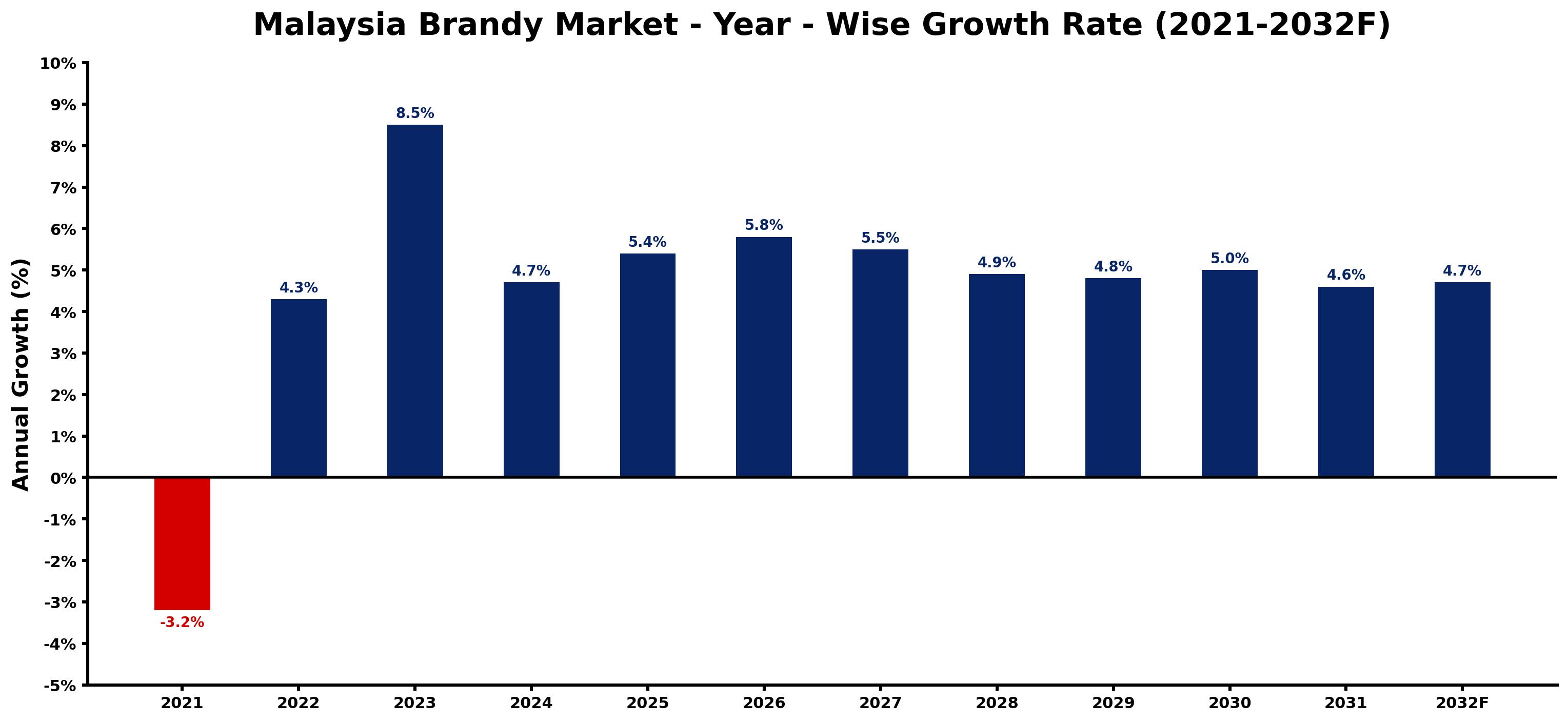
The table below presents the year wise growth rates along with the key drivers influencing the market
| Year | Growth Rate | Major Drivers |
| 2021 | -3.2% | Decreased tourism inflow during the pandemic severely impacted brandy sales in social settings. |
| 2022 | 4.3% | Local distilleries focused on producing artisanal brandy, enhancing product diversity and quality. |
| 2023 | 8.5% | Millennials' evolving taste preferences shifted towards more sophisticated drinking experiences. |
| 2024 | 4.7% | Increased tourism contributed to higher demand for luxury spirits in urban centers. |
| 2025 | 5.4% | Social media marketing campaigns effectively engaged younger consumers, boosting brand awareness. |
| 2026 | 5.8% | Traditional celebrations and festivals increasingly featured brandy as a beverage of choice. |
| 2027 | 5.5% | Diverse cocktail culture emerged, incorporating brandy into innovative drink recipes. |
| 2028 | 4.9% | Distribution channels expanded, with online platforms facilitating access to premium products. |
| 2029 | 4.8% | Partnerships with upscale restaurants introduced brandy to new, discerning audiences. |
| 2030 | 5.0% | Investment in sustainable practices appealed to environmentally-conscious consumers in the market. |
| 2031 | 4.6% | International brand collaborations introduced Malaysia-specific flavors, enhancing local brandy options. |
| 2032 | 4.7% | Increased focus on health and wellness shaped brandy marketing towards lower-calorie options. |
Note - Market size estimations and growth projections presented in this report are based on 6Wresearch's advanced forecasting approach, validated with industry datasets as of June 2026.
Malaysia Brandy Market Synopsis
The Malaysia Brandy Market is projected to reach 5.8% and witness significant growth during the forecast period (2026-2032). The anticipated market growth is attributed to a burgeoning consumer interest in brandy, spurred by its perceived relaxation and mood-enhancing properties, as well as various health benefits. This trend is particularly prevalent among young adults and teenagers, whose increasing disposable incomes further contribute to the uptick in brandy consumption. Additionally, the growing presence of premium brands across retail outlets and online platforms is driving this dynamic market forward.
Malaysia Brandy Market Growth Drivers
Several factors are propelling the growth of the Malaysia Brandy Market. Firstly, the rising inclination of consumers towards brandy, attributed to its cultural significance and social acceptance, is a key driver of this market's expansion. Secondly, the evolving lifestyle choices of young Malaysians, who increasingly seek premium alcoholic beverages, have significantly contributed to brandy's popularity. Thirdly, enhanced marketing strategies, particularly through digital mediums, are effectively reaching target demographics, further stimulating demand.
- As households experience increasing disposable income, there are shifts in consumer preferences towards premium and luxury alcohol brands.
- The accessibility of diverse brandy options in retail and e-commerce platforms has amplified consumer interest in exploring different varieties.
- Social events and gatherings frequently showcase brandy as a sophisticated beverage choice, enhancing its visibility and desirability among consumers.
- Strategic partnerships between local distributors and international brand manufacturers have increased the availability of premium products in Malaysia.
- The infusion of brandy into local drinking traditions is helping to create a unique market identity that appeals to local consumers.
Malaysia Brandy Market Challenges and Restraints
Despite the positive growth trajectory, the Malaysia Brandy Market faces several challenges that could restrain its expansion. One significant factor is the stringent regulations imposed by the Malaysian government on alcohol consumption. These regulations aim to curb alcohol-related issues but inadvertently limit market potential. Additionally, social stigmas surrounding alcohol use, particularly in certain demographic segments, may deter potential consumers from adopting brandy as a beverage choice. Furthermore, economic fluctuations could potentially impact disposable incomes, affecting overall spending on luxury goods like brandy.
- Government policies aimed at reducing alcohol consumption can pose significant barriers to market growth.
- Cultural sensitivities in certain regions can influence consumer acceptance and adoption of brandy.
- Economic downturns may lead to reduced discretionary spending on luxury and non-essential items, including premium alcoholic beverages.
- Increasing competition from other alcoholic beverages could divert consumer interest from brandy.
- Potential disruptions in supply chains for imported brandy can lead to shortages and price fluctuations.
Malaysia Brandy Market Trends and Opportunities
The Malaysia Brandy Market is poised for growth, with several emerging trends indicating opportunities for expansion. An increased focus on health and wellness among consumers is leading to a demand for lower-alcohol options, which could include brandy variants. Additionally, the rise of craft beverages is inspiring local distilleries to innovate and create unique brandy flavors, appealing to adventurous consumers. Furthermore, the adaptation of brandy in mixology and as an ingredient in premium cocktails presents a lucrative avenue for market players. The trend towards sustainability also encourages brands to promote eco-friendly practices in production and packaging.
- The introduction of organic or locally sourced brandy variants is appealing to health-conscious consumers.
- Craft distilleries are increasingly gaining traction, emphasizing unique flavors and production methods.
- Emergence of experiential marketing campaigns that focus on tasting events and brand storytelling is enhancing consumer engagement.
- Collaborations with local bars and restaurants create unique brand experiences, introducing brandy to new consumer segments.
- Sustainable production practices are becoming a key selling point for environmentally-conscious consumers.
Malaysia Brandy Market Government Investment and Initiatives
The Malaysian government has implemented various initiatives aimed at regulating and promoting responsible drinking within the alcohol sector. While strict regulations exist concerning alcohol marketing and sales to minors, there are also efforts focused on educating consumers about responsible consumption. Development plans targeting tourism often include the promotion of local alcoholic beverages, providing opportunities for brandy producers to showcase their products at cultural festivals and events. Incentives for local distilleries to innovate and market their products are also gaining traction, as authorities recognize the potential economic contribution of this sector.
Malaysia Brandy Market Latest Developments (May 2025 - June 2026)
Recent developments within the Malaysia Brandy Market between May 2025 and June 2026 have indicated a shift towards premiumization. Brands are increasingly focusing on launching high-quality market offerings, appealing to a more discerning consumer base that values craftsmanship and origin. Additionally, collaborations between local producers and international brands have emerged, fostering innovation and enhancing brand visibility. The growth of social media has enabled brands to connect directly with consumers, creating tailored marketing strategies that resonate with younger demographics. As a result, the landscape of the market continues to evolve, driven by shifting consumer preferences.
Malaysia Brandy Market - Key Attractiveness of the Report
- 10 Years of Market Numbers
- Historical Data Starting from 2022 to 2025
- Base Year: 2025
- Forecast Data until 2032
- Key Performance Indicators Impacting the Market
- Major Upcoming Developments and Projects
Key Highlights of the Report:
- Malaysia Brandy Market Outlook
- Market Size of Malaysia Brandy Market, 2025
- Forecast of Malaysia Brandy Market, 2032F
- Historical Data and Forecast of Malaysia Brandy Revenues & Volume for the Period 2022-2032F
- Malaysia Brandy Market Trend Evolution
- Malaysia Brandy Market Drivers and Challenges
- Malaysia Brandy Price Trends
- Malaysia Brandy Porter's Five Forces
- Malaysia Brandy Industry Life Cycle
- Historical Data and Forecast of Malaysia Brandy Market Revenues & Volume By Type for the Period 2022-2032F
- Historical Data and Forecast of Malaysia Brandy Market Revenues & Volume By V.S. ("very special") for the Period 2022-2032F
- Historical Data and Forecast of Malaysia Brandy Market Revenues & Volume By V.S.O.P. ("very superior old pale") for the Period 2022-2032F
- Historical Data and Forecast of Malaysia Brandy Market Revenues & Volume By XO ("extra old") for the Period 2022-2032F
- Historical Data and Forecast of Malaysia Brandy Market Revenues & Volume By Hors d'age ("beyond age") for the Period 2022-2032F
- Historical Data and Forecast of Malaysia Brandy Market Revenues & Volume By Applications for the Period 2022-2032F
- Historical Data and Forecast of Malaysia Brandy Market Revenues & Volume By Shop & Supermarket for the Period 2022-2032F
- Historical Data and Forecast of Malaysia Brandy Market Revenues & Volume By Restaurant & Bar & Club for the Period 2022-2032F
- Historical Data and Forecast of Malaysia Brandy Market Revenues & Volume By Exclusive Store for the Period 2022-2032F
- Historical Data and Forecast of Malaysia Brandy Market Revenues & Volume By Others for the Period 2022-2032F
- Malaysia Brandy Import Export Trade Statistics
- Market Opportunity Assessment By Type
- Market Opportunity Assessment By Applications
- Malaysia Brandy Top Companies Market Share
- Malaysia Brandy Competitive Benchmarking By Technical and Operational Parameters
- Malaysia Brandy Company Profiles
- Malaysia Brandy Key Strategic Recommendations






































