Malaysia Cloud Managed Services Market Size & Growth Rate (2026-2032)
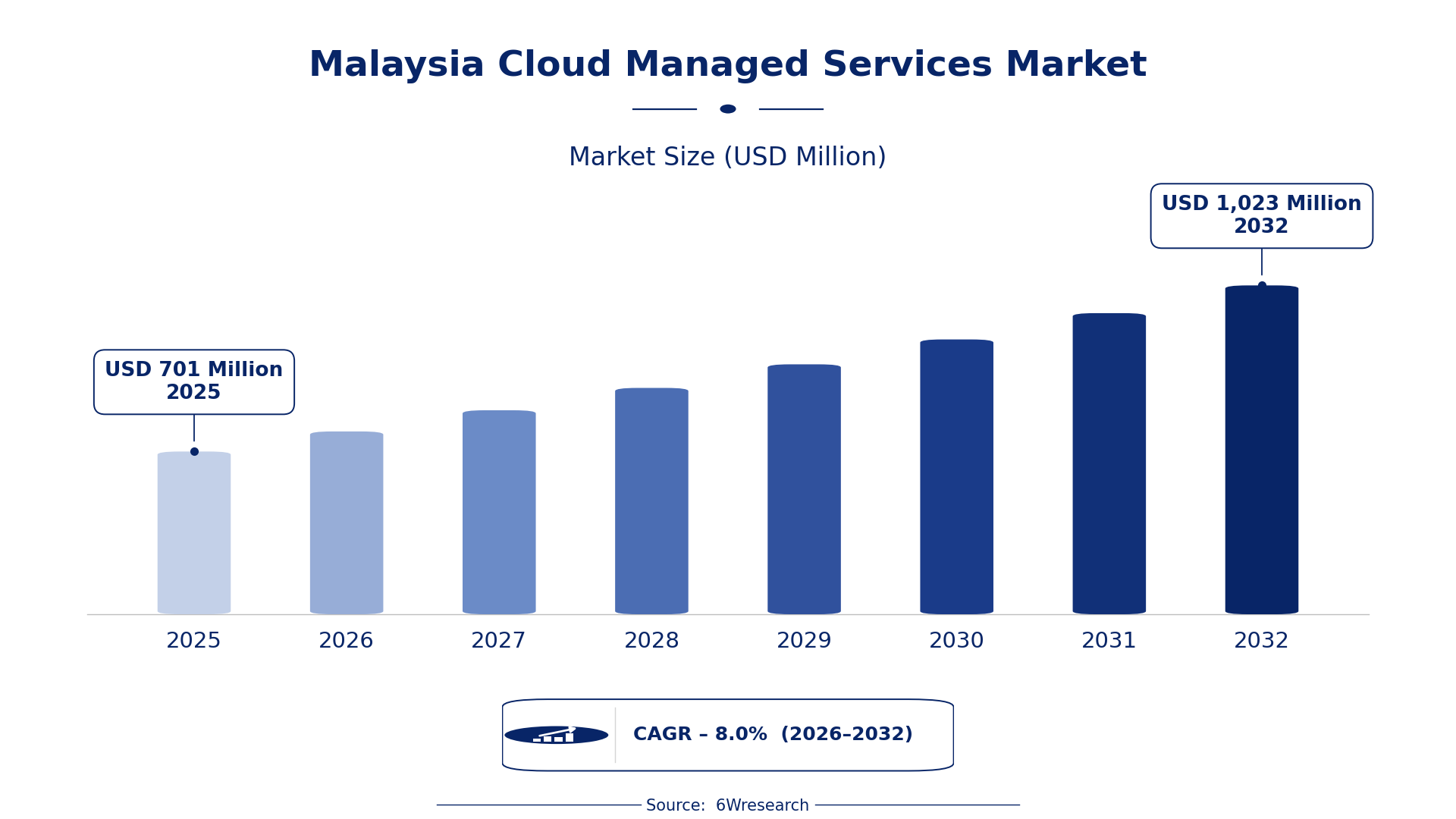
The Malaysia Cloud Managed Services Market was estimated at USD 701 Million in 2025 and is projected to reach USD 1023 Million by 2032, growing at a CAGR of 8.0% from 2026 to 2032.
Malaysia Cloud Managed Services Market Synopsis
The demand for specialized cloud management expertise is reshaping the Malaysia Cloud Managed Services Market. As businesses increasingly recognize the complexities of managing cloud environments, they are turning to managed service providers to enhance operational efficiency and security.
This shift is driven by a growing emphasis on data security and compliance, prompting organizations to outsource these critical functions. As cloud ecosystems become more intricate, the reliance on skilled providers is set to escalate, further fueling market growth.
Malaysia Cloud Managed Services Market Year-wise Growth Rate and Key Drivers
This graph illustrates the annual growth rates of the Malaysia Cloud Managed Services Market from 2021 to 2032, highlighting a steady upward trajectory and projected expansion over the forecast period.
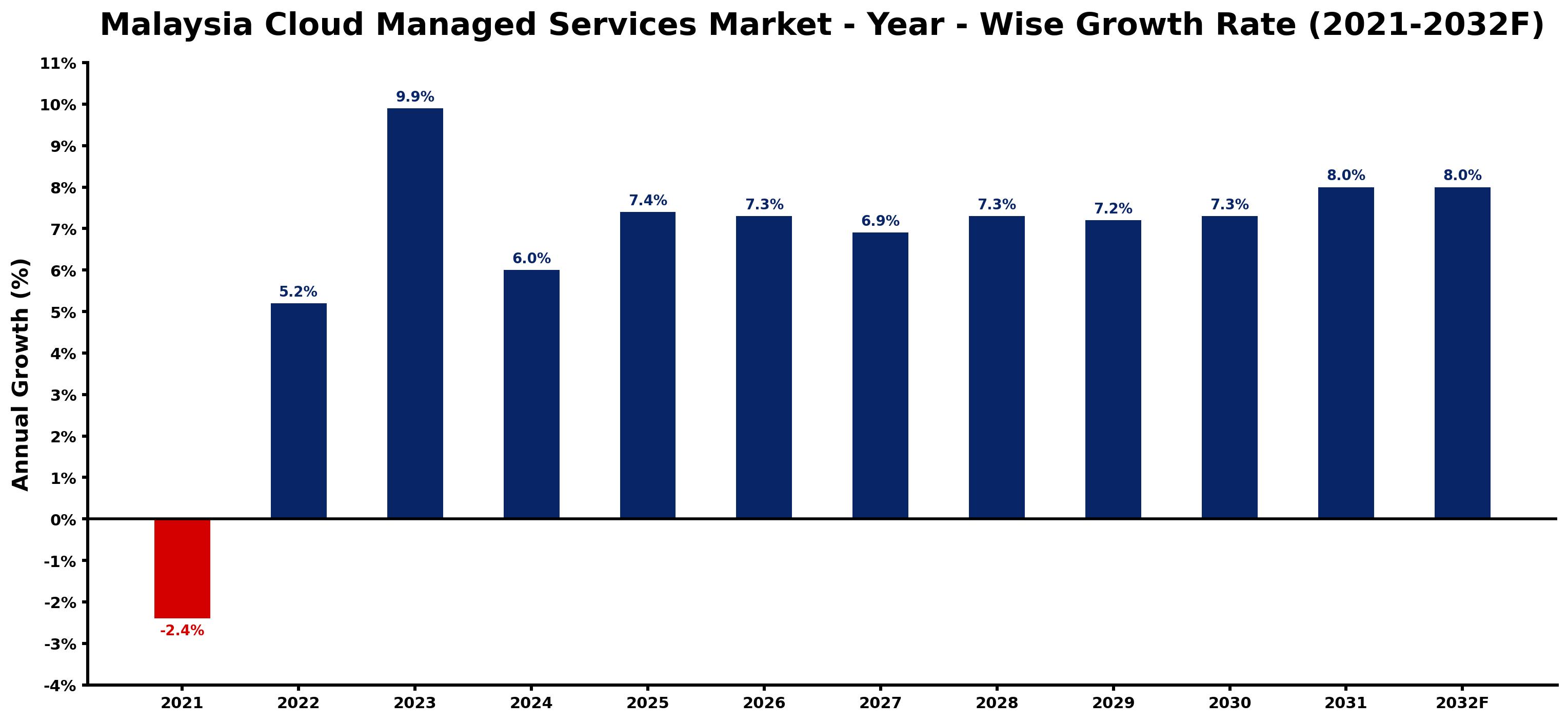
The table below presents the year‑wise growth rates along with the key drivers influencing the market
| Year | Growth Rate | Major Drivers |
| 2021 | -2.4% | Delayed digital adoption due to MCMC regulation changes. |
| 2022 | 5.2% | Increasing cybersecurity regulations spur cloud service adoption. |
| 2023 | 9.9% | Digital economy growth boosts demand for managed services. |
| 2024 | 6.0% | Government grants incentivize cloud migration for businesses. |
| 2025 | 7.4% | Rising e-commerce platforms driving cloud infrastructure needs. |
| 2026 | 7.3% | Emergence of local data centers enhances service reliability. |
| 2027 | 6.9% | Growing interest in AI solutions pushes cloud provider growth. |
| 2028 | 7.3% | Increased mobile internet penetration fuels cloud usage. |
| 2029 | 7.2% | Proliferation of startups demands scalable cloud solutions. |
| 2030 | 7.3% | Local content creation increases demand for cloud storage. |
| 2031 | 8.0% | Public sector digitalization initiatives drive service expansion. |
| 2032 | 8.0% | Corporate sustainability goals promote cloud efficiency solutions. |
Note: Market size estimations and growth projections presented in this report are based on 6Wresearch's proprietary forecasting methodology, utilizing the latest available industry data, government publications, and primary research inputs.
Malaysia Cloud Managed Services Market Key Takeaways
Below are some of the specific key takeaways from the market, including:
- The market is witnessing a notable shift towards outsourcing cloud management to enhance security and operational efficiency.
- Demand for cloud monitoring and optimization services is steadily increasing as companies seek to improve their service availability.
- Challenges related to data security and compliance are driving organizations to engage managed service providers.
- The COVID-19 pandemic has accelerated the need for reliable cloud infrastructure management solutions.
- Investments in skilled professionals and advanced technologies are critical to overcoming current market hurdles.
Evaluation of Restraints in Malaysia Cloud Managed Services Market
Despite its promising growth, the Malaysia Cloud Managed Services Market faces several restraints. One major challenge is ensuring compliance with stringent data security regulations. As organizations increasingly rely on cloud providers, the responsibility for safeguarding sensitive data falls heavily on these service providers. Adapting to evolving regulatory frameworks can be both complex and costly.
on top of that, the need for a workforce skilled in cloud management is critical. The rapid evolution of cloud technologies demands continuous training and education, which many companies struggle to provide. Cost control remains a persistent concern as poorly managed cloud resources can lead to inflated expenditures.
Malaysia Cloud Managed Services Market Trends
The trend towards hybrid cloud solutions is gaining traction among Malaysian businesses. Companies are increasingly looking to blend on-premises infrastructure with cloud capabilities, seeking flexibility and enhanced control. This shift is driving demand for managed services that can support diverse environments.
AI and machine learning are also making their mark in cloud management, providing tools for predictive analytics and automation. Organizations are leveraging these technologies to optimize resource allocation and improve response times in cloud operations.
Malaysia Cloud Managed Services Market Opportunities
Several growth opportunities lie ahead for the Malaysia Cloud Managed Services Market. First, the increasing adoption of Internet of Things (IoT) technologies creates a demand for robust cloud management solutions to handle the influx of data generated by connected devices. Additionally, small and medium-sized enterprises (SMEs) are recognizing the value of cloud services, presenting a lucrative segment for managed service providers.
Partnerships between local firms and global cloud providers can enhance service offerings, allowing Malaysian companies to access cutting-edge technologies. As businesses continue to prioritize digital transformation, tailored cloud solutions will become essential for maintaining competitive advantage.
Government Initiatives in the Malaysia Cloud Managed Services Market
Government policies are increasingly influencing the Malaysia Cloud Managed Services Market. The Malaysian government is focusing on digital transformation as a national priority, encouraging businesses to adopt cloud technologies. This initiative aims to enhance the overall competitiveness of Malaysian enterprises in the global market.
- A national digital infrastructure upgrade programme was launched in early 2025 to improve cloud service accessibility across various sectors.
- Currently ongoing is a regulatory framework aimed at enhancing data protection measures for cloud service providers, ensuring compliance with international standards.
- A planned public-private initiative is expected to enhance workforce development in cloud technologies by 2026, addressing the skill gap in the industry.
- Recent policies have been introduced to incentivize SMEs to adopt cloud solutions, including tax benefits and grants.
- Ongoing collaborations between government agencies and tech companies are focused on creating a comprehensive roadmap for cloud adoption in public services.
Future Insights of the Malaysia Cloud Managed Services Market
Looking ahead to 2026-2032, the Malaysia Cloud Managed Services Market is set to expand significantly. As organizations increasingly shift to digital-first strategies, the reliance on managed services will only grow. Companies will seek providers who can ensure compliance, enhance security, and optimize performance.
The integration of advanced technologies, such as AI and IoT, will also shape service offerings. Managed service providers will need to adapt and innovate continuously to meet evolving client needs, positioning themselves as strategic partners in their clients' digital journeys.
Malaysia Cloud Managed Services Market Latest Developments
Recent activity in the Malaysia Cloud Managed Services Market has been vibrant, with various initiatives aimed at enhancing service delivery and innovation. Organizations are increasingly investing in advanced cloud solutions to keep pace with the growing demand for secure and efficient cloud management.
- A major technology vendor announced the rollout of a comprehensive cloud optimization service in Q1 2025, designed to enhance resource efficiency for clients.
- In mid-2025, a leading regional operator launched a partnership with a global cloud provider to offer enhanced security solutions tailored for local businesses.
- By late 2025, a service upgrade is expected to incorporate AI-driven analytics into cloud management, improving client decision-making capabilities.
- Currently underway is an initiative to expand data center infrastructure to support increasing cloud service demand, expected to complete by early 2026.
- A planned rollout of a new customer support platform, utilizing machine learning for improved service response times, is set to begin in Q3 2026.
Malaysia Cloud Managed Services Market - Key Attractiveness of the Report
- 10 Years of Market Numbers
- Historical Data Starting from 2022 to 2025
- Base Year: 2025
- Forecast Data until 2032
- Key Performance Indicators Impacting the Market
- Major Upcoming Developments and Projects
Key Highlights of the Report:
- Malaysia Cloud Managed Services Market Outlook
- Market Size of Malaysia Cloud Managed Services Market, 2025
- Forecast of Malaysia Cloud Managed Services Market, 2032
- Historical Data and Forecast of Malaysia Cloud Managed Services Revenues & Volume for the Period 2022-2032F
- Malaysia Cloud Managed Services Market Trend Evolution
- Malaysia Cloud Managed Services Market Drivers and Challenges
- Malaysia Cloud Managed Services Price Trends
- Malaysia Cloud Managed Services Porter's Five Forces
- Malaysia Cloud Managed Services Industry Life Cycle
- Historical Data and Forecast of Malaysia Cloud Managed Services Market Revenues & Volume By Service Type for the Period 2022-2032F
- Historical Data and Forecast of Malaysia Cloud Managed Services Market Revenues & Volume By Managed Security Services for the Period 2022-2032F
- Historical Data and Forecast of Malaysia Cloud Managed Services Market Revenues & Volume By Managed Network Services for the Period 2022-2032F
- Historical Data and Forecast of Malaysia Cloud Managed Services Market Revenues & Volume By Managed Infrastructure Services for the Period 2022-2032F
- Historical Data and Forecast of Malaysia Cloud Managed Services Market Revenues & Volume By Managed Communication & Collaboration Services for the Period 2022-2032F
- Historical Data and Forecast of Malaysia Cloud Managed Services Market Revenues & Volume By Managed Mobility Services for the Period 2022-2032F
- Historical Data and Forecast of Malaysia Cloud Managed Services Market Revenues & Volume By Managed Business Services for the Period 2022-2032F
- Historical Data and Forecast of Malaysia Cloud Managed Services Market Revenues & Volume By Security Services for the Period 2022-2032F
- Historical Data and Forecast of Malaysia Cloud Managed Services Market Revenues & Volume By Managed Identity & Access Management for the Period 2022-2032F
- Historical Data and Forecast of Malaysia Cloud Managed Services Market Revenues & Volume By Managed Antivirus/Anti-Malware for the Period 2022-2032F
- Historical Data and Forecast of Malaysia Cloud Managed Services Market Revenues & Volume By Managed Firewall for the Period 2022-2032F
- Historical Data and Forecast of Malaysia Cloud Managed Services Market Revenues & Volume By Managed Risk & Compliance Management for the Period 2022-2032F
- Historical Data and Forecast of Malaysia Cloud Managed Services Market Revenues & Volume By Managed Vulnerability Management for the Period 2022-2032F
- Historical Data and Forecast of Malaysia Cloud Managed Services Market Revenues & Volume By Managed Security Information & Event Management for the Period 2022-2032F
- Historical Data and Forecast of Malaysia Cloud Managed Services Market Revenues & Volume By Managed Intrusion Detection System/Intrusion Prevention System for the Period 2022-2032F
- Historical Data and Forecast of Malaysia Cloud Managed Services Market Revenues & Volume By Managed Data Loss Prevention for the Period 2022-2032F
- Historical Data and Forecast of Malaysia Cloud Managed Services Market Revenues & Volume By Network Services for the Period 2022-2032F
- Historical Data and Forecast of Malaysia Cloud Managed Services Market Revenues & Volume By Managed Network Provisioning for the Period 2022-2032F
- Historical Data and Forecast of Malaysia Cloud Managed Services Market Revenues & Volume By Managed Network Monitoring & Management for the Period 2022-2032F
- Historical Data and Forecast of Malaysia Cloud Managed Services Market Revenues & Volume By Infrastructure Services for the Period 2022-2032F
- Historical Data and Forecast of Malaysia Cloud Managed Services Market Revenues & Volume By Storage Management for the Period 2022-2032F
- Historical Data and Forecast of Malaysia Cloud Managed Services Market Revenues & Volume By Server Management for the Period 2022-2032F
- Historical Data and Forecast of Malaysia Cloud Managed Services Market Revenues & Volume By Managed Print Services for the Period 2022-2032F
- Historical Data and Forecast of Malaysia Cloud Managed Services Market Revenues & Volume By Managed Communication & Collaboration Services for the Period 2022-2032F
- Historical Data and Forecast of Malaysia Cloud Managed Services Market Revenues & Volume By Managed Voice Over Internet Protocol for the Period 2022-2032F
- Historical Data and Forecast of Malaysia Cloud Managed Services Market Revenues & Volume By Managed Unified Communication as a Service for the Period 2022-2032F
- Historical Data and Forecast of Malaysia Cloud Managed Services Market Revenues & Volume By Managed Mobility Services for the Period 2022-2032F
- Historical Data and Forecast of Malaysia Cloud Managed Services Market Revenues & Volume By Device Management Services for the Period 2022-2032F
- Historical Data and Forecast of Malaysia Cloud Managed Services Market Revenues & Volume By Application Management Services for the Period 2022-2032F
- Historical Data and Forecast of Malaysia Cloud Managed Services Market Revenues & Volume By Managed Business Services for the Period 2022-2032F
- Historical Data and Forecast of Malaysia Cloud Managed Services Market Revenues & Volume By Business Process Services for the Period 2022-2032F
- Historical Data and Forecast of Malaysia Cloud Managed Services Market Revenues & Volume By Continuity & Disaster Recovery Services for the Period 2022-2032F
- Historical Data and Forecast of Malaysia Cloud Managed Services Market Revenues & Volume By Other Managed Business Services for the Period 2022-2032F
- Historical Data and Forecast of Malaysia Cloud Managed Services Market Revenues & Volume By Organization Size for the Period 2022-2032F
- Historical Data and Forecast of Malaysia Cloud Managed Services Market Revenues & Volume By SMEs for the Period 2022-2032F
- Historical Data and Forecast of Malaysia Cloud Managed Services Market Revenues & Volume By Large Enterprises for the Period 2022-2032F
- Malaysia Cloud Managed Services Import Export Trade Statistics
- Market Opportunity Assessment By Service Type
- Market Opportunity Assessment By Security Services
- Market Opportunity Assessment By Network Services
- Market Opportunity Assessment By Infrastructure Services
- Market Opportunity Assessment By Managed Communication & Collaboration Services
- Market Opportunity Assessment By Managed Mobility Services
- Market Opportunity Assessment By Managed Business Services
- Market Opportunity Assessment By Organization Size
- Malaysia Cloud Managed Services Top Companies Market Share
- Malaysia Cloud Managed Services Competitive Benchmarking By Technical and Operational Parameters
- Malaysia Cloud Managed Services Company Profiles
- Malaysia Cloud Managed Services Key Strategic Recommendations






































