Malaysia Dump Trucks Market Size, Share & Growth Rate
The Malaysia Dump Trucks Market was estimated at USD 432 Million in 2025 and is projected to reach USD 563 Million by 2032, growing at a CAGR of 3.9% from 2026 to 2032. This growth is primarily driven by ongoing infrastructure projects and increasing urbanization across Malaysia, which creates a consistent demand for efficient material transport solutions. The mining and construction sectors are anticipated to remain key contributors to this upward trajectory, as demand for robust dump trucks intensifies with expanding industrial activities.
Malaysia Dump Trucks Market Year-wise Growth Rate and Key Drivers
This graph highlights how the Malaysia Dump Trucks Market has steadily grown over the years, supported by major growth factors.
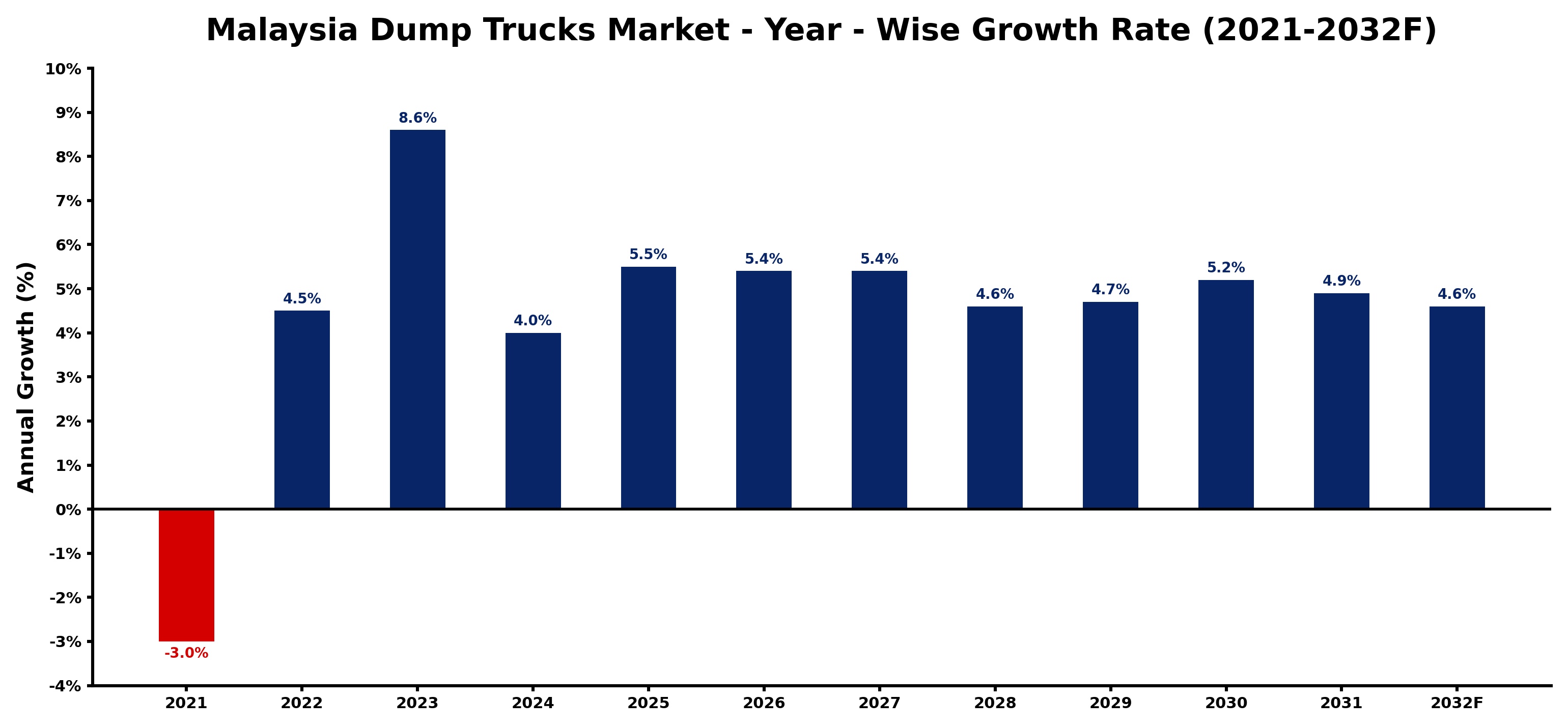
The table below presents the year‑wise growth rates along with the key drivers influencing the market
| Year | Growth Rate | Major Drivers |
| 2021 | -3.0% | Increasing smart city development projects |
| 2022 | 4.5% | Growing urbanization and commercial development |
| 2023 | 8.6% | Increasing adoption of advanced technologies |
| 2024 | 4.0% | Increasing adoption of advanced technologies |
| 2025 | 5.5% | Rapid growth in telecom and data center sectors |
| 2026 | 5.4% | Government infrastructure modernization initiatives |
| 2027 | 5.4% | Expansion of commercial construction activities |
| 2028 | 4.6% | Expansion of transportation and logistics networks |
| 2029 | 4.7% | Expansion of transportation and logistics networks |
| 2030 | 5.2% | Rising electricity demand across industries |
| 2031 | 4.9% | Rising electricity demand across industries |
| 2032 | 4.6% | Expansion of commercial construction activities |
Note - Market size estimations and growth projections presented in this report are based on 6Wresearch's advanced forecasting approach, validated with industry datasets as of June 2026.
Malaysia Dump Trucks Market Synopsis
In 2015, the Malaysia dump trucks market was estimated at USD 277 million, with approximately 2,700 units sold that year. As the infrastructure and construction landscape matures, the need for reliable and heavy-duty dump trucks to transport various materials has surged, making them indispensable for projects ranging from urban development to mining operations.
The role of dump trucks is pivotal in facilitating efficient transportation of construction aggregates, minerals, and waste materials. The Malaysian government's commitment to boosting infrastructure spending, along with ongoing urban development initiatives, is poised to drive further demand, reflecting an optimistic outlook for manufacturers and suppliers in the sector.
Malaysia Dump Trucks Market Key Takeaways
- The market is projected to witness substantial growth, reaching USD 563 Million by 2032.
- Urbanization and government investments are primary growth drivers for the market.
- Demand is closely tied to the performance of the construction and mining sectors.
- Adoption of advanced technologies in dump truck manufacturing is on the rise.
- Regulatory support and stability in the economic landscape are crucial for sustained growth.
Evaluation of Restraints in Malaysia Dump Trucks Market
The Malaysia dump trucks market faces several challenges that may impede growth, notably fluctuations in economic conditions and delays in infrastructure projects. Economic downturns can lead to reduced investments in construction and mining, directly impacting the demand for dump trucks. Additionally, varying regulatory environments and logistical challenges can complicate the operational efficiency of market players. To navigate these hurdles, stakeholders must remain agile and responsive to changing market dynamics, continually adapting strategies to align with economic trends.
Malaysia Dump Trucks Market Trends
A noticeable trend in the Malaysia dump trucks market is the increasing integration of technology in vehicle design and functionality. Manufacturers are increasingly focusing on developing fuel-efficient engines, advanced safety features, and automation to enhance operator experience and operational efficiency. Furthermore, as environmental regulations become stricter, there is a shift towards eco-friendly alternatives and electric dump trucks, which may redefine market dynamics in the coming years.
Malaysia Dump Trucks Market Opportunities
There are significant opportunities for growth within the Malaysia dump trucks market, particularly in enhancing fleet capabilities and expanding into newer regions. With ongoing urbanization efforts and a push for sustainable infrastructure solutions, companies can invest in innovations that not only meet current demands but also anticipate future requirements. Collaborations with local governments on public projects can further unlock potential, allowing businesses to establish a strong foothold in the expanding market.
Government Initiatives in the Malaysia Dump Trucks Market
The Malaysian government has launched various initiatives aimed at enhancing the infrastructure landscape across the country. Public spending on construction projects, particularly in urban areas, is expected to rise, driving demand for dump trucks. Initiatives focusing on sustainability and green technology are also being prioritized, which may influence manufacturers to adapt to eco-friendly designs and emissions standards. Regulatory frameworks supporting infrastructure investments provide a stable foundation for growth, indicating a robust governmental backing for the sector.
Future Insights of the Malaysia Dump Trucks Market
As we look towards the future, from 2026 to 2032, the Malaysia dump trucks market is expected to evolve significantly. With anticipated advancements in technology and increasing government infrastructure investments, demand for more efficient and durable dump trucks will likely surge. Furthermore, as construction and mining activities regain momentum post-COVID-19, market players will need to prioritize innovation to stay competitive and align with changing consumer expectations.
Malaysia Dump Trucks Market Latest Developments (May 2025 - June 2026)
In recent months, the Malaysia dump trucks market has witnessed a shift towards enhanced vehicle safety and durability features, reflecting a broader industry trend towards improving operational efficiencies. Additionally, partnerships between manufacturers and local construction firms have emerged, aimed at addressing the rising demand for eco-friendly dump trucks. The focus remains on streamlining supply chains to manage costs effectively, while logistical challenges are being addressed to ensure timely delivery of vehicles across various regions.
Malaysia Dump Trucks Market - Key Attractiveness of the Report
- 10 Years of Market Numbers
- Historical Data Starting from 2022 to 2025
- Base Year: 2025
- Forecast Data until 2032
- Key Performance Indicators Impacting the Market
- Major Upcoming Developments and Projects
Key Highlights of the Report:
- Malaysia Dump Trucks Market Outlook
- Market Size of Malaysia Dump Trucks Market, 2025
- Forecast of Malaysia Dump Trucks Market, 2032
- Historical Data and Forecast of Malaysia Dump Trucks Revenues & Volume for the Period 2022-2032F
- Malaysia Dump Trucks Market Trend Evolution
- Malaysia Dump Trucks Market Drivers and Challenges
- Malaysia Dump Trucks Price Trends
- Malaysia Dump Trucks Porter's Five Forces
- Malaysia Dump Trucks Industry Life Cycle
- Historical Data and Forecast of Malaysia Dump Trucks Market Revenues & Volume By Type for the Period 2022-2032F
- Historical Data and Forecast of Malaysia Dump Trucks Market Revenues & Volume By Rear for the Period 2022-2032F
- Historical Data and Forecast of Malaysia Dump Trucks Market Revenues & Volume By Side for the Period 2022-2032F
- Historical Data and Forecast of Malaysia Dump Trucks Market Revenues & Volume By Roll- Off for the Period 2022-2032F
- Historical Data and Forecast of Malaysia Dump Trucks Market Revenues & Volume By On-Road Dump Truck for the Period 2022-2032F
- Historical Data and Forecast of Malaysia Dump Trucks Market Revenues & Volume By Off-Road Dump Truck for the Period 2022-2032F
- Historical Data and Forecast of Malaysia Dump Trucks Market Revenues & Volume By Engine Type for the Period 2022-2032F
- Historical Data and Forecast of Malaysia Dump Trucks Market Revenues & Volume By Internal Combustion Engine for the Period 2022-2032F
- Historical Data and Forecast of Malaysia Dump Trucks Market Revenues & Volume By Electric Engine for the Period 2022-2032F
- Historical Data and Forecast of Malaysia Dump Trucks Market Revenues & Volume By End-users for the Period 2022-2032F
- Historical Data and Forecast of Malaysia Dump Trucks Market Revenues & Volume By Construction for the Period 2022-2032F
- Historical Data and Forecast of Malaysia Dump Trucks Market Revenues & Volume By Mining for the Period 2022-2032F
- Historical Data and Forecast of Malaysia Dump Trucks Market Revenues & Volume By Infrastructure for the Period 2022-2032F
- Historical Data and Forecast of Malaysia Dump Trucks Market Revenues & Volume By Military for the Period 2022-2032F
- Historical Data and Forecast of Malaysia Dump Trucks Market Revenues & Volume By Agriculture for the Period 2022-2032F
- Historical Data and Forecast of Malaysia Dump Trucks Market Revenues & Volume By Others for the Period 2022-2032F
- Historical Data and Forecast of Malaysia Dump Trucks Market Revenues & Volume By Engine Capacity for the Period 2022-2032F
- Historical Data and Forecast of Malaysia Dump Trucks Market Revenues & Volume By 5L for the Period 2022-2032F
- Historical Data and Forecast of Malaysia Dump Trucks Market Revenues & Volume By 5L to 10L for the Period 2022-2032F
- Historical Data and Forecast of Malaysia Dump Trucks Market Revenues & Volume By More Than 10L for the Period 2022-2032F
- Historical Data and Forecast of Malaysia Dump Trucks Market Revenues & Volume By Application for the Period 2022-2032F
- Historical Data and Forecast of Malaysia Dump Trucks Market Revenues & Volume By Building Construction for the Period 2022-2032F
- Historical Data and Forecast of Malaysia Dump Trucks Market Revenues & Volume By Mining Industry for the Period 2022-2032F
- Malaysia Dump Trucks Import Export Trade Statistics
- Market Opportunity Assessment By Type
- Market Opportunity Assessment By Engine Type
- Market Opportunity Assessment By End-users
- Market Opportunity Assessment By Engine Capacity
- Market Opportunity Assessment By Application
- Malaysia Dump Trucks Top Companies Market Share
- Malaysia Dump Trucks Competitive Benchmarking By Technical and Operational Parameters
- Malaysia Dump Trucks Company Profiles
- Malaysia Dump Trucks Key Strategic Recommendations






































