Malaysia Forklift battery Market Size, Share & Growth Rate
The Malaysia Forklift battery Market was estimated at USD 998 Million in 2025 and is projected to reach USD 1475 Million by 2032, growing at a CAGR of 5.7% from 2026 to 2032. This substantial growth is propelled by the expansion of sectors such as manufacturing, logistics, and food processing. The increasing reliance on forklift operations for efficient material handling signifies a robust demand for advanced battery solutions that offer enhanced efficiency and reduced operational costs.
Malaysia Forklift battery Market Growth Rate Analysis (2021-2032)
The forklift battery market in Malaysia is poised for notable growth, recovering from a downturn of -2.0% in 2021. The sector rebounded strongly with a 5.3% increase in 2022, driven by rising consumer demand as industries ramped up operations post-pandemic. This momentum accelerated in 2023, with growth reaching 10.3%, fueled by significant investments in technology and infrastructure aimed at enhancing supply chain efficiencies. The market is projected to maintain a robust expansion rate, averaging around 7-8% through 2032, as companies increasingly adopt electric forklifts, aligning with the global energy transition and sustainability trends. Supportive government policies further bolster this upward trajectory, ensuring a vibrant future for the industry.
Malaysia Forklift battery Market Year-wise Growth Rate and Key Drivers
This graph highlights how the Malaysia Forklift battery Market has steadily grown over the past five years, supported by major growth factors.
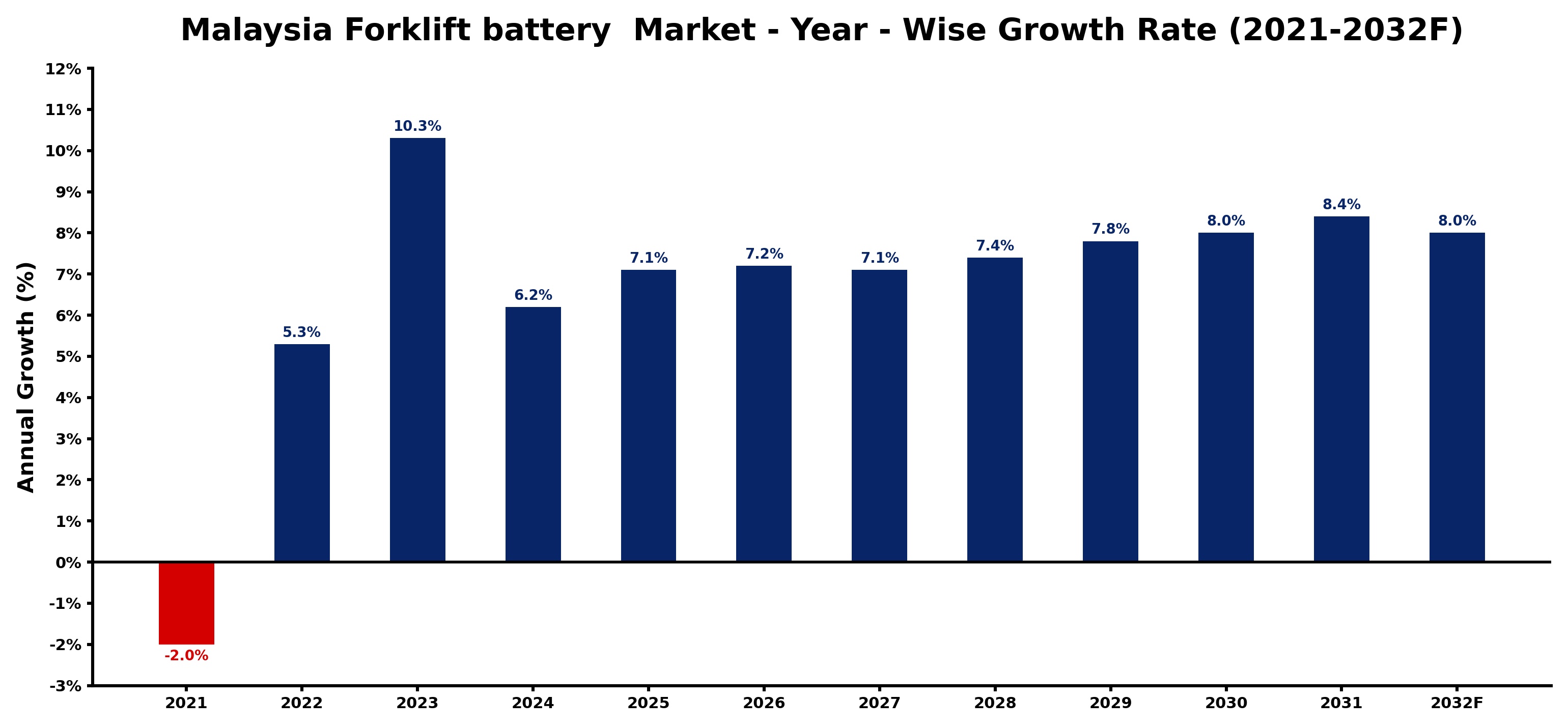
The table below presents the year‑wise growth rates along with the key drivers influencing the market
| Year | Growth Rate | Major Drivers |
| 2021 | -2.0% | Supply chain disruptions limited availability |
| 2022 | 5.3% | Increased logistics demand drove growth |
| 2023 | 10.3% | E-commerce adoption enhanced sales |
| 2024 | 6.2% | Manufacturing sector expansion increased demand |
| 2025 | 7.1% | Sustainability initiatives gained traction |
| 2026 | 7.2% | Technological advancements improved efficiency |
| 2027 | 7.1% | Infrastructure development supported growth |
| 2028 | 7.4% | Rising industrial automation boosted usage |
| 2029 | 7.8% | Government incentives encouraged investments |
| 2030 | 8.0% | Electric forklift popularity increased rapidly |
| 2031 | 8.4% | Battery technology innovations enhanced performance |
| 2032 | 8.0% | Market diversification attracted new players |
Note - Market size estimations and growth projections presented in this report are based on 6Wresearch’s advanced forecasting approach, validated with industry datasets as of June 2026.
Malaysia Forklift battery Market Synopsis
In Malaysia, the rising industrial landscape is stimulating the demand for high-performance forklift batteries, essential for maintaining productivity across various sectors. As companies increasingly adopt battery-powered forklifts, the need for innovative battery technologies is becoming critical to support uninterrupted operations.
The forklift battery market is witnessing a significant shift, driven by technological advancements in battery chemistry and energy management. This is enhancing the performance characteristics of batteries, making them more appealing to businesses seeking both economic and environmental advantages.
Malaysia Forklift battery Market Key Takeaways
- The market is set for substantial growth fueled by industrial expansion and increased demand for efficient material handling solutions.
- Technological innovations in battery performance, including rapid charging capabilities, are driving market evolution.
- Environmental sustainability considerations are influencing companies to switch to electric forklifts powered by advanced batteries.
- Strategic partnerships and flexible financing options are vital for overcoming barriers to market entry.
- Ongoing recovery from the COVID-19 pandemic is revitalizing industrial activities, positively impacting market dynamics.
Evaluation of Restraints in Malaysia Forklift battery Market
Despite promising growth, the Malaysia Forklift battery market faces notable restraints. The initial investment required for electric forklifts and their associated battery systems remains a challenge for small and medium-sized enterprises. This high upfront cost can deter businesses from making the switch to more efficient, battery-powered solutions. Additionally, ensuring the availability of skilled technicians for maintenance and repair is critical for sustaining battery performance. Addressing these issues through comprehensive training and affordable financing options can foster broader adoption.
Malaysia Forklift battery Market Trends
The market is currently experiencing a trend towards sustainable practices, with businesses increasingly opting for green technologies. The integration of smart battery management systems is gaining traction, enhancing efficiency and extending battery life. Furthermore, with the rise of e-commerce, the demand for automated warehouse solutions is pushing forklift operators to invest in advanced battery technologies to meet rapid throughput demands.
Malaysia Forklift battery Market Opportunities
Significant growth opportunities lie in developing battery technologies that offer higher energy densities and longer lifespans. Additionally, the push towards smart warehousing presents a favorable environment for innovative solutions in battery management systems. Companies that can provide adaptable financing solutions and support services will find themselves well-positioned to capitalize on this evolving landscape.
Government Initiatives in the Malaysia Forklift battery Market
The Malaysian government is actively promoting the adoption of electric vehicles, including forklifts, as part of its commitment to reducing carbon emissions. Various initiatives are in place, such as subsidies for electric vehicle purchases and investments in infrastructure to support electric mobility. These policies are aimed at bolstering the local forklift battery market while fostering a sustainable industrial environment.
Future Insights of the Malaysia Forklift battery Market
Looking ahead to 2026-2032, the Malaysia Forklift battery market is poised for robust growth. As industrial activities continue to escalate, the demand for efficient and reliable battery solutions will only increase. Ongoing advancements in battery technology, particularly in terms of energy efficiency and lifespan, will drive further adoption. The focus on sustainable practices will continue to reshape market dynamics, presenting both challenges and opportunities for stakeholders.
Malaysia Forklift battery Market Latest Developments (May 2025 - June 2026)
Recent developments indicate a strong movement towards electrification in the forklift sector, with manufacturers exploring innovative battery technologies to enhance performance. Partnerships between battery producers and logistics companies are emerging, aimed at creating tailored solutions for specific operational needs. Additionally, an emphasis on sustainability is prompting companies to explore eco-friendly materials in battery production.
Malaysia Forklift battery Market - Key Attractiveness of the Report
- 10 Years of Market Numbers
- Historical Data Starting from 2022 to 2025
- Base Year: 2025
- Forecast Data until 2032
- Key Performance Indicators Impacting the Market
- Major Upcoming Developments and Projects
Key Highlights of the Report:
- Malaysia Forklift battery Market Outlook
- Market Size of Malaysia Forklift battery Market, 2025
- Forecast of Malaysia Forklift battery Market, 2032F
- Historical Data and Forecast of Malaysia Forklift battery Revenues & Volume for the Period 2022-2032F
- Malaysia Forklift battery Market Trend Evolution
- Malaysia Forklift battery Market Drivers and Challenges
- Malaysia Forklift battery Price Trends
- Malaysia Forklift battery Porter's Five Forces
- Malaysia Forklift battery Industry Life Cycle
- Historical Data and Forecast of Malaysia Forklift battery Market Revenues & Volume By Application for the Period 2022-2032F
- Historical Data and Forecast of Malaysia Forklift battery Market Revenues & Volume By Warehouses for the Period 2022-2032F
- Historical Data and Forecast of Malaysia Forklift battery Market Revenues & Volume By Manufacturing for the Period 2022-2032F
- Historical Data and Forecast of Malaysia Forklift battery Market Revenues & Volume By Construction for the Period 2022-2032F
- Historical Data and Forecast of Malaysia Forklift battery Market Revenues & Volume By Retail and Wholesale Stores for the Period 2022-2032F
- Historical Data and Forecast of Malaysia Forklift battery Market Revenues & Volume By Others for the Period 2022-2032F
- Historical Data and Forecast of Malaysia Forklift battery Market Revenues & Volume By Type for the Period 2022-2032F
- Historical Data and Forecast of Malaysia Forklift battery Market Revenues & Volume By Lithium Ion (LI-ion) for the Period 2022-2032F
- Historical Data and Forecast of Malaysia Forklift battery Market Revenues & Volume By Lead Acid Battery for the Period 2022-2032F
- Historical Data and Forecast of Malaysia Forklift battery Market Revenues & Volume By Others for the Period 2022-2032F
- Malaysia Forklift battery Import Export Trade Statistics
- Market Opportunity Assessment By Application
- Market Opportunity Assessment By Type
- Malaysia Forklift battery Top Companies Market Share
- Malaysia Forklift battery Competitive Benchmarking By Technical and Operational Parameters
- Malaysia Forklift battery Company Profiles
- Malaysia Forklift battery Key Strategic Recommendations






































