Malaysia Gum And Wood Chemicals Market Size, Share & Growth Rate
The Malaysia Gum And Wood Chemicals Market was estimated at USD 489 Million in 2025 and is projected to reach USD 633 Million by 2032, growing at a CAGR of 3.8% from 2026 to 2032. This growth trajectory is largely driven by the increasing global demand for sustainable wood products, as well as a rising emphasis on eco-friendly chemicals in manufacturing processes. The shift towards sustainable forestry practices further enhances market potential, making this sector a vital component of Malaysia's economic landscape.
Malaysia Gum And Wood Chemicals Market Year-wise Growth Rate and Key Drivers
This graph highlights how the Malaysia Gum And Wood Chemicals Market has steadily grown over the years, supported by major growth factors.
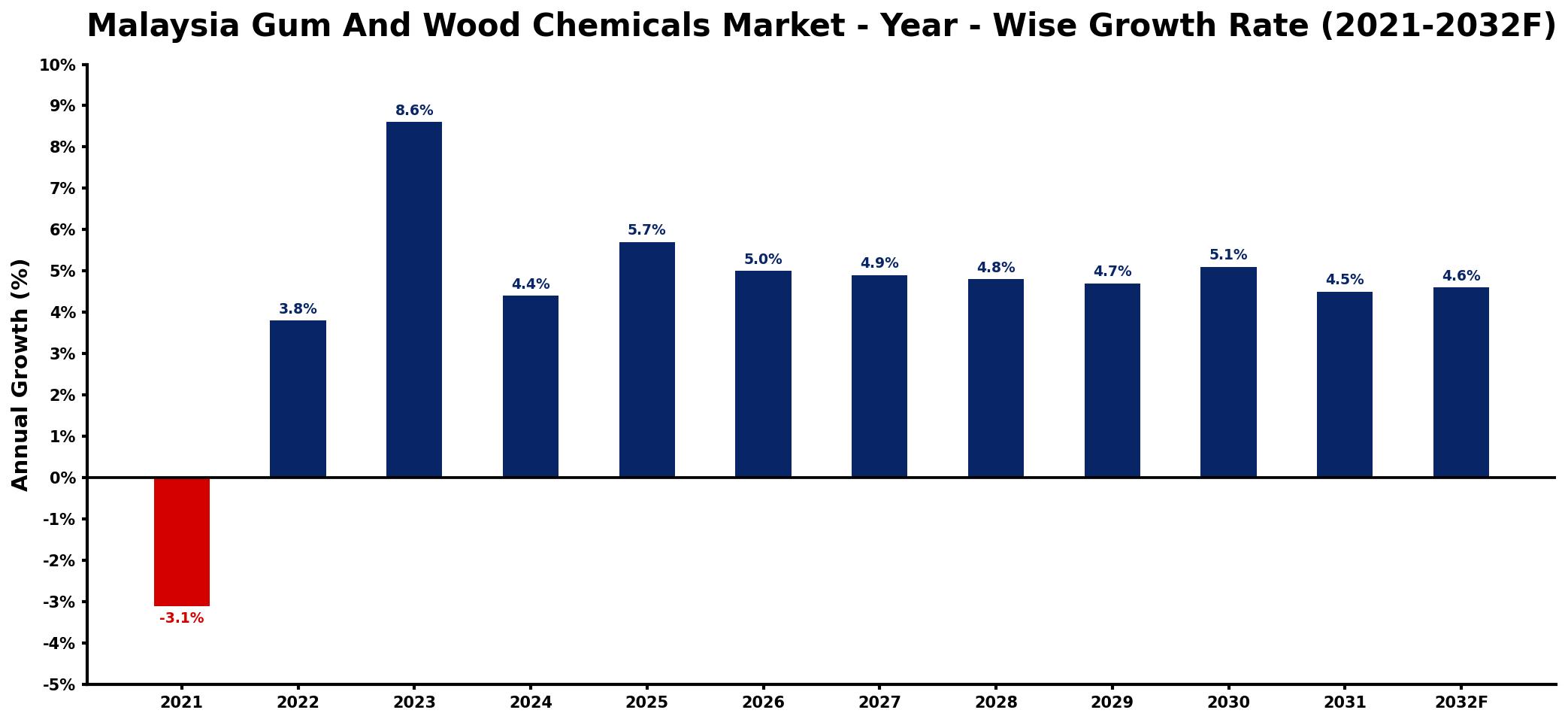
The table below presents the year‑wise growth rates along with the key drivers influencing the market
| Year | Growth Rate | Major Drivers |
| 2021 | -3.1% | decreased industrial production activities |
| 2022 | 3.8% | increased construction sector investments |
| 2023 | 8.6% | growing demand for eco-friendly products |
| 2024 | 4.4% | expansion of export markets |
| 2025 | 5.7% | rising consumer preferences for sustainability |
| 2026 | 5.0% | enhanced technological advancements adoption |
| 2027 | 4.9% | growing residential renovation projects |
| 2028 | 4.8% | increased government infrastructure spending |
| 2029 | 4.7% | rising awareness of environmental regulations |
| 2030 | 5.1% | growing downstream application demand |
| 2031 | 4.5% | increased research and development funding |
| 2032 | 4.6% | growing automotive sector requirements |
Note: Market size estimations and growth projections presented in this report are based on 6Wresearch's proprietary forecasting methodology, utilizing the latest available industry data, government publications, and primary research inputs.
Malaysia Gum And Wood Chemicals Market Synopsis
The gum and wood chemicals market in Malaysia plays a pivotal role in the supply of adhesives, coatings, and other chemical applications. As industries focus more on sustainability, there is a marked increase in the demand for natural and eco-friendly alternatives derived from wood and gums. This shift presents significant growth opportunities for local manufacturers and suppliers aiming to meet evolving consumer preferences.
Moreover, the interdependence between the gum and wood chemicals market and the forestry industry highlights the critical importance of sustainable practices. The market's expansion hinges on ensuring responsible sourcing and compliance with environmental regulations, setting the stage for future growth and innovation in this sector.
Malaysia Gum And Wood Chemicals Market Key Takeaways
- The market is projected to grow from USD 489 Million in 2025 to USD 633 Million by 2032.
- Increasing demand for eco-friendly wood products is driving market expansion.
- Sustainable forestry practices are essential for the market's long-term viability.
- The food and pharmaceutical industries present significant application opportunities for gum and wood extracts.
- The industry is experiencing shifts in demand dynamics due to global market fluctuations.
Evaluation of Restraints in Malaysia Gum And Wood Chemicals Market
The Malaysia gum and wood chemicals market encounters several restraints, particularly concerning sustainability and resource management. Unsustainable harvesting practices pose a serious threat, risking depletion of natural resources and damaging ecosystems. Such practices often lead to stringent regulatory challenges, which can stifle growth. Additionally, market volatility stemming from fluctuating demand for chemical products derived from wood and gum can create instability, requiring companies to adopt more diversified product lines to remain competitive and resilient.
Malaysia Gum And Wood Chemicals Market Trends
Current trends in the Malaysia gum and wood chemicals market are steering towards the integration of advanced technologies in production processes. This includes the adoption of biodegradable materials and chemical innovations that enhance the performance of wood products. Furthermore, the industry's responsiveness to consumer demands for transparency and sustainability is reshaping product offerings, allowing for growth in niche markets that prioritize eco-friendliness.
Malaysia Gum And Wood Chemicals Market Opportunities
The market presents various growth opportunities, particularly in the realm of product diversification. Companies can invest in developing new wood treatments that comply with sustainability criteria while enhancing performance. Additionally, tapping into the burgeoning health and wellness sector through the use of natural gums in pharmaceutical and food applications offers significant potential. Collaborative efforts with local forestry initiatives can also foster responsible sourcing practices, enhancing both market reputation and product value.
Government Initiatives in the Malaysia Gum And Wood Chemicals Market
The Malaysian government has been proactive in promoting sustainable forestry practices through various policies and incentives aimed at environmental conservation. Initiatives such as the National Forestry Policy encourage responsible management of forest resources and support research into sustainable harvesting methods. Furthermore, public spending on infrastructure and development projects within the timber and chemical sectors underscores the government's commitment to fostering a sustainable and competitive market landscape.
Future Insights of the Malaysia Gum And Wood Chemicals Market
Looking ahead, the Malaysia gum and wood chemicals market is poised for sustained growth through 2026-2032. The increasing focus on sustainability is expected to reshape consumer preferences, thereby driving demand for eco-friendly products. Technological advancements and a commitment to responsible sourcing will be crucial in navigating challenges related to resource management and regulatory compliance. By aligning with these trends, the market can ensure a prosperous future and continued relevance in the global landscape.
Malaysia Gum And Wood Chemicals Market Latest Developments (2025 - 2026)
Recent developments in the Malaysia gum and wood chemicals market indicate a shift towards more sustainable production practices, with several companies reporting initiatives aimed at reducing carbon footprints. Additionally, collaborations between industry stakeholders and research institutions have been on the rise, focusing on innovative product development. Moreover, the post-pandemic recovery phase has prompted a renewed interest in the wood chemicals sector, as demand stabilizes and logistical challenges are addressed.
Malaysia Gum And Wood Chemicals Market - Key Attractiveness of the Report
- 10 Years of Market Numbers
- Historical Data Starting from 2022 to 2025
- Base Year: 2025
- Forecast Data until 2032
- Key Performance Indicators Impacting the Market
- Major Upcoming Developments and Projects
Key Highlights of the Report:
- Malaysia Gum And Wood Chemicals Market Outlook
- Market Size of Malaysia Gum And Wood Chemicals Market, 2025
- Forecast of Malaysia Gum And Wood Chemicals Market, 2032
- Historical Data and Forecast of Malaysia Gum And Wood Chemicals Revenues & Volume for the Period 2022-2032F
- Malaysia Gum And Wood Chemicals Market Trend Evolution
- Malaysia Gum And Wood Chemicals Market Drivers and Challenges
- Malaysia Gum And Wood Chemicals Price Trends
- Malaysia Gum And Wood Chemicals Porter's Five Forces
- Malaysia Gum And Wood Chemicals Industry Life Cycle
- Historical Data and Forecast of Malaysia Gum And Wood Chemicals Market Revenues & Volume By Product Type for the Period 2022-2032F
- Historical Data and Forecast of Malaysia Gum And Wood Chemicals Market Revenues & Volume By Gum Arabic for the Period 2022-2032F
- Historical Data and Forecast of Malaysia Gum And Wood Chemicals Market Revenues & Volume By Guar Gum for the Period 2022-2032F
- Historical Data and Forecast of Malaysia Gum And Wood Chemicals Market Revenues & Volume By Wood Chemicals for the Period 2022-2032F
- Historical Data and Forecast of Malaysia Gum And Wood Chemicals Market Revenues & Volume By Charcoal for the Period 2022-2032F
- Historical Data and Forecast of Malaysia Gum And Wood Chemicals Market Revenues & Volume By Tannic Acid for the Period 2022-2032F
- Historical Data and Forecast of Malaysia Gum And Wood Chemicals Market Revenues & Volume By End-User for the Period 2022-2032F
- Historical Data and Forecast of Malaysia Gum And Wood Chemicals Market Revenues & Volume By Commercial for the Period 2022-2032F
- Historical Data and Forecast of Malaysia Gum And Wood Chemicals Market Revenues & Volume By Industrial for the Period 2022-2032F
- Historical Data and Forecast of Malaysia Gum And Wood Chemicals Market Revenues & Volume By Household for the Period 2022-2032F
- Historical Data and Forecast of Malaysia Gum And Wood Chemicals Market Revenues & Volume By Sales Channel for the Period 2022-2032F
- Historical Data and Forecast of Malaysia Gum And Wood Chemicals Market Revenues & Volume By Direct Sales for the Period 2022-2032F
- Historical Data and Forecast of Malaysia Gum And Wood Chemicals Market Revenues & Volume By Distributor for the Period 2022-2032F
- Malaysia Gum And Wood Chemicals Import Export Trade Statistics
- Market Opportunity Assessment By Product Type
- Market Opportunity Assessment By End-User
- Market Opportunity Assessment By Sales Channel
- Malaysia Gum And Wood Chemicals Top Companies Market Share
- Malaysia Gum And Wood Chemicals Competitive Benchmarking By Technical and Operational Parameters
- Malaysia Gum And Wood Chemicals Company Profiles
- Malaysia Gum And Wood Chemicals Key Strategic Recommendations






































