Malaysia Hand Carts & Trolleys Market Summary
The malaysia hand carts & trolleys market was estimated at USD 181 Million in 2025 and is projected to reach USD 236 Million by 2032, growing at a CAGR of 5.2% from 2026 to 2032.
Malaysia Hand Carts & Trolleys Market Year-wise Growth Rate and Key Drivers
This graph highlights how the Malaysia Hand Carts & Trolleys Market has steadily grown over the past five years, supported by major growth factors.
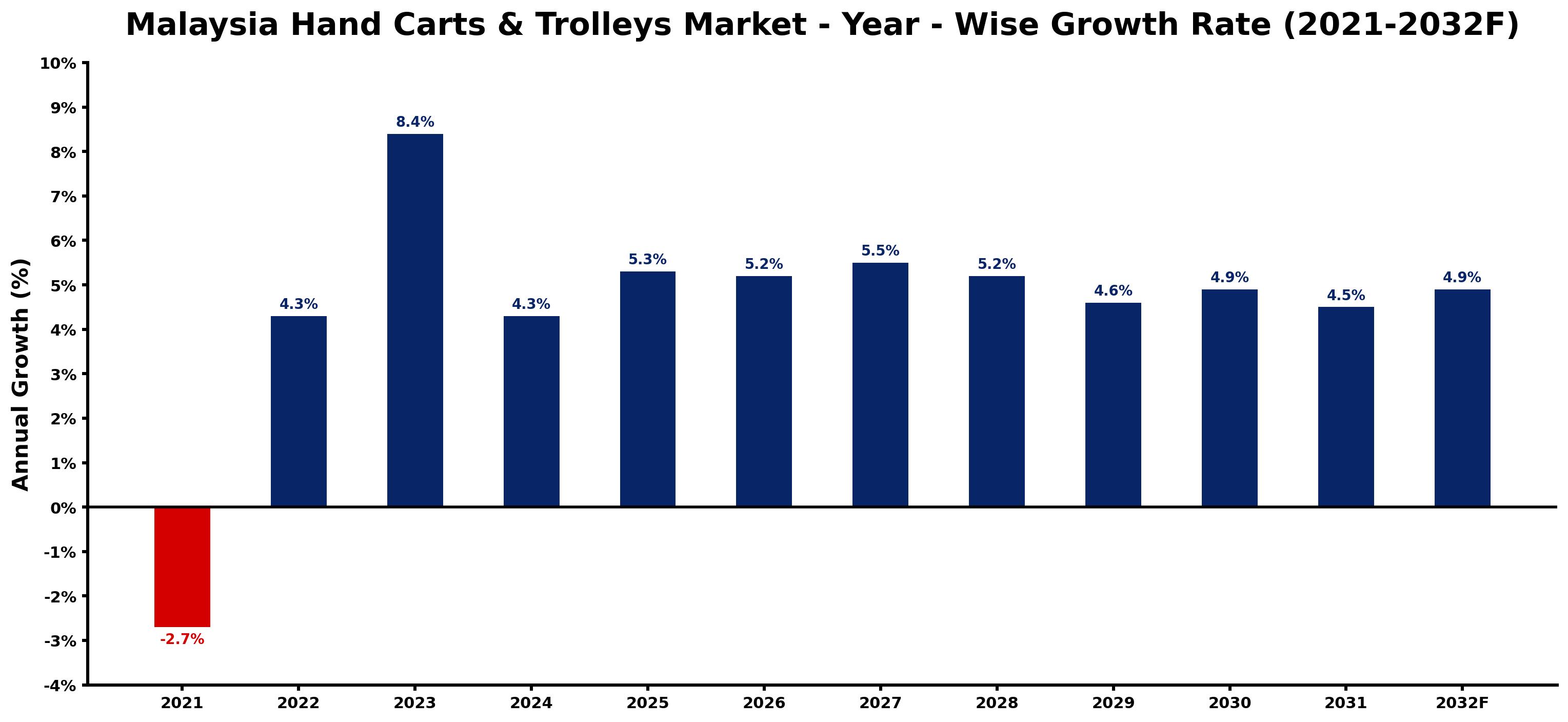
The table below presents the year wise growth rates along with the key drivers influencing the market
| Year | Growth Rate | Major Drivers |
| 2021 | -2.7% | Decreased tourism and local events sharply reduced demand for hand carts and trolleys in 2021. |
| 2022 | 4.3% | Urbanization trends prompted demand for versatile hand carts in bustling cities. |
| 2023 | 8.4% | E-commerce expansion led to increased use of trolleys for delivery services. |
| 2024 | 4.3% | Small businesses focused on cost-effective logistics turned to hand carts for efficiency. |
| 2025 | 5.3% | The hospitality sector adopted customized trolleys to enhance guest experiences. |
| 2026 | 5.2% | Sustainability initiatives encouraged the adoption of eco-friendly materials in cart designs. |
| 2027 | 5.5% | Increased street food vending spurred demand for specialized hand carts and trolleys. |
| 2028 | 5.2% | Emerging logistics startups introduced innovative trolley designs tailored for urban environments. |
| 2029 | 4.6% | Tourism recovery highlighted the need for portable transport solutions in high-traffic areas. |
| 2030 | 4.9% | Local manufacturing capabilities started reducing reliance on imports for hand carts. |
| 2031 | 4.5% | The construction industry required heavy-duty trolleys for managing materials effectively. |
| 2032 | 4.9% | Technological integrations in carts improved efficiency, attracting more diverse industry users. |
Note - Market size estimations and growth projections presented in this report are based on 6Wresearch's advanced forecasting approach, validated with industry datasets as of June 2026.
Malaysia Hand Carts & Trolleys Market Synopsis
The Malaysia Hand Carts Trolleys Market is projected to reach 5.2% and witness significant growth during the forecast period (2026-2032). This growth is primarily driven by several key factors, including the increasing demand for convenience products, the expansion of the e-commerce sector, and favorable government policies that support market development. Rising disposable incomes among consumers further contribute to the growing consumption of hand carts and trolleys across the country. Additionally, rapid urbanization and the proliferation of shopping malls in urban areas are poised to enhance market dynamics in the coming years.
Malaysia Hand Carts & Trolleys Market Growth Drivers
The growth of the Malaysia Hand Carts & Trolleys Market is underpinned by several driving forces:
- The increasing demand for convenience products is a significant motivator, as consumers seek efficient solutions for transporting goods in various settings, from grocery stores to warehouses.
- The expanding e-commerce sector has resulted in a heightened need for reliable transportation solutions for goods, leading to an increased adoption of hand carts and trolleys by businesses.
- Government initiatives, such as tax holidays and infrastructure investments, are fostering a conducive environment for market growth, encouraging both domestic production and foreign investment.
- Urbanization is contributing to the increasing number of shopping malls and commercial spaces, which subsequently drives the demand for these transportation solutions in urban areas.
- The availability of online shopping platforms that offer discounts and cashbacks is expanding the consumer base, making it easier for potential buyers to access hand carts and trolleys.
Malaysia Hand Carts & Trolleys Market Government Investment and Initiatives
The Malaysian government has implemented several initiatives aimed at bolstering the Hand Carts & Trolleys Market. These initiatives include investment in infrastructure development, which enhances logistics and distribution channels essential for the effective movement of goods. Tax incentives have been introduced to encourage businesses to innovate and produce quality products that meet consumer needs. Additionally, the government's focus on establishing international trade agreements is expected to improve the export potential of hand carts and trolleys, further stimulating market growth. The enhancement of public transportation and urban infrastructure aligns with the growing demand in urban centers, thus providing an enabling environment for the market.
Malaysia Hand Carts & Trolleys Market Trends and Opportunities
The Malaysia Hand Carts & Trolleys Market is witnessing evolving trends that present opportunities for growth:
- There is a growing trend towards eco-friendly and sustainable products, with consumers increasingly preferring hand carts and trolleys made from recyclable materials.
- Innovation in design and functionality is becoming a focal point, as manufacturers strive to meet the diverse needs of consumers, such as foldable trolleys and lightweight hand carts.
- The rise of urban farming and local markets is fueling demand for versatile transportation solutions for agricultural products, further enhancing market potential.
- Technological advancements, such as the integration of smart features in hand carts and trolleys, are likely to attract tech-savvy consumers and differentiate products in the market.
- The growing focus on health and fitness is leading to increased interest in hand carts designed for recreational and physical activities, expanding the market's applications beyond traditional use.
Malaysia Hand Carts & Trolleys Market Latest Developments (May 2025 - June 2026)
Recent developments in the Malaysia Hand Carts & Trolleys Market from May 2025 to June 2026 highlight an upward trajectory in both innovation and adoption. During this period, there has been a notable increase in the introduction of lightweight and ergonomic designs aimed at enhancing user comfort and efficiency. Many manufacturers have started focusing on eco-friendly materials to align with consumer preferences for sustainability. Furthermore, the growth of online retail platforms has accelerated, providing consumers with greater access to a wide array of choices and competitive pricing. The market is also witnessing collaborations among manufacturers to promote unique designs and improved functionality. In parallel, consumer awareness campaigns about the benefits of using hand carts and trolleys for both business and personal use have gained momentum, further encouraging adoption.
Malaysia Hand Carts & Trolleys Market - Key Attractiveness of the Report
- 10 Years of Market Numbers
- Historical Data Starting from 2022 to 2025
- Base Year: 2025
- Forecast Data until 2032
- Key Performance Indicators Impacting the Market
- Major Upcoming Developments and Projects
Key Highlights of the Report:
- Malaysia Hand Carts & Trolleys Market Outlook
- Market Size of Malaysia Hand Carts & Trolleys Market, 2025
- Forecast of Malaysia Hand Carts & Trolleys Market, 2032F
- Historical Data and Forecast of Malaysia Hand Carts & Trolleys Revenues & Volume for the Period 2022-2032F
- Malaysia Hand Carts & Trolleys Market Trend Evolution
- Malaysia Hand Carts & Trolleys Market Drivers and Challenges
- Malaysia Hand Carts & Trolleys Price Trends
- Malaysia Hand Carts & Trolleys Porter's Five Forces
- Malaysia Hand Carts & Trolleys Industry Life Cycle
- Historical Data and Forecast of Malaysia Hand Carts & Trolleys Market Revenues & Volume By Types for the Period 2022-2032F
- Historical Data and Forecast of Malaysia Hand Carts & Trolleys Market Revenues & Volume By Steel Hand Truck for the Period 2022-2032F
- Historical Data and Forecast of Malaysia Hand Carts & Trolleys Market Revenues & Volume By Aluminium Hand Truck for the Period 2022-2032F
- Historical Data and Forecast of Malaysia Hand Carts & Trolleys Market Revenues & Volume By Applications for the Period 2022-2032F
- Historical Data and Forecast of Malaysia Hand Carts & Trolleys Market Revenues & Volume By Online Sales for the Period 2022-2032F
- Historical Data and Forecast of Malaysia Hand Carts & Trolleys Market Revenues & Volume By Offline Sales for the Period 2022-2032F
- Malaysia Hand Carts & Trolleys Import Export Trade Statistics
- Market Opportunity Assessment By Types
- Market Opportunity Assessment By Applications
- Malaysia Hand Carts & Trolleys Top Companies Market Share
- Malaysia Hand Carts & Trolleys Competitive Benchmarking By Technical and Operational Parameters
- Malaysia Hand Carts & Trolleys Company Profiles
- Malaysia Hand Carts & Trolleys Key Strategic Recommendations






































