Malaysia Ingots Market Summary
The malaysia ingots market was estimated at USD 311 Million in 2025 and is projected to reach USD 406 Million by 2032, growing at a CAGR of 5.8% from 2026 to 2032.
Malaysia Ingots Market Year-wise Growth Rate and Key Drivers
This graph highlights how the Malaysia Ingots Market has steadily grown over the past five years, supported by major growth factors.
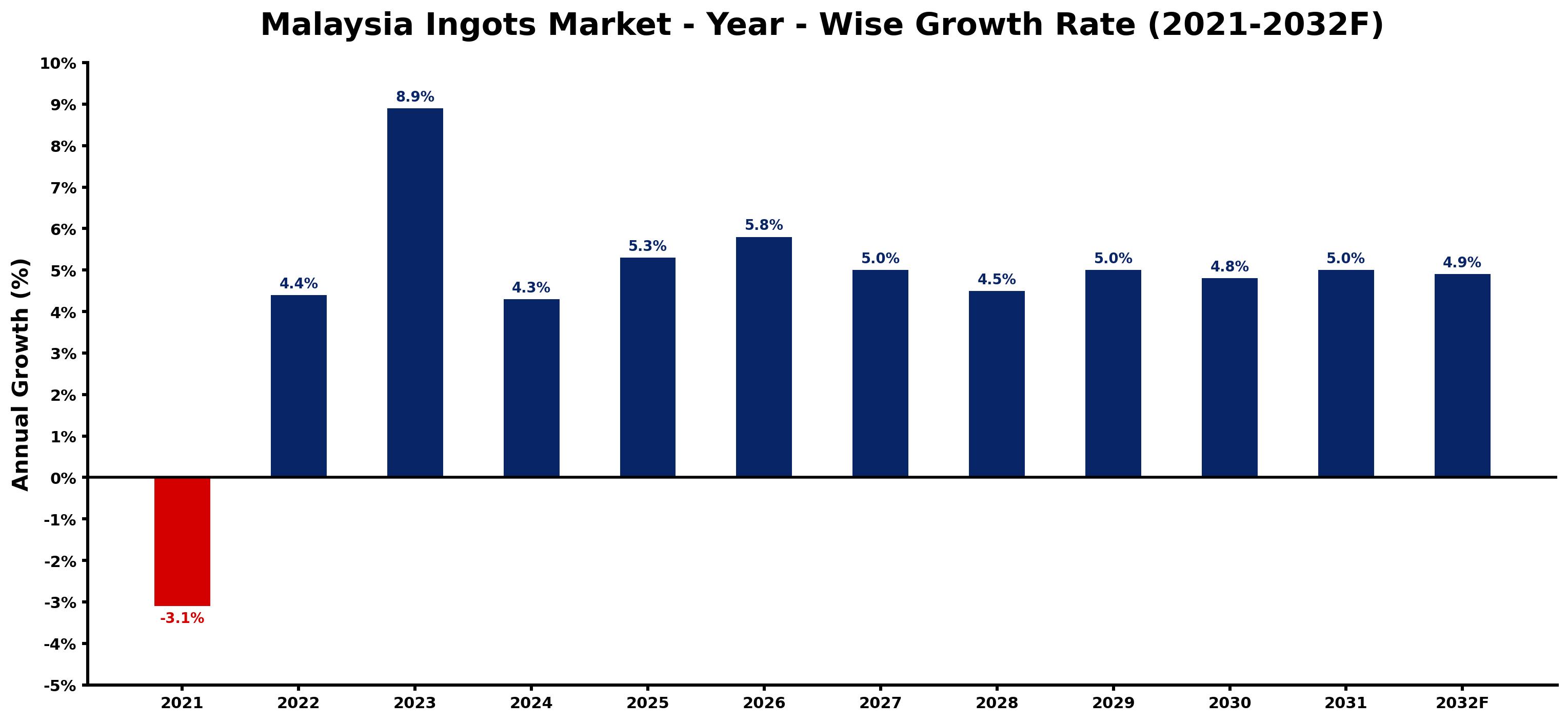
The table below presents the year wise growth rates along with the key drivers influencing the market
| Year | Growth Rate | Major Drivers |
| 2021 | -3.1% | Decreased global demand for aluminum led to surplus inventory and lowered prices in the ingots market. |
| 2022 | 4.4% | Local manufacturers expanded production capabilities to meet increasing domestic consumption needs. |
| 2023 | 8.9% | Construction activities surged, driven by infrastructure projects and urban development initiatives. |
| 2024 | 4.3% | Environmental regulations prompted industries to seek sustainable metal sourcing and recycling options. |
| 2025 | 5.3% | Increased foreign investments in Malaysia's mining sector reinforced ingot production potential. |
| 2026 | 5.8% | Technological innovations in smelting processes improved efficiency and reduced production costs significantly. |
| 2027 | 5.0% | Growing automotive and electronics industries heightened the demand for high-quality aluminum ingots. |
| 2028 | 4.5% | Emerging markets in Southeast Asia began tapping into Malaysia's ingot exports for infrastructure. |
| 2029 | 5.0% | Collaborations between mining companies and tech firms enhanced market competitiveness and output quality. |
| 2030 | 4.8% | International trade agreements opened new markets, diversifying Malaysia's ingot export destinations. |
| 2031 | 5.0% | Sustainability trends led to a shift towards recycled aluminum, impacting traditional ingot demand. |
| 2032 | 4.9% | Supply chain resilience initiatives prompted local players to secure raw material sources effectively. |
Note - Market size estimations and growth projections presented in this report are based on 6Wresearch's advanced forecasting approach, validated with industry datasets as of June 2026.
Malaysia Ingots Market Synopsis
The Malaysia Ingots Market is projected to reach 5.8% and witness significant growth during the forecast period (2026-2032). This remarkable growth is anticipated to be propelled by increasing demand from the industrial and manufacturing sectors, coupled with a robust surge in construction activities across the nation. The Malaysian government has been proactive in enhancing the investment landscape for foreign and local investors, which plays a crucial role in the expansion of the ingots industry.
Malaysia Ingots Market Growth Drivers
Several factors are contributing to the growth of the Malaysia Ingots Market. Firstly, the ongoing industrialization and urbanization in Malaysia have led to a heightened demand for aluminium and other metal products in various sectors. Secondly, the construction boom, fueled by government initiatives in infrastructure development, is creating a steady demand for ingots. Thirdly, the automotive and aviation industries are also experiencing rapid growth, which subsequently increases the need for ingots as they require various metal alloys for manufacturing components.
- The expansion of manufacturing facilities in Malaysia is expected to drive up the local consumption of ingots, thereby pushing the market forward.
- Government policies, including tax incentives, have created a favorable environment for investment, further stimulating demand in the ingot sector.
- Technological advancements in metallurgy and production processes are enhancing the efficiency and quality of ingots, which can attract more buyers.
- The rising focus on sustainable construction practices and lightweight materials is boosting the demand for specific types of ingots that meet these criteria.
- Export opportunities, particularly in the Southeast Asian region, are likely to increase, as neighboring countries seek quality ingots to support their own industrial growth.
Malaysia Ingots Market Trends and Opportunities
The Malaysia Ingots Market is experiencing numerous trends that present substantial opportunities for growth. Notably, there is a growing inclination towards the use of recycled metals in ingot production, which aligns with global sustainability goals. The increasing focus on energy-efficient production methods is prompting manufacturers to adopt innovative technologies that reduce emissions while enhancing output.
- Adopting smart manufacturing practices using IoT and AI can improve operational efficiency, thereby lowering production costs in the ingots market.
- The shift towards electric vehicles is driving demand for specialized alloys, creating niche opportunities within the ingots market.
- Collaborations and partnerships among industry stakeholders are likely to foster innovation in product development, enabling diversified offerings.
- Educational initiatives aimed at promoting metal recycling could elevate the overall ingots market by increasing raw material availability.
- Enhancing supply chain dynamics through digital solutions can expedite the distribution processes, making ingots more accessible to manufacturers.
Malaysia Ingots Market Challenges and Restraints
Despite strong growth trajectories, the Malaysia Ingots Market faces several challenges that could impede its progress. Chief among these challenges is the fluctuating prices of raw materials, which can impact production costs and profit margins. Additionally, increasing competition from regional markets could pose threats to local manufacturers.
- Supply chain disruptions, particularly in the wake of global economic shifts, can lead to delays in production and delivery timelines.
- The stringent environmental regulations aimed at reducing emissions from the ingot manufacturing process may require significant investment, straining smaller companies.
- Resistance to adopting new technologies may hinder innovation, limiting the potential for manufacturers to stay competitive.
- Talent shortages in skilled metallurgy and engineering positions may create bottlenecks in production and development capabilities.
- Market volatility driven by economic uncertainties can affect investor confidence in the Malaysian ingots sector.
Malaysia Ingots Market Government Investment and Initiatives
The government of Malaysia plays a pivotal role in shaping the ingots market through various investment initiatives and policies that support growth and development. Several programs aim to enhance technological advancement within the manufacturing sphere, ensuring that production capabilities keep pace with global standards.
- The Malaysian government has implemented various financial incentives, such as tax breaks and grants, to encourage foreign direct investment in the manufacturing sector.
- Strategic development plans, including the Malaysia Vision 2020, focus on promoting industrial growth, which inherently supports the ingots market.
- Public spending on infrastructure projects has substantially increased, directly correlating with rising demand for ingots used in construction.
- Collaborations with educational institutions to foster a skilled workforce in metallurgy is a vital initiative aimed at addressing workforce challenges in the sector.
- Policies promoting sustainability and environmental protection are shaping the ingot production landscape, necessitating adaptations in manufacturing processes.
Malaysia Ingots Market Latest Developments (May 2025 - June 2026)
In recent months, the Malaysia Ingots Market has seen significant developments that reflect the evolving dynamics of the industry. The government has announced new investments in infrastructure, bolstering demand for ingots, particularly in construction and related sectors. Additionally, there has been a notable push towards adopting green technologies, with manufacturers exploring eco-friendly production methods to align with global sustainability trends.
- The sector has witnessed increasing collaborations between local firms and international technology providers, aimed at enhancing production efficiency and product quality.
- Growing demand from the automotive sector has led to innovations in alloy formulations, particularly for lightweight applications.
- Research initiatives focused on recycling metals have gained traction, aiming to improve raw material supply chains and reduce dependence on virgin materials.
- Market sentiment has been positive, with manufacturers optimistic about future growth owing to the favorable policy environment and investment influx.
- Emerging trends in electric mobility are influencing ingot specifications, with new demands arising for materials tailored for battery and electric vehicle components.
Malaysia Ingots Market - Key Attractiveness of the Report
- 10 Years of Market Numbers
- Historical Data Starting from 2022 to 2025
- Base Year: 2025
- Forecast Data until 2032
- Key Performance Indicators Impacting the Market
- Major Upcoming Developments and Projects
Key Highlights of the Report:
- Malaysia Ingots Market Outlook
- Market Size of Malaysia Ingots Market, 2025
- Forecast of Malaysia Ingots Market, 2032F
- Historical Data and Forecast of Malaysia Ingots Revenues & Volume for the Period 2022-2032F
- Malaysia Ingots Market Trend Evolution
- Malaysia Ingots Market Drivers and Challenges
- Malaysia Ingots Price Trends
- Malaysia Ingots Porter's Five Forces
- Malaysia Ingots Industry Life Cycle
- Historical Data and Forecast of Malaysia Ingots Market Revenues & Volume By Product Types for the Period 2022-2032F
- Historical Data and Forecast of Malaysia Ingots Market Revenues & Volume By Single Crystals for the Period 2022-2032F
- Historical Data and Forecast of Malaysia Ingots Market Revenues & Volume By Copper Alloys for the Period 2022-2032F
- Historical Data and Forecast of Malaysia Ingots Market Revenues & Volume By Material Types for the Period 2022-2032F
- Historical Data and Forecast of Malaysia Ingots Market Revenues & Volume By Aluminium for the Period 2022-2032F
- Historical Data and Forecast of Malaysia Ingots Market Revenues & Volume By Steel for the Period 2022-2032F
- Historical Data and Forecast of Malaysia Ingots Market Revenues & Volume By Gold for the Period 2022-2032F
- Historical Data and Forecast of Malaysia Ingots Market Revenues & Volume By Tin for the Period 2022-2032F
- Historical Data and Forecast of Malaysia Ingots Market Revenues & Volume By Others for the Period 2022-2032F
- Historical Data and Forecast of Malaysia Ingots Market Revenues & Volume By Applications for the Period 2022-2032F
- Historical Data and Forecast of Malaysia Ingots Market Revenues & Volume By Petroleum for the Period 2022-2032F
- Historical Data and Forecast of Malaysia Ingots Market Revenues & Volume By Oil & Gas for the Period 2022-2032F
- Historical Data and Forecast of Malaysia Ingots Market Revenues & Volume By Chemical for the Period 2022-2032F
- Historical Data and Forecast of Malaysia Ingots Market Revenues & Volume By Marine for the Period 2022-2032F
- Historical Data and Forecast of Malaysia Ingots Market Revenues & Volume By Others for the Period 2022-2032F
- Malaysia Ingots Import Export Trade Statistics
- Market Opportunity Assessment By Product Types
- Market Opportunity Assessment By Material Types
- Market Opportunity Assessment By Applications
- Malaysia Ingots Top Companies Market Share
- Malaysia Ingots Competitive Benchmarking By Technical and Operational Parameters
- Malaysia Ingots Company Profiles
- Malaysia Ingots Key Strategic Recommendations






































