Malaysia Mineral Oil Market Size, Share & Growth Rate
The Malaysia Mineral Oil Market was estimated at USD 156 Million in 2025 and is projected to reach USD 203 Million by 2032, growing at a CAGR of 3.8% from 2026 to 2032. This growth trajectory reflects a combination of increasing industrial activity and the heightened need for reliable lubricants and base oils across numerous sectors. Additionally, the automotive industry in Malaysia, in particular, has been a significant driver, as the demand for efficient and high-performance lubricants continues to rise.
Malaysia Mineral Oil Market Growth Rate Analysis (2021-2032)
The Malaysia mineral oil market has shown a notable recovery following a -3.0% contraction in 2021, attributed mainly to pandemic-related disruptions. As global demand revitalized, the market rebounded with a growth rate of 3.8% in 2022, driven by increased industrial activity and investments in infrastructure. In 2023, growth surged to 8.8%, spurred by heightened consumer demand and technological advancements in oil extraction and refining processes. This upward trend is expected to continue, with annual growth rates stabilizing around 4.2% to 5.8% through 2026, as the sector adapts to shifts in energy transition policies and embraces digitalization. This strategic evolution positions Malaysia favorably amidst rising competition.
Malaysia Mineral Oil Market Year-wise Growth Rate and Key Drivers
This graph highlights how the Malaysia Mineral Oil Market has steadily grown over the past five years, supported by major growth factors.
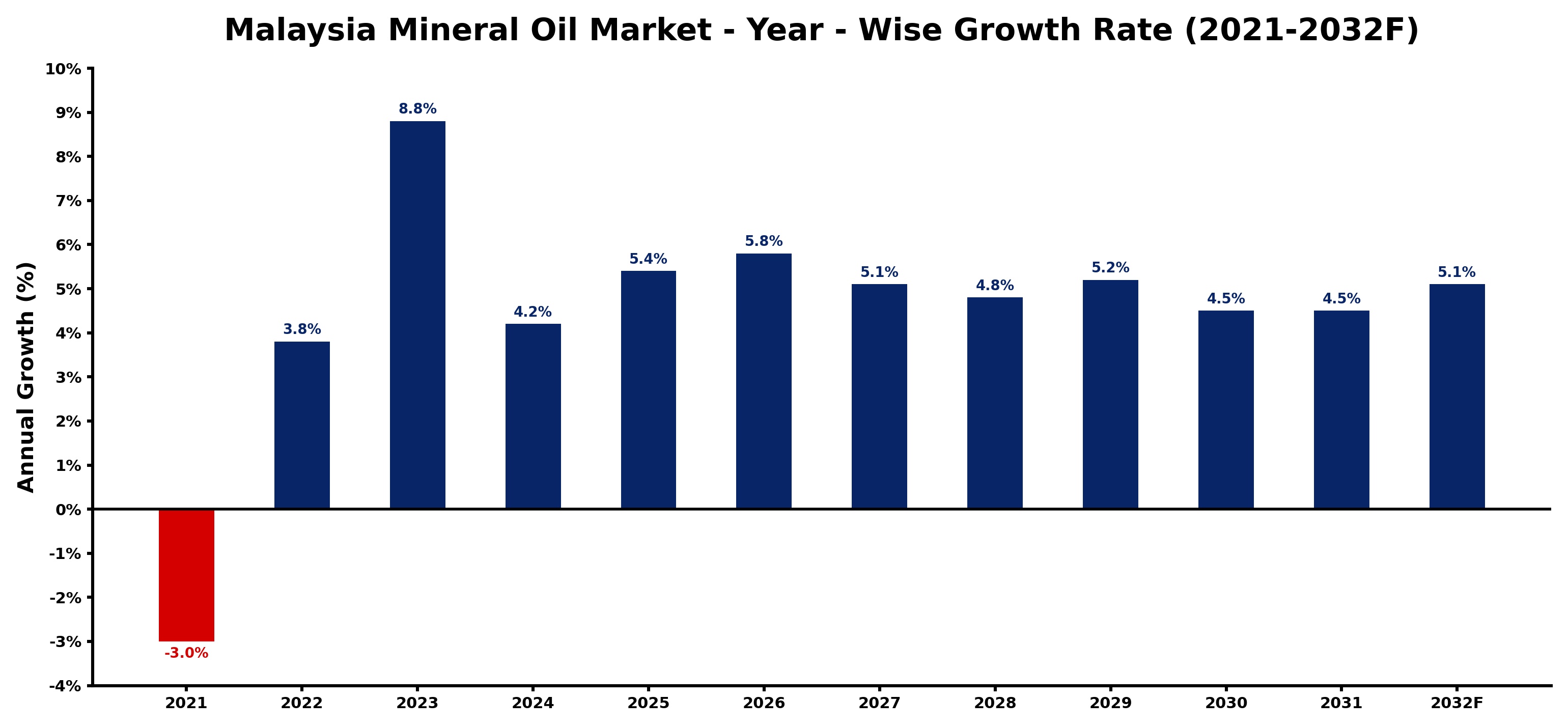
The table below presents the year‑wise growth rates along with the key drivers influencing the market
| Year | Growth Rate | Major Drivers |
| 2021 | -3.0% | Increasing smart city development projects |
| 2022 | 3.8% | Increasing smart city development projects |
| 2023 | 8.8% | Government infrastructure modernization initiatives |
| 2024 | 4.2% | Rapid growth in telecom and data center sectors |
| 2025 | 5.4% | Expansion of transportation and logistics networks |
| 2026 | 5.8% | Rising electricity demand across industries |
| 2027 | 5.1% | Growing renewable energy integration projects |
| 2028 | 4.8% | Growing urbanization and commercial development |
| 2029 | 5.2% | Rising electricity demand across industries |
| 2030 | 4.5% | Expansion of transportation and logistics networks |
| 2031 | 4.5% | Expansion of manufacturing activities |
| 2032 | 5.1% | Increasing industrial infrastructure investments |
Note - Market size estimations and growth projections presented in this report are based on 6Wresearch’s advanced forecasting approach, validated with industry datasets as of June 2026.
Malaysia Mineral Oil Market Synopsis
The Malaysian mineral oil market is characterized by its critical role in the country's industrial sectors, providing essential components for lubricants and hydraulic fluids. With the automotive and manufacturing industries experiencing robust growth, the demand for mineral oil as a base material is projected to rise, underpinned by the necessity of machinery maintenance and the operational efficiency of industrial equipment.
Furthermore, Malaysia's strategic geographical location has facilitated its growth as a hub for mineral oil processing and distribution in the Asia-Pacific region. This positioning not only enhances accessibility to key markets but also encourages investments in research and development to diversify mineral oil applications, ensuring a dynamic and responsive market environment.
Malaysia Mineral Oil Market Key Takeaways
- The Malaysia Mineral Oil Market is projected to grow significantly, driven by industrial expansion and increased lubricant demand.
- Technological advancements in mineral oil applications are helping industries to improve efficiency and reduce costs.
- The market is supported by a strong supply chain infrastructure, enhancing distribution and accessibility.
- Key sectors like automotive and manufacturing are expected to remain the primary consumers of mineral oil products.
- There is a growing emphasis on innovation and sustainability to meet evolving market demands and regulatory requirements.
Evaluation of Restraints in Malaysia Mineral Oil Market
The Malaysia mineral oil market grapples with significant restraints, primarily driven by the global shift towards sustainable energy sources. As industries increasingly adopt cleaner alternatives, the demand for conventional mineral oils may face limitations, particularly in transportation and energy sectors. This transition necessitates that market players innovate and pivot towards environmentally friendly solutions, potentially impacting traditional mineral oil production and consumption patterns. Additionally, fluctuating global oil prices and stringent regulatory frameworks pose challenges that companies must navigate to maintain market viability and competitive edge.
Malaysia Mineral Oil Market Trends
Emerging trends within the Malaysia mineral oil market include a growing focus on bio-based lubricants and the adoption of advanced refining technologies to enhance product quality. Additionally, there is an increasing consumer demand for high-performance lubricants, which are driving R&D investments in formulations that improve efficiency while reducing environmental impact. The integration of digital technologies in monitoring and optimizing oil usage also signals a shift toward more data-driven decision-making processes within the industry.
Malaysia Mineral Oil Market Opportunities
Significant opportunities exist in the Malaysia mineral oil market, particularly in the development of bio-lubricants and sustainable alternatives that align with global environmental initiatives. The expanding automotive sector presents a chance for market players to innovate and offer specialized products catering to high-performance requirements. Moreover, the increasing emphasis on equipment maintenance in manufacturing and industrial processes provides avenues for growth, especially in sectors seeking reliable and efficient lubricant solutions.
Government Initiatives in the Malaysia Mineral Oil Market
The Malaysian government actively promotes initiatives aimed at enhancing the country's energy security and sustainability. Programs focusing on research into cleaner energy technologies and incentives for the adoption of renewable resources are increasingly shaping the landscape of the mineral oil market. Furthermore, public spending in infrastructure development is likely to create additional demand for lubricants and mineral oils across various industries, thereby supporting market growth in alignment with national economic goals.
Future Insights of the Malaysia Mineral Oil Market
Looking ahead to 2026-2032, the Malaysia mineral oil market is poised for a transformation driven by innovation and evolving consumer expectations. The ongoing industrial expansion and the urgent need for efficient machinery are expected to sustain demand, while environmental concerns will push for the development of greener product lines. The market's adaptability will be crucial, as stakeholders navigate regulatory changes and shifting consumer preferences towards sustainability, thus positioning themselves for long-term success.
Malaysia Mineral Oil Market Latest Developments (May 2025 - June 2026)
Recent developments in the Malaysia mineral oil market indicate a shift towards the integration of smart technologies in oil management systems, reflecting a trend towards efficiency and sustainability. Companies are investing in innovations aimed at improving the environmental footprint of mineral oil products while also enhancing performance characteristics. Additionally, collaborations among industry stakeholders are increasing, focusing on the exploration of bio-lubricants and alternative formulations that meet contemporary market demands.
Malaysia Mineral Oil Market - Key Attractiveness of the Report
- 10 Years of Market Numbers
- Historical Data Starting from 2022 to 2025
- Base Year: 2025
- Forecast Data until 2032
- Key Performance Indicators Impacting the Market
- Major Upcoming Developments and Projects
Key Highlights of the Report:
- Malaysia Mineral Oil Market Outlook
- Market Size of Malaysia Mineral Oil Market, 2025
- Forecast of Malaysia Mineral Oil Market, 2032F
- Historical Data and Forecast of Malaysia Mineral Oil Revenues & Volume for the Period 2022-2032F
- Malaysia Mineral Oil Market Trend Evolution
- Malaysia Mineral Oil Market Drivers and Challenges
- Malaysia Mineral Oil Price Trends
- Malaysia Mineral Oil Porter's Five Forces
- Malaysia Mineral Oil Industry Life Cycle
- Historical Data and Forecast of Malaysia Mineral Oil Market Revenues & Volume By Grade for the Period 2022-2032F
- Historical Data and Forecast of Malaysia Mineral Oil Market Revenues & Volume By Technical Oil for the Period 2022-2032F
- Historical Data and Forecast of Malaysia Mineral Oil Market Revenues & Volume By White Oil for the Period 2022-2032F
- Historical Data and Forecast of Malaysia Mineral Oil Market Revenues & Volume By Application for the Period 2022-2032F
- Historical Data and Forecast of Malaysia Mineral Oil Market Revenues & Volume By Baby Oil for the Period 2022-2032F
- Historical Data and Forecast of Malaysia Mineral Oil Market Revenues & Volume By Cosmetics for the Period 2022-2032F
- Historical Data and Forecast of Malaysia Mineral Oil Market Revenues & Volume By Skin Care Products for the Period 2022-2032F
- Historical Data and Forecast of Malaysia Mineral Oil Market Revenues & Volume By Hair Care Products for the Period 2022-2032F
- Historical Data and Forecast of Malaysia Mineral Oil Market Revenues & Volume By Consumer Goods for the Period 2022-2032F
- Historical Data and Forecast of Malaysia Mineral Oil Market Revenues & Volume By Others for the Period 2022-2032F
- Malaysia Mineral Oil Import Export Trade Statistics
- Market Opportunity Assessment By Grade
- Market Opportunity Assessment By Application
- Malaysia Mineral Oil Top Companies Market Share
- Malaysia Mineral Oil Competitive Benchmarking By Technical and Operational Parameters
- Malaysia Mineral Oil Company Profiles
- Malaysia Mineral Oil Key Strategic Recommendations






































