Malaysia Pharmaceutical Glass Vials and Ampoules Market Size, Share & Growth Rate
The Malaysia Pharmaceutical Glass Vials and Ampoules Market was estimated at USD 370 Million in 2025 and is projected to reach USD 481 Million by 2032, growing at a CAGR of 3.8% from 2026 to 2032. This upward trajectory is primarily fueled by the increasing healthcare expenditure and the expanding pharmaceutical sector in Malaysia. As more companies invest in drug manufacturing and vaccine production, the demand for high-quality glass packaging solutions is set to surge, reflecting a concerted effort to enhance product safety and efficacy.
Malaysia Pharmaceutical Glass Vials and Ampoules Market Year-wise Growth Rate and Key Drivers
This graph highlights how the Malaysia Pharmaceutical Glass Vials and Ampoules Market has steadily grown over the years, supported by major growth factors.
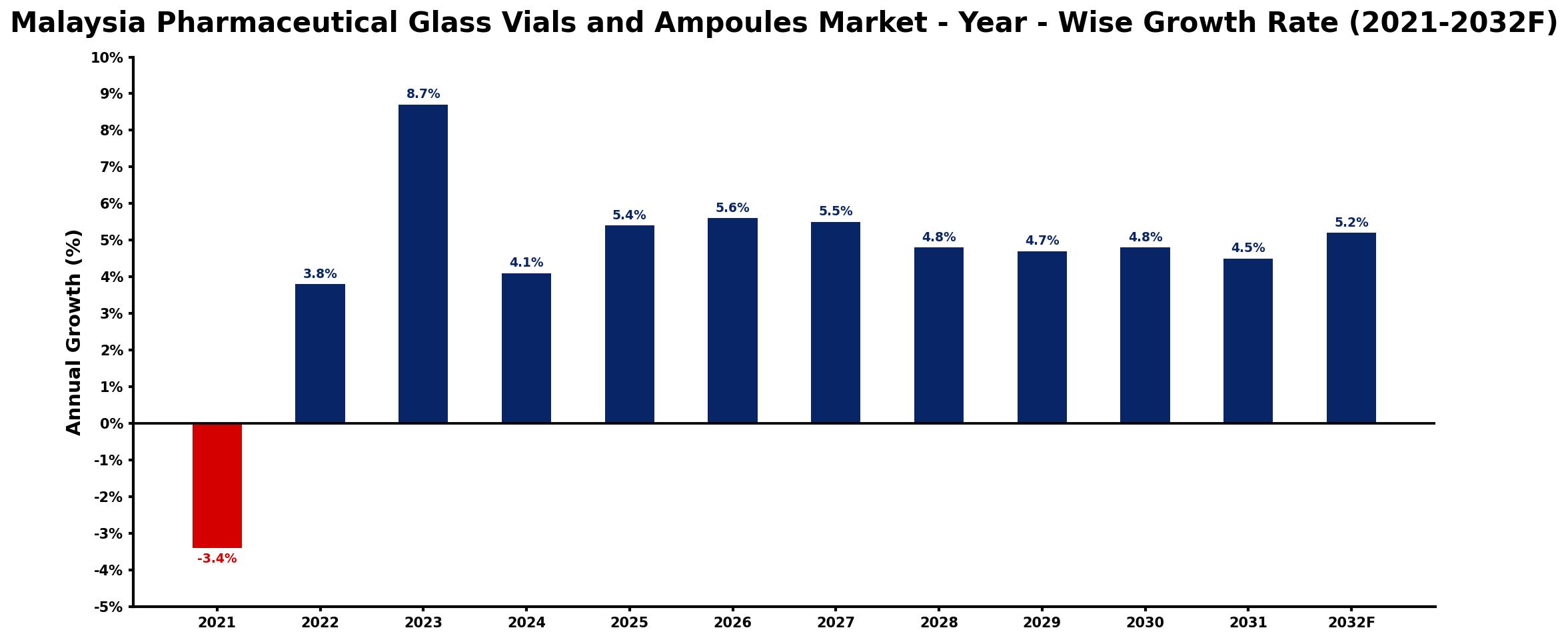
The table below presents the year‑wise growth rates along with the key drivers influencing the market
| Year | Growth Rate | Major Drivers |
| 2021 | -3.4% | decreased healthcare investments and spending |
| 2022 | 3.8% | rising demand for injectable medications |
| 2023 | 8.7% | expansion of biotechnology industry applications |
| 2024 | 4.1% | increased focus on personalized medicine |
| 2025 | 5.4% | increased overall sector activity |
| 2026 | 5.6% | rising global health awareness initiatives |
| 2027 | 5.5% | enhanced regulatory support for innovations |
| 2028 | 4.8% | increased production capacity investments |
| 2029 | 4.7% | growing partnerships with research institutions |
| 2030 | 4.8% | rising export shipment volumes |
| 2031 | 4.5% | increased adoption of sustainable practices |
| 2032 | 5.2% | emerging markets driving regional growth |
Note: Market size estimations and growth projections presented in this report are based on 6Wresearch's proprietary forecasting methodology, utilizing the latest available industry data, government publications, and primary research inputs.
Malaysia Pharmaceutical Glass Vials and Ampoules Market Synopsis
The Malaysian market for pharmaceutical glass vials and ampoules is witnessing a significant demand for specialized packaging solutions. This is particularly evident in the rising need for sterile vials and ampoules capable of accommodating a wide range of drug formulations and delivery methods.
Recent advancements in glass manufacturing technologies are enabling the production of innovative packaging options. Features such as enhanced compatibility with biologics and anti-counterfeiting measures are becoming increasingly vital as the market evolves.
Malaysia Pharmaceutical Glass Vials and Ampoules Market Key Takeaways
- The market is driven by increasing healthcare expenditures and pharmaceutical industry growth.
- Stringent regulatory standards are pushing manufacturers towards higher quality glass packaging solutions.
- Advancements in glass technology are enhancing product offerings with specialized features.
- Continuous demand for vaccine-related products is a positive market indicator post-COVID-19.
- Emerging competition from alternative materials necessitates a focus on sustainability among manufacturers.
Evaluation of Restraints in Malaysia Pharmaceutical Glass Vials and Ampoules Market
The Malaysia Pharmaceutical Glass Vials and Ampoules Market does face certain restraints that may hinder its growth trajectory. Stringent regulatory standards impose a significant compliance burden on manufacturers, necessitating regular investment in quality control and assurance measures. Furthermore, competition from emerging packaging materials such as plastics, which offer lighter and potentially cheaper alternatives, presents challenges to traditional glass products. The industry must also address growing consumer and regulatory demand for sustainable packaging solutions, as eco-friendliness becomes a prominent criterion for procurement decisions.
Malaysia Pharmaceutical Glass Vials and Ampoules Market Trends
Several trends are shaping the Malaysia Pharmaceutical Glass Vials and Ampoules Market. A marked shift towards biologics and personalized medicine is driving demand for versatile and robust packaging solutions. Enhanced drug compatibility and innovations such as prefilled syringes and smart vials are also gaining traction. Additionally, growing awareness around counterfeit drugs has propelled the demand for advanced anti-counterfeiting technologies integrated into glass packaging, establishing trust and safety for end users.
Malaysia Pharmaceutical Glass Vials and Ampoules Market Opportunities
Opportunities for growth within the Malaysia Pharmaceutical Glass Vials and Ampoules Market are abundant. The ongoing expansion of local pharmaceutical manufacturing capabilities opens avenues for partnerships and collaborations. As the government invests in healthcare infrastructure, there are increased prospects for large-scale projects requiring bulk packaging solutions. Furthermore, as sustainability continues to be a focal point, companies that invest in eco-friendly glass production methods may capture an increasingly conscientious consumer base.
Government Initiatives in the Malaysia Pharmaceutical Glass Vials and Ampoules Market
The Malaysian government has implemented various initiatives aimed at bolstering the healthcare and pharmaceutical sectors, which indirectly benefit the glass vials and ampoules market. Investments in healthcare infrastructure and a commitment to improving pharmaceutical regulations are notable. Supportive policies aimed at local production capabilities encourage the development of indigenous packaging solutions, fostering a more competitive and self-reliant market landscape.
Future Insights of the Malaysia Pharmaceutical Glass Vials and Ampoules Market
Looking towards 2026-2032, the Malaysia Pharmaceutical Glass Vials and Ampoules Market is poised for sustained growth. The ongoing expansion of the pharmaceutical industry, coupled with a shift towards more complex drug formulations, will continue to drive demand for high-quality glass packaging. As manufacturers innovate to meet regulatory requirements and consumer expectations, the market is likely to witness the introduction of increasingly sophisticated packaging solutions that enhance product integrity and safety.
Malaysia Pharmaceutical Glass Vials and Ampoules Market Latest Developments (2025 - 2026)
Recent developments in the Malaysian pharmaceutical glass packaging sector have focused on adopting more sustainable manufacturing processes. Industry players are exploring alternative raw materials and eco-friendly production methods to meet both regulatory requirements and consumer preferences for sustainable packaging solutions. Concurrently, there is a notable uptick in research and development aimed at creating smart packaging technologies that can provide real-time tracking and authentication features.
Malaysia Pharmaceutical Glass Vials and Ampoules Market - Key Attractiveness of the Report
- 10 Years of Market Numbers
- Historical Data Starting from 2022 to 2025
- Base Year: 2025
- Forecast Data until 2032
- Key Performance Indicators Impacting the Market
- Major Upcoming Developments and Projects
Key Highlights of the Report:
- Malaysia Pharmaceutical Glass Vials and Ampoules Market Outlook
- Market Size of Malaysia Pharmaceutical Glass Vials and Ampoules Market, 2025
- Forecast of Malaysia Pharmaceutical Glass Vials and Ampoules Market, 2032
- Historical Data and Forecast of Malaysia Pharmaceutical Glass Vials and Ampoules Revenues & Volume for the Period 2022-2032F
- Malaysia Pharmaceutical Glass Vials and Ampoules Market Trend Evolution
- Malaysia Pharmaceutical Glass Vials and Ampoules Market Drivers and Challenges
- Malaysia Pharmaceutical Glass Vials and Ampoules Price Trends
- Malaysia Pharmaceutical Glass Vials and Ampoules Porter's Five Forces
- Malaysia Pharmaceutical Glass Vials and Ampoules Industry Life Cycle
- Historical Data and Forecast of Malaysia Pharmaceutical Glass Vials and Ampoules Market Revenues & Volume By Type for the Period 2022-2032F
- Historical Data and Forecast of Malaysia Pharmaceutical Glass Vials and Ampoules Market Revenues & Volume By 2ml for the Period 2022-2032F
- Historical Data and Forecast of Malaysia Pharmaceutical Glass Vials and Ampoules Market Revenues & Volume By 3ml to 5ml for the Period 2022-2032F
- Historical Data and Forecast of Malaysia Pharmaceutical Glass Vials and Ampoules Market Revenues & Volume By 6ml to 8ml for the Period 2022-2032F
- Historical Data and Forecast of Malaysia Pharmaceutical Glass Vials and Ampoules Market Revenues & Volume By 8ml or more for the Period 2022-2032F
- Historical Data and Forecast of Malaysia Pharmaceutical Glass Vials and Ampoules Market Revenues & Volume By Application for the Period 2022-2032F
- Historical Data and Forecast of Malaysia Pharmaceutical Glass Vials and Ampoules Market Revenues & Volume By Pharmaceutical for the Period 2022-2032F
- Historical Data and Forecast of Malaysia Pharmaceutical Glass Vials and Ampoules Market Revenues & Volume By Chemical Reagent for the Period 2022-2032F
- Malaysia Pharmaceutical Glass Vials and Ampoules Import Export Trade Statistics
- Market Opportunity Assessment By Type
- Market Opportunity Assessment By Application
- Malaysia Pharmaceutical Glass Vials and Ampoules Top Companies Market Share
- Malaysia Pharmaceutical Glass Vials and Ampoules Competitive Benchmarking By Technical and Operational Parameters
- Malaysia Pharmaceutical Glass Vials and Ampoules Company Profiles
- Malaysia Pharmaceutical Glass Vials and Ampoules Key Strategic Recommendations






































