Malaysia Prepaid Cards Market Size, Share & Growth Rate
The Malaysia Prepaid Cards Market was estimated at USD 817 Million in 2025 and is projected to reach USD 1231 Million by 2032, growing at a CAGR of 6.0% from 2026 to 2032. This growth trajectory is primarily fueled by the increasing adoption of digital payment solutions in the wake of an expanding e-commerce landscape. Additionally, rising consumer preference for secure and convenient online transactions is significantly driving the popularity of prepaid cards across various demographics.
Malaysia Prepaid Cards Market Year-wise Growth Rate and Key Drivers
This graph highlights how the Malaysia Prepaid Cards Market has steadily grown over the years, supported by major growth factors.
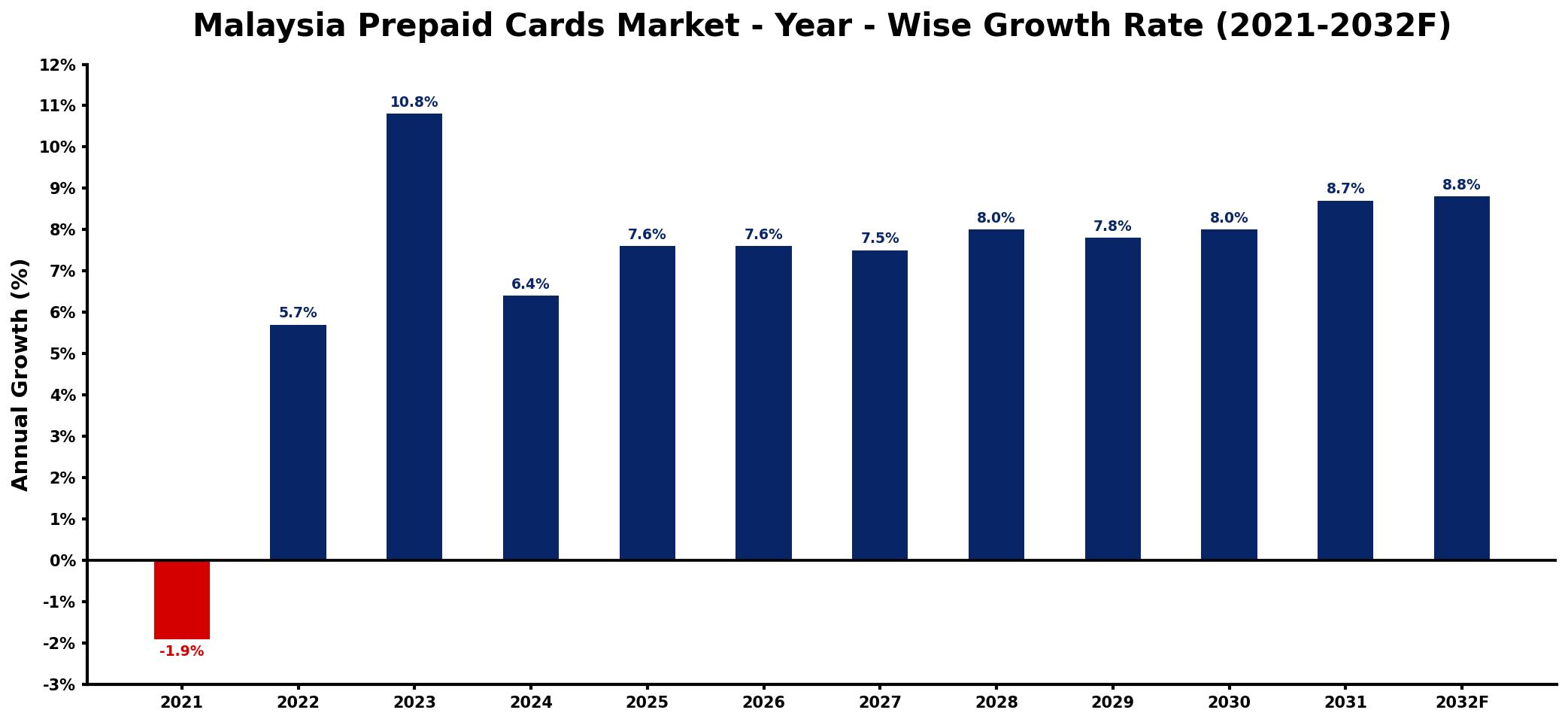
The table below presents the year‑wise growth rates along with the key drivers influencing the market
| Year | Growth Rate | Major Drivers |
| 2021 | -1.9% | decreased consumer spending patterns |
| 2022 | 5.7% | increased digital payment adoption |
| 2023 | 10.8% | growing e-commerce market penetration |
| 2024 | 6.4% | rising mobile wallet usage |
| 2025 | 7.6% | expansion of fintech innovations |
| 2026 | 7.6% | rising demand from electronics |
| 2027 | 7.5% | enhanced loyalty program integrations |
| 2028 | 8.0% | growing demand for contactless payments |
| 2029 | 7.8% | rising popularity of subscription services |
| 2030 | 8.0% | increased investment in technology |
| 2031 | 8.7% | rising procurement volume requirements |
| 2032 | 8.8% | growing consumer preference for convenience |
Note: Market size estimations and growth projections presented in this report are based on 6Wresearch's proprietary forecasting methodology, utilizing the latest available industry data, government publications, and primary research inputs.
Malaysia Prepaid Cards Market Synopsis
In recent years, the prepaid cards market in Malaysia has gained substantial momentum, significantly boosted by changes in consumer payment behavior. As digital payment methods become more ingrained in everyday life, prepaid cards are transitioning from a niche product to a mainstream financial tool, appealing to a wider range of users for purposes such as online shopping, gifting, and remittances.
Looking ahead, the market is set to evolve even further, with ongoing innovations and the introduction of versatile card offerings designed to meet specific consumer needs. Government initiatives aimed at fostering a cashless economy will play a pivotal role in sustaining the positive momentum of the prepaid cards market in Malaysia, ensuring its relevance in a rapidly changing financial landscape.
Malaysia Prepaid Cards Market Key Takeaways
- Continued growth driven by digital payment adoption and government support.
- Prepaid cards increasingly used for various consumer needs, including gifting and travel.
- Innovations in prepaid card offerings are key to staying competitive.
- Security measures and regulatory compliance remain essential for market players.
- The market is adapting to shifts in consumer behavior post-COVID-19, focusing on contactless transactions.
Evaluation of Restraints in Malaysia Prepaid Cards Market
While the prepaid cards market shows promising growth, it faces several restraints that may hinder its potential. One major concern is the ongoing battle against fraud and cyber threats, as prepaid cards can be attractive targets for cybercriminals. Moreover, the rapid pace of innovation in alternative payment methods, such as digital wallets and mobile banking applications, poses a competitive challenge. Additionally, strict regulatory compliance requirements can limit the agility of card providers, making it essential to strike a balance between innovation and adherence to legal standards.
Malaysia Prepaid Cards Market Trends
The prepaid cards market in Malaysia is witnessing significant trends that are shaping its future. A notable trend is the increasing integration of mobile payment capabilities, allowing consumers to manage prepaid cards through their smartphones seamlessly. Furthermore, the rise of social commerce is leading businesses to offer branded prepaid cards as rewards, enhancing customer engagement. Additionally, sustainability has emerged as a growing concern, with some card providers exploring eco-friendly options to appeal to environmentally-conscious consumers.
Malaysia Prepaid Cards Market Opportunities
Opportunities for growth in the Malaysia prepaid cards market are abundant, particularly in the realm of customization and personalization. As consumers seek tailored solutions, offering customizable prepaid cards could attract diverse segments. Furthermore, partnerships with e-commerce platforms and retail businesses can expand the utility of prepaid cards, creating cross-promotional opportunities. The emergence of innovative technologies, such as blockchain, also opens up avenues for enhanced security and transparency in prepaid card transactions.
Government Initiatives in the Malaysia Prepaid Cards Market
The Malaysian government has been actively promoting cashless transactions through various initiatives aimed at enhancing the country's digital economy. Programs focusing on improving digital infrastructure and increasing financial literacy have been implemented to encourage the adoption of digital payment solutions, including prepaid cards. By fostering an environment conducive to innovation and ensuring consumer protection, the government plays a crucial role in bolstering the prepaid cards market's growth potential.
Future Insights of the Malaysia Prepaid Cards Market
As we move towards 2032, the Malaysia prepaid cards market is likely to continue its upward trajectory, driven by the ongoing digital transformation of financial services. The increasing need for secure and efficient payment options will prompt further innovations in card technologies and features. With a greater emphasis on user experience and security, card providers who leverage emerging technologies will likely gain a competitive edge. Additionally, collaboration with fintech firms could enhance service offerings, ultimately expanding market reach.
Malaysia Prepaid Cards Market Latest Developments (2025 - 2026)
Recent developments in the prepaid cards market indicate a strong focus on enhancing user experience and security. Providers are actively introducing new features, such as virtual cards for online transactions, while also bolstering security measures to counteract rising fraud incidents. Strategic partnerships between prepaid card companies and e-commerce platforms are becoming increasingly common, aimed at boosting customer acquisition through integrated payment solutions. The market appears vibrant, with a clear trajectory towards greater innovation and consumer engagement.
Malaysia Prepaid Cards Market - Key Attractiveness of the Report
- 10 Years of Market Numbers
- Historical Data Starting from 2022 to 2025
- Base Year: 2025
- Forecast Data until 2032
- Key Performance Indicators Impacting the Market
- Major Upcoming Developments and Projects
Key Highlights of the Report:
- Malaysia Prepaid Cards Market Outlook
- Market Size of Malaysia Prepaid Cards Market, 2025
- Forecast of Malaysia Prepaid Cards Market, 2032
- Historical Data and Forecast of Malaysia Prepaid Cards Revenues & Volume for the Period 2022-2032F
- Malaysia Prepaid Cards Market Trend Evolution
- Malaysia Prepaid Cards Market Drivers and Challenges
- Malaysia Prepaid Cards Price Trends
- Malaysia Prepaid Cards Porter's Five Forces
- Malaysia Prepaid Cards Industry Life Cycle
- Historical Data and Forecast of Malaysia Prepaid Cards Market Revenues & Volume By Offering for the Period 2022-2032F
- Historical Data and Forecast of Malaysia Prepaid Cards Market Revenues & Volume By General Purpose Card for the Period 2022-2032F
- Historical Data and Forecast of Malaysia Prepaid Cards Market Revenues & Volume By Gift Card for the Period 2022-2032F
- Historical Data and Forecast of Malaysia Prepaid Cards Market Revenues & Volume By Government Benefit/Disbursement Card for the Period 2022-2032F
- Historical Data and Forecast of Malaysia Prepaid Cards Market Revenues & Volume By Incentive/Payroll Card for the Period 2022-2032F
- Historical Data and Forecast of Malaysia Prepaid Cards Market Revenues & Volume By Others for the Period 2022-2032F
- Historical Data and Forecast of Malaysia Prepaid Cards Market Revenues & Volume By Card Type for the Period 2022-2032F
- Historical Data and Forecast of Malaysia Prepaid Cards Market Revenues & Volume By Closed Loop Card for the Period 2022-2032F
- Historical Data and Forecast of Malaysia Prepaid Cards Market Revenues & Volume By Open Loop Card for the Period 2022-2032F
- Historical Data and Forecast of Malaysia Prepaid Cards Market Revenues & Volume By End User for the Period 2022-2032F
- Historical Data and Forecast of Malaysia Prepaid Cards Market Revenues & Volume By Retail for the Period 2022-2032F
- Historical Data and Forecast of Malaysia Prepaid Cards Market Revenues & Volume By Corporate for the Period 2022-2032F
- Historical Data and Forecast of Malaysia Prepaid Cards Market Revenues & Volume By Government/Public Sector for the Period 2022-2032F
- Malaysia Prepaid Cards Import Export Trade Statistics
- Market Opportunity Assessment By Offering
- Market Opportunity Assessment By Card Type
- Market Opportunity Assessment By End User
- Malaysia Prepaid Cards Top Companies Market Share
- Malaysia Prepaid Cards Competitive Benchmarking By Technical and Operational Parameters
- Malaysia Prepaid Cards Company Profiles
- Malaysia Prepaid Cards Key Strategic Recommendations






































