Malaysia Railway Maintenance Machinery Market Size, Share & Growth Rate
The Malaysia Railway Maintenance Machinery Market was estimated at USD 1397 Million in 2025 and is projected to reach USD 2098 Million by 2032, growing at a CAGR of 6.0% from 2026 to 2032. This anticipated growth trajectory is underpinned by significant investments in rail infrastructure initiatives, such as the High Speed Rail (HSR) and the East Coast Rail Line (ECRL), coupled with the government's unwavering commitment to enhance public transport services. Additionally, the increasing adoption of advanced technologies, including automated track inspection systems, further bolsters the market's expansion.
Malaysia Railway Maintenance Machinery Market Year-wise Growth Rate and Key Drivers
This graph highlights how the Malaysia Railway Maintenance Machinery Market has steadily grown over the years, supported by major growth factors.
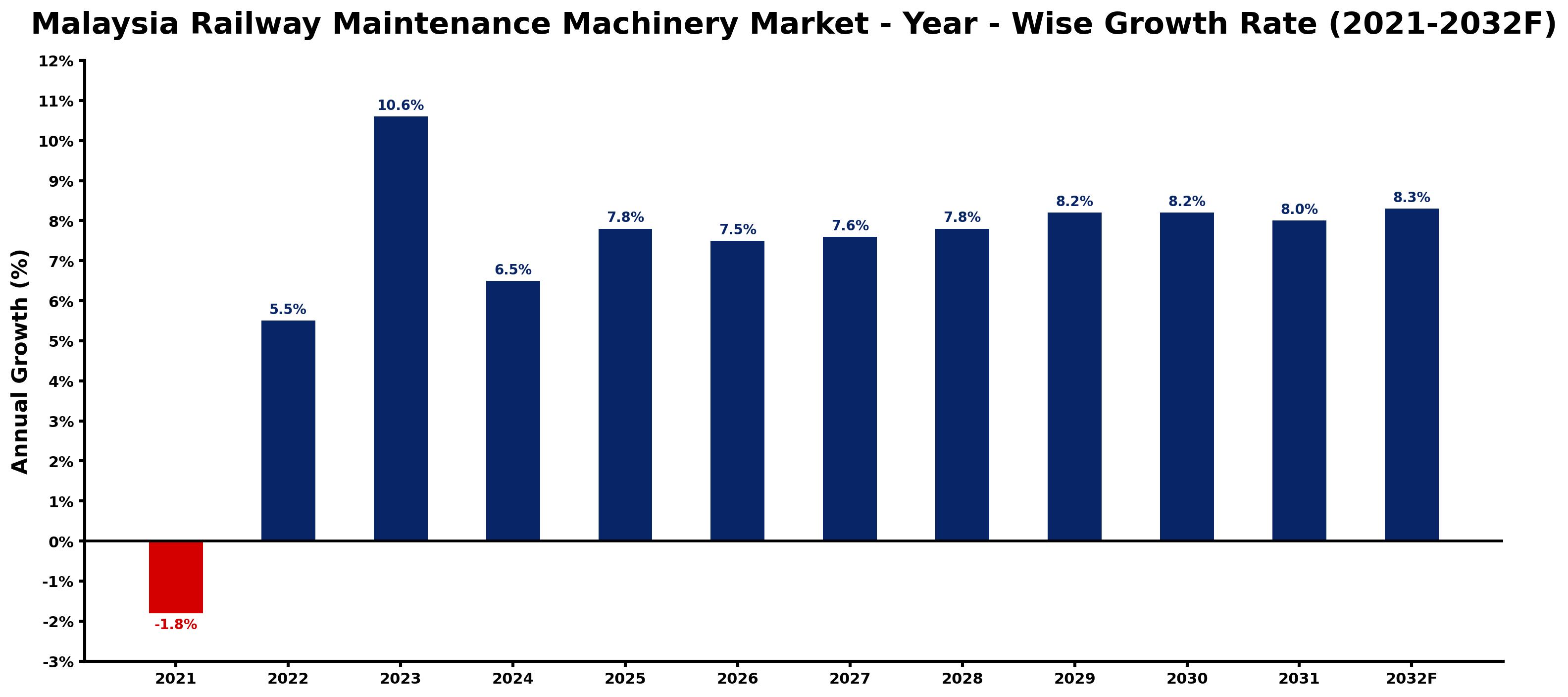
The table below presents the year‑wise growth rates along with the key drivers influencing the market
| Year | Growth Rate | Major Drivers |
| 2021 | -1.8% | Government infrastructure modernization initiatives |
| 2022 | 5.5% | Increasing industrial infrastructure investments |
| 2023 | 10.6% | Expansion of manufacturing activities |
| 2024 | 6.5% | Rising electricity demand across industries |
| 2025 | 7.8% | Increasing industrial infrastructure investments |
| 2026 | 7.5% | Increasing industrial infrastructure investments |
| 2027 | 7.6% | Increasing adoption of advanced technologies |
| 2028 | 7.8% | Expansion of commercial construction activities |
| 2029 | 8.2% | Increasing industrial automation investments |
| 2030 | 8.2% | Expansion of commercial construction activities |
| 2031 | 8.0% | Increasing smart city development projects |
| 2032 | 8.3% | Expansion of commercial construction activities |
Note - Market size estimations and growth projections presented in this report are based on 6Wresearch’s advanced forecasting approach, validated with industry datasets as of June 2026.
Malaysia Railway Maintenance Machinery Market Synopsis
Recently, Malaysia has witnessed a surge in railway maintenance activity, driven by a national agenda focused on modernizing and expanding its rail network. This momentum is expected to accelerate as the government prioritizes projects aimed at improving connectivity and safety across urban areas. The market outlook appears bright, particularly as technological innovations continue to reshape the operational landscape.
As Malaysia invests heavily in railway infrastructure, the demand for effective maintenance machinery is growing in tandem. The focus on safety and efficiency is prompting a shift towards automated solutions, reinforcing the necessity for advanced maintenance tools. This growing reliance on technology is set to transform the railway maintenance sector, ultimately leading to enhanced operational standards.
Malaysia Railway Maintenance Machinery Market Key Takeaways
- Steady growth projected at a CAGR of 6.0%, highlighting robust market demand.
- Government initiatives are pivotal in driving investments in railway infrastructure.
- Technological advancements are enhancing maintenance efficiency and safety.
- Increased adoption of automated systems is crucial for proactive track management.
- Investment in public transport improvements is a key growth catalyst.
Evaluation of Restraints in Malaysia Railway Maintenance Machinery Market
Despite the promising outlook, several restraints could hinder market growth. One of the significant factors is the limited availability of skilled labor trained to operate and maintain advanced machinery. Additionally, the initial capital investment required for sophisticated technologies can be a barrier for smaller operators. Regulatory hurdles and bureaucratic processes can also slow down the implementation of new projects, impacting timely deployment of maintenance machinery across the rail network.
Malaysia Railway Maintenance Machinery Market Trends
The railway maintenance sector in Malaysia is currently trending towards the integration of artificial intelligence and predictive analytics. These technologies are becoming crucial for anticipating potential track failures, leading to timely interventions that minimize downtime. Moreover, the use of drones and remote sensing technologies for inspection is gaining traction, offering a safer and more efficient alternative to traditional methods.
Malaysia Railway Maintenance Machinery Market Opportunities
Significant opportunities for growth lie in the implementation of smart technologies that enhance maintenance efficiency. The ongoing development of new rail lines presents a robust demand for advanced maintenance machinery capable of handling increased operational requirements. Furthermore, partnerships with tech firms to innovate railway solutions can open new revenue streams and enhance service quality.
Government Initiatives in the Malaysia Railway Maintenance Machinery Market
The Malaysian government has taken proactive steps to stimulate growth in the railway sector through various initiatives. Investment programs aimed at expanding railway networks are being implemented, alongside infrastructure projects that focus on upgrading existing lines. Public-private partnerships are encouraged to foster innovation, while grants and funding opportunities are available for companies developing new technologies in railway maintenance.
Future Insights of the Malaysia Railway Maintenance Machinery Market
Looking towards 2026-2032, the Malaysia Railway Maintenance Machinery Market is poised for sustained growth fueled by ongoing infrastructure projects and technological advancements. The focus on safety and efficiency will drive the demand for maintenance machinery, particularly those utilizing AI and automation. As the market evolves, the integration of smart technologies will likely redefine operational standards, ensuring a resilient and high-performing railway network.
Malaysia Railway Maintenance Machinery Market Latest Developments (May 2025 - June 2026)
Recent developments indicate a shift towards adopting automated solutions for track maintenance, reflecting a broader trend in the industry. Additionally, the government has announced several key initiatives aimed at fast-tracking railway projects, with an emphasis on incorporating modern technologies. Industry players are actively exploring collaborations that leverage innovative solutions to improve railway infrastructure resilience and safety standards.
Malaysia Railway Maintenance Machinery Market - Key Attractiveness of the Report
- 10 Years of Market Numbers
- Historical Data Starting from 2022 to 2025
- Base Year: 2025
- Forecast Data until 2032
- Key Performance Indicators Impacting the Market
- Major Upcoming Developments and Projects
Key Highlights of the Report:
- Malaysia Railway Maintenance Machinery Market Outlook
- Market Size of Malaysia Railway Maintenance Machinery Market, 2025
- Forecast of Malaysia Railway Maintenance Machinery Market, 2032
- Historical Data and Forecast of Malaysia Railway Maintenance Machinery Revenues & Volume for the Period 2022-2032F
- Malaysia Railway Maintenance Machinery Market Trend Evolution
- Malaysia Railway Maintenance Machinery Market Drivers and Challenges
- Malaysia Railway Maintenance Machinery Price Trends
- Malaysia Railway Maintenance Machinery Porter's Five Forces
- Malaysia Railway Maintenance Machinery Industry Life Cycle
- Historical Data and Forecast of Malaysia Railway Maintenance Machinery Market Revenues & Volume By Type for the Period 2022-2032F
- Historical Data and Forecast of Malaysia Railway Maintenance Machinery Market Revenues & Volume By Tamping Machine for the Period 2022-2032F
- Historical Data and Forecast of Malaysia Railway Maintenance Machinery Market Revenues & Volume By Stabilizing Machinery for the Period 2022-2032F
- Historical Data and Forecast of Malaysia Railway Maintenance Machinery Market Revenues & Volume By Rail Handling Machinery for the Period 2022-2032F
- Historical Data and Forecast of Malaysia Railway Maintenance Machinery Market Revenues & Volume By Ballast Cleaning Machine for the Period 2022-2032F
- Historical Data and Forecast of Malaysia Railway Maintenance Machinery Market Revenues & Volume By Other for the Period 2022-2032F
- Historical Data and Forecast of Malaysia Railway Maintenance Machinery Market Revenues & Volume By Applications for the Period 2022-2032F
- Historical Data and Forecast of Malaysia Railway Maintenance Machinery Market Revenues & Volume By Ballast Track for the Period 2022-2032F
- Historical Data and Forecast of Malaysia Railway Maintenance Machinery Market Revenues & Volume By Ballastless Track for the Period 2022-2032F
- Malaysia Railway Maintenance Machinery Import Export Trade Statistics
- Market Opportunity Assessment By Type
- Market Opportunity Assessment By Applications
- Malaysia Railway Maintenance Machinery Top Companies Market Share
- Malaysia Railway Maintenance Machinery Competitive Benchmarking By Technical and Operational Parameters
- Malaysia Railway Maintenance Machinery Company Profiles
- Malaysia Railway Maintenance Machinery Key Strategic Recommendations






































