Malaysia Rolling Mill Components and Ancillary Equipment Market Size, Share & Growth Rate
The Malaysia Rolling Mill Components and Ancillary Equipment Market was estimated at USD 368 Million in 2025 and is projected to reach USD 479 Million by 2032, growing at a CAGR of 3.8% from 2026 to 2032. The market's growth trajectory is significantly influenced by Malaysia's robust investments in infrastructure and ongoing industrialization, which are increasing the demand for high-quality steel and metal products. The evolution of manufacturing technologies, alongside a push for efficiency in production processes, further supports this positive outlook.
Malaysia Rolling Mill Components and Ancillary Equipment Market Year-wise Growth Rate and Key Drivers
This graph highlights how the Malaysia Rolling Mill Components and Ancillary Equipment Market has steadily grown over the years, supported by major growth factors.
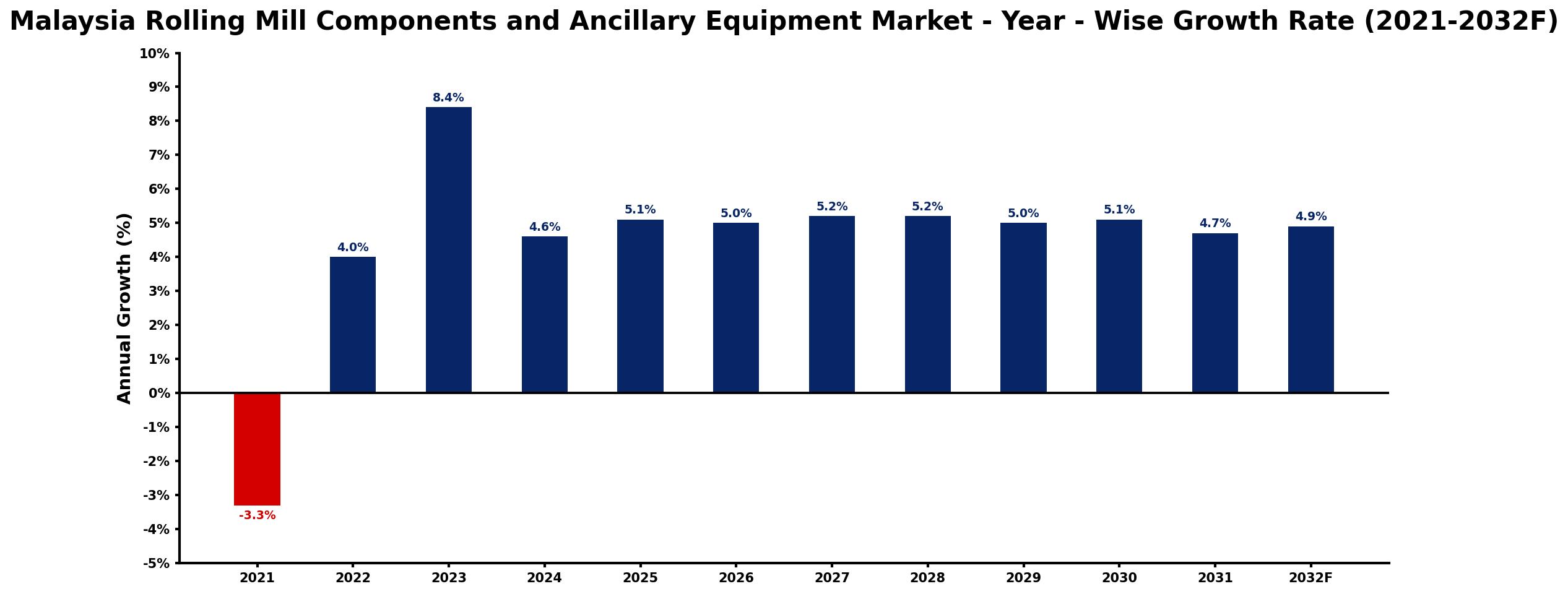
The table below presents the year‑wise growth rates along with the key drivers influencing the market
| Year | Growth Rate | Major Drivers |
| 2021 | -3.3% | Decreased demand from construction sector |
| 2022 | 4.0% | Rising investments in manufacturing sector |
| 2023 | 8.4% | Increased infrastructure development projects |
| 2024 | 4.6% | Growing automotive industry requirements |
| 2025 | 5.1% | Expansion of renewable energy projects |
| 2026 | 5.0% | Surge in export opportunities abroad |
| 2027 | 5.2% | Technological advancements in production |
| 2028 | 5.2% | Strengthening of local supply chains |
| 2029 | 5.0% | Boost in residential construction activity |
| 2030 | 5.1% | Rising demand from aerospace sector |
| 2031 | 4.7% | Increased focus on sustainability initiatives |
| 2032 | 4.9% | Growth in regional trade agreements |
Note: Market size estimations and growth projections presented in this report are based on 6Wresearch's proprietary forecasting methodology, utilizing the latest available industry data, government publications, and primary research inputs.
Malaysia Rolling Mill Components and Ancillary Equipment Market Synopsis
In Malaysia, the necessity for reliable and efficient rolling mill components, such as rolls, guides, and cooling systems, is on the rise, driven by the burgeoning steel and metal fabrication sectors. As construction and infrastructure projects escalate, the demand for ancillary equipment tailored to the specific needs of these industries is expected to follow suit.
Moreover, the demand for customization and innovation among local manufacturers necessitates an emphasis on quality assurance and advanced technological solutions. This creates a dynamic market environment, compelling suppliers to adapt rapidly to meet the evolving specifications of steel producers and fabricators.
Malaysia Rolling Mill Components and Ancillary Equipment Market Key Takeaways
- The market is closely linked to Malaysia's infrastructure projects, significantly driving demand.
- Technological advancements in material science are influencing the design of rolling mill components.
- Quality assurance and customization are key factors for success in this competitive landscape.
- International competition poses a challenge for local manufacturers seeking market share.
- Value-added services are becoming increasingly important for market players aiming to differentiate themselves.
Evaluation of Restraints in Malaysia Rolling Mill Components and Ancillary Equipment Market
While the Malaysia rolling mill components and ancillary equipment market shows promising growth prospects, several restraints are impacting its full potential. Fluctuating raw material prices, particularly for steel and copper, impose challenges on production costs, hampering profitability. Additionally, the requirement for manufacturers to develop comprehensive solutions that cater to various sectors complicates market dynamics, necessitating continuous innovation and adaptability. The rising adoption of automation and digital technologies also demands significant investments in research and development, which could strain resources for smaller players. These factors combined underscore the complex landscape in which market participants must navigate.
Malaysia Rolling Mill Components and Ancillary Equipment Market Trends
Several key trends are shaping the Malaysia rolling mill components and ancillary equipment market. An increased focus on sustainability and energy efficiency is compelling manufacturers to innovate and adopt greener practices. Digital transformation is also gaining momentum, as manufacturers embrace automation and smart technologies to enhance operational efficiencies. Additionally, there is a growing trend toward the customization of equipment, which allows for tailored solutions that meet the unique needs of specific sectors like construction and metal fabrication.
Malaysia Rolling Mill Components and Ancillary Equipment Market Opportunities
The Malaysian market presents numerous opportunities for growth and investment in rolling mill components and ancillary equipment. As infrastructure development accelerates, particularly in urban areas, the demand for superior quality steel and metal products is expected to rise. Furthermore, leveraging advanced technologies to develop innovative solutions can position manufacturers favorably. There is also significant potential in exploring export opportunities as neighboring regions enhance their industrial capabilities and seek reliable equipment suppliers.
Government Initiatives in the Malaysia Rolling Mill Components and Ancillary Equipment Market
The Malaysian government has been proactive in supporting the steel and metal fabrication industries through various initiatives. Policies aimed at boosting foreign investment, coupled with strategic public spending on infrastructure development, create a conducive environment for the rolling mill components market. Additionally, government programs that focus on technological advancements and industry standards serve to strengthen the market position of domestic manufacturers, fostering growth and innovation.
Future Insights of the Malaysia Rolling Mill Components and Ancillary Equipment Market
Looking ahead to 2026-2032, the Malaysia rolling mill components and ancillary equipment market is poised for steady growth. Enhanced infrastructure projects, combined with a continued push towards modernization in the manufacturing sector, will fuel demand for advanced rolling mill technologies. As industry players emphasize quality and innovation, the integration of digital solutions and sustainable practices will become essential. This evolution, driven by market needs and technological advancements, indicates a bright future for the sector, as it adapts to an increasingly competitive landscape.
Malaysia Rolling Mill Components and Ancillary Equipment Market Latest Developments (2025 - 2026)
Recent industry developments indicate a shift towards more automated processes within the rolling mill components sector, with manufacturers increasingly investing in smart technologies. Collaborative ventures between local firms and technology providers have emerged to enhance product offerings and operational efficiencies. Additionally, there is a noticeable trend towards forming strategic alliances to strengthen supply chains and enhance market reach, reflecting an adaptive response to competitive pressures.
Malaysia Rolling Mill Components and Ancillary Equipment Market - Key Attractiveness of the Report
- 10 Years of Market Numbers
- Historical Data Starting from 2022 to 2025
- Base Year: 2025
- Forecast Data until 2032
- Key Performance Indicators Impacting the Market
- Major Upcoming Developments and Projects
Key Highlights of the Report:
- Malaysia Rolling Mill Components and Ancillary Equipment Market Outlook
- Market Size of Malaysia Rolling Mill Components and Ancillary Equipment Market, 2025
- Forecast of Malaysia Rolling Mill Components and Ancillary Equipment Market, 2032
- Historical Data and Forecast of Malaysia Rolling Mill Components and Ancillary Equipment Revenues & Volume for the Period 2022-2032F
- Malaysia Rolling Mill Components and Ancillary Equipment Market Trend Evolution
- Malaysia Rolling Mill Components and Ancillary Equipment Market Drivers and Challenges
- Malaysia Rolling Mill Components and Ancillary Equipment Price Trends
- Malaysia Rolling Mill Components and Ancillary Equipment Porter's Five Forces
- Malaysia Rolling Mill Components and Ancillary Equipment Industry Life Cycle
- Historical Data and Forecast of Malaysia Rolling Mill Components and Ancillary Equipment Market Revenues & Volume By Product for the Period 2022-2032F
- Historical Data and Forecast of Malaysia Rolling Mill Components and Ancillary Equipment Market Revenues & Volume By Iron Rolls for the Period 2022-2032F
- Historical Data and Forecast of Malaysia Rolling Mill Components and Ancillary Equipment Market Revenues & Volume By Steel Rolls for the Period 2022-2032F
- Historical Data and Forecast of Malaysia Rolling Mill Components and Ancillary Equipment Market Revenues & Volume By Others for the Period 2022-2032F
- Historical Data and Forecast of Malaysia Rolling Mill Components and Ancillary Equipment Market Revenues & Volume By End User for the Period 2022-2032F
- Historical Data and Forecast of Malaysia Rolling Mill Components and Ancillary Equipment Market Revenues & Volume By Oil & Gas for the Period 2022-2032F
- Historical Data and Forecast of Malaysia Rolling Mill Components and Ancillary Equipment Market Revenues & Volume By Industrial for the Period 2022-2032F
- Historical Data and Forecast of Malaysia Rolling Mill Components and Ancillary Equipment Market Revenues & Volume By Automotive for the Period 2022-2032F
- Historical Data and Forecast of Malaysia Rolling Mill Components and Ancillary Equipment Market Revenues & Volume By Mining for the Period 2022-2032F
- Historical Data and Forecast of Malaysia Rolling Mill Components and Ancillary Equipment Market Revenues & Volume By Others for the Period 2022-2032F
- Malaysia Rolling Mill Components and Ancillary Equipment Import Export Trade Statistics
- Market Opportunity Assessment By Product
- Market Opportunity Assessment By End User
- Malaysia Rolling Mill Components and Ancillary Equipment Top Companies Market Share
- Malaysia Rolling Mill Components and Ancillary Equipment Competitive Benchmarking By Technical and Operational Parameters
- Malaysia Rolling Mill Components and Ancillary Equipment Company Profiles
- Malaysia Rolling Mill Components and Ancillary Equipment Key Strategic Recommendations






































