Malaysia Sea Bass Market Size, Share & Growth Rate
The Malaysia Sea Bass Market was estimated at USD 416 Million in 2025 and is projected to reach USD 543 Million by 2032, growing at a CAGR of 3.9% from 2026 to 2032. This growth trajectory is primarily driven by the rising consumer demand for healthy seafood options and the increasing popularity of sea bass in various culinary applications. Furthermore, advancements in aquaculture practices are enhancing production efficiency, ensuring a steady supply of this sought-after fish.
Malaysia Sea Bass Market Year-wise Growth Rate and Key Drivers
This graph highlights how the Malaysia Sea Bass Market has steadily grown over the years, supported by major growth factors.
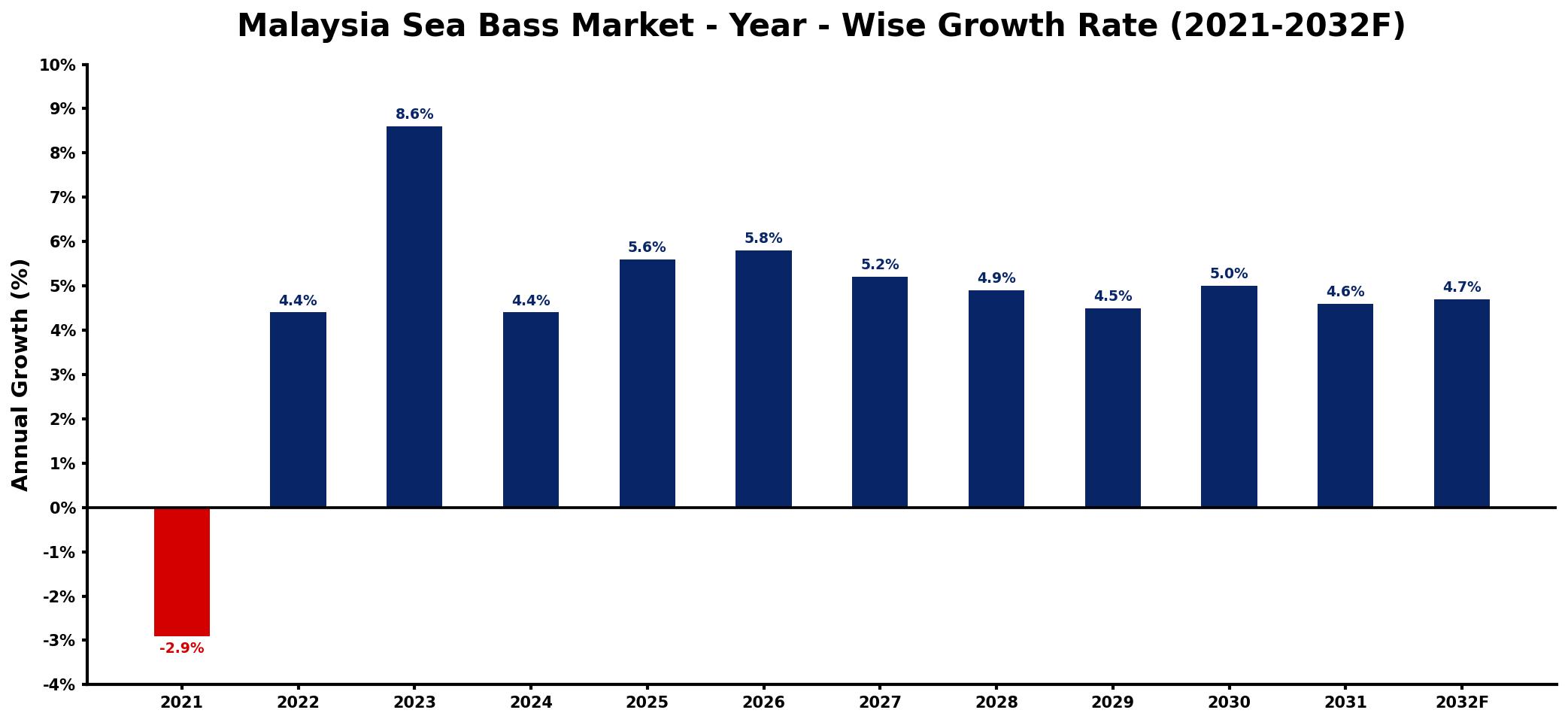
The table below presents the year‑wise growth rates along with the key drivers influencing the market
| Year | Growth Rate | Major Drivers |
| 2021 | -2.9% | decreased consumer purchasing power |
| 2022 | 4.4% | improved processing technologies adoption |
| 2023 | 8.6% | increased investment in aquaculture |
| 2024 | 4.4% | expansion of distribution networks |
| 2025 | 5.6% | growing popularity of health trends |
| 2026 | 5.8% | increased culinary tourism activities |
| 2027 | 5.2% | rising export opportunities abroad |
| 2028 | 4.9% | enhanced sustainability practices adopted |
| 2029 | 4.5% | growing consumer awareness initiatives |
| 2030 | 5.0% | technological advancements in fishing |
| 2031 | 4.6% | increased partnerships in supply chain |
| 2032 | 4.7% | rising procurement volume requirements |
Note: Market size estimations and growth projections presented in this report are based on 6Wresearch's proprietary forecasting methodology, utilizing the latest available industry data, government publications, and primary research inputs.
Malaysia Sea Bass Market Synopsis
In Malaysia, sea bass holds a significant place in local cuisine, with its mild flavor and versatile preparation methods contributing to a robust domestic demand. The increase in aquaculture production has made high-quality sea bass more accessible, bolstering its presence in both local and export markets.
The growing trend towards healthier eating habits is encouraging consumers to choose white fish like sea bass over other seafood options. This trend is further supported by effective marketing strategies that highlight sea bass's nutritional benefits, solidifying its status as a favored seafood choice.
Malaysia Sea Bass Market Key Takeaways
- Strong domestic demand driven by culinary preferences for sea bass.
- Growing aquaculture production enhances supply and accessibility.
- Rising consumer awareness of health benefits linked to seafood consumption.
- Positive export potential boosts overall market outlook.
- Resilience in market dynamics post-COVID-19, with adaptation to consumer behavior shifts.
Evaluation of Restraints in Malaysia Sea Bass Market
Despite its promising growth, the Malaysia Sea Bass Market faces several constraints. Competition from other fish species can divert consumer interest, particularly as alternatives become more affordable. Additionally, ensuring sustainable sourcing practices remains a priority for both consumers and industry stakeholders. Price volatility is another concern, as fluctuations can impact consumer purchasing decisions, especially in price-sensitive segments of the market.
Malaysia Sea Bass Market Trends
Several key trends are shaping the Malaysia Sea Bass Market. The increasing adoption of sustainable aquaculture practices is driving efficiencies in production, while consumer preferences are shifting towards ethically sourced seafood. Furthermore, the rise of online seafood retail platforms is providing greater access to fresh sea bass, catering to evolving shopping habits. Additionally, innovative culinary uses are emerging, expanding sea bass's appeal across diverse dining experiences.
Malaysia Sea Bass Market Opportunities
The Malaysia Sea Bass Market presents numerous growth and investment opportunities. Expanding international markets for premium sea bass products can enhance export revenues. Additionally, developing value-added products, such as marinated or ready-to-cook sea bass options, can tap into the convenience-seeking consumer segment. Investing in research and development for aquaculture technologies also holds potential for increasing yield and sustainability in sea bass farming.
Government Initiatives in the Malaysia Sea Bass Market
The Malaysian government is actively promoting sustainable aquaculture through various policies and programs aimed at enhancing fish farming practices. Public spending on research and development in aquaculture technologies aims to improve production efficiency and sustainability. Furthermore, incentives for sustainable fishing and aquaculture practices are in place to support the industry's growth while ensuring the conservation of marine ecosystems.
Future Insights of the Malaysia Sea Bass Market
Looking ahead to the period from 2026 to 2032, the Malaysia Sea Bass Market is poised for steady growth. As consumer preferences continue to lean towards healthy and sustainable seafood choices, sea bass is expected to remain at the forefront. The integration of technology in aquaculture, alongside ongoing marketing efforts to highlight the fishs culinary versatility, will likely propel its demand further. Additionally, the market's adaptability to changing economic conditions and consumer behaviors will be crucial for sustaining its growth momentum.
Malaysia Sea Bass Market Latest Developments (2025 - 2026)
Recent developments within the Malaysia Sea Bass Market indicate a shift towards enhanced distribution channels, with several aquaculture businesses exploring partnerships to streamline logistics and improve supply chain efficiency. There is also a notable increase in consumer engagement through digital platforms, where online marketing strategies are being employed to educate consumers about the benefits of sea bass. Additionally, sustainability initiatives are gaining traction, with a focus on responsible fishing practices aimed at preserving marine biodiversity.
Malaysia Sea Bass Market - Key Attractiveness of the Report
- 10 Years of Market Numbers
- Historical Data Starting from 2022 to 2025
- Base Year: 2025
- Forecast Data until 2032
- Key Performance Indicators Impacting the Market
- Major Upcoming Developments and Projects
Key Highlights of the Report:
- Malaysia Sea Bass Market Outlook
- Market Size of Malaysia Sea Bass Market, 2025
- Forecast of Malaysia Sea Bass Market, 2032
- Historical Data and Forecast of Malaysia Sea Bass Revenues & Volume for the Period 2022-2032F
- Malaysia Sea Bass Market Trend Evolution
- Malaysia Sea Bass Market Drivers and Challenges
- Malaysia Sea Bass Price Trends
- Malaysia Sea Bass Porter's Five Forces
- Malaysia Sea Bass Industry Life Cycle
- Historical Data and Forecast of Malaysia Sea Bass Market Revenues & Volume By Nature for the Period 2022-2032F
- Historical Data and Forecast of Malaysia Sea Bass Market Revenues & Volume By Wild for the Period 2022-2032F
- Historical Data and Forecast of Malaysia Sea Bass Market Revenues & Volume By Farmed for the Period 2022-2032F
- Historical Data and Forecast of Malaysia Sea Bass Market Revenues & Volume By Type for the Period 2022-2032F
- Historical Data and Forecast of Malaysia Sea Bass Market Revenues & Volume By Fresh for the Period 2022-2032F
- Historical Data and Forecast of Malaysia Sea Bass Market Revenues & Volume By Processed for the Period 2022-2032F
- Historical Data and Forecast of Malaysia Sea Bass Market Revenues & Volume By Sales Channel for the Period 2022-2032F
- Historical Data and Forecast of Malaysia Sea Bass Market Revenues & Volume By Food Service for the Period 2022-2032F
- Historical Data and Forecast of Malaysia Sea Bass Market Revenues & Volume By Hypermarket/Supermarket for the Period 2022-2032F
- Historical Data and Forecast of Malaysia Sea Bass Market Revenues & Volume By Specialty Stores for the Period 2022-2032F
- Historical Data and Forecast of Malaysia Sea Bass Market Revenues & Volume By Online Channels for the Period 2022-2032F
- Malaysia Sea Bass Import Export Trade Statistics
- Market Opportunity Assessment By Nature
- Market Opportunity Assessment By Type
- Market Opportunity Assessment By Sales Channel
- Malaysia Sea Bass Top Companies Market Share
- Malaysia Sea Bass Competitive Benchmarking By Technical and Operational Parameters
- Malaysia Sea Bass Company Profiles
- Malaysia Sea Bass Key Strategic Recommendations






































