Malaysia Signals Intelligence (SIGINT) Market Size, Share & Growth Rate
The Malaysia Signals Intelligence (SIGINT) Market was estimated at USD 321 Million in 2025 and is projected to reach USD 417 Million by 2032, growing at a CAGR of 3.8% from 2026 to 2032. This growth trajectory is driven by escalating national security concerns and an increasing reliance on advanced surveillance technologies by governmental and military organizations. As cyber threats evolve, the demand for sophisticated SIGINT capabilities is likely to further intensify, prompting strategic investments in both hardware and software solutions.
Malaysia Signals Intelligence (SIGINT) Market Year-wise Growth Rate and Key Drivers
This graph highlights how the Malaysia Signals Intelligence (SIGINT) Market has steadily grown over the years, supported by major growth factors.
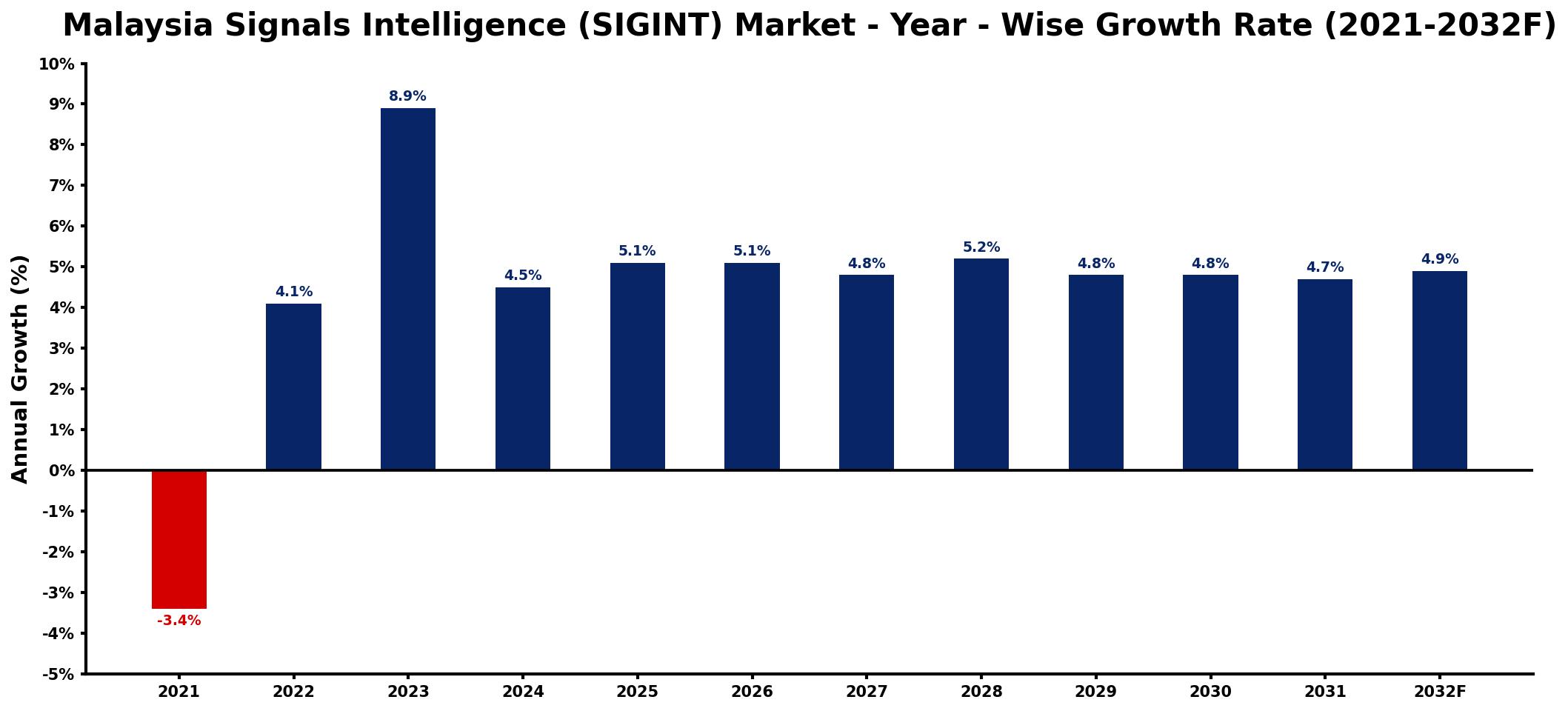
The table below presents the year‑wise growth rates along with the key drivers influencing the market
| Year | Growth Rate | Major Drivers |
| 2021 | -3.4% | Decreased government defense spending priorities |
| 2022 | 4.1% | Increased cybersecurity investment requirements |
| 2023 | 8.9% | Expansion of defense technology collaborations |
| 2024 | 4.5% | Growth in regional security partnerships |
| 2025 | 5.1% | Rising demand for data protection |
| 2026 | 5.1% | Emergence of advanced threat detection |
| 2027 | 4.8% | Enhancement of surveillance capabilities |
| 2028 | 5.2% | increased domestic production output |
| 2029 | 4.8% | Strengthening of national security frameworks |
| 2030 | 4.8% | Development of new communication protocols |
| 2031 | 4.7% | Diversification of technology vendor offerings |
| 2032 | 4.9% | Adoption of next-generation analytics tools |
Note: Market size estimations and growth projections presented in this report are based on 6Wresearch's proprietary forecasting methodology, utilizing the latest available industry data, government publications, and primary research inputs.
Malaysia Signals Intelligence (SIGINT) Market Synopsis
The most significant force shaping the Malaysia SIGINT market today is the urgent need for enhanced national security measures. In light of rising geopolitical tensions and cybersecurity threats, agencies across the government and military sectors are actively seeking out advanced SIGINT technologies to bolster their intelligence-gathering capabilities.
These advancements are not merely reactive; they reflect a broader trend towards modernization in Malaysias security infrastructure. With investments aimed at enhancing communication interception methods, the demand for reliable SIGINT solutions is set to experience consistent growth.
Malaysia Signals Intelligence (SIGINT) Market Key Takeaways
- The market is poised for steady growth, driven by national security needs and technological advancements.
- Ongoing investments from the government and military sectors are enhancing surveillance capabilities.
- The threat of cyberattacks is a major factor driving demand for SIGINT solutions.
- Government initiatives are increasingly focused on integrating advanced technologies in intelligence operations.
- Data privacy concerns present ongoing challenges for the market, necessitating careful regulatory compliance.
Evaluation of Restraints in Malaysia Signals Intelligence (SIGINT) Market
Despite the positive outlook for the SIGINT market in Malaysia, several constraints remain. Chief among these are the continuous need for significant investment in cutting-edge technologies, which can strain budgets. Additionally, concerns regarding data privacy and the ethical implications of surveillance pose challenges. Navigating international regulations surrounding intelligence gathering adds another layer of complexity, potentially hindering swift market growth. As these factors persist, stakeholders will need to address them strategically to capitalize on market opportunities.
Malaysia Signals Intelligence (SIGINT) Market Trends
Current trends in the Malaysia SIGINT market include an increasing emphasis on integrated systems that combine various forms of electronic signals interception. Additionally, advancements in artificial intelligence and machine learning are facilitating the development of smarter analytical tools that improve intelligence analysis efficiency. The demand for mobile SIGINT solutions is also on the rise, as agencies seek to enhance operational capabilities in dynamic environments. Overall, these trends reflect a shift towards more adaptable and sophisticated SIGINT technologies.
Malaysia Signals Intelligence (SIGINT) Market Opportunities
Significant opportunities in the Malaysia SIGINT market lie in the enhancement of cybersecurity frameworks. As the government prioritizes national security, investments in robust SIGINT capabilities are expected to increase. The growing focus on public-private partnerships to develop innovative surveillance technologies presents avenues for collaboration that can drive market expansion. Moreover, the integration of advanced analytics and real-time data processing capabilities will enhance the effectiveness of SIGINT solutions, creating further growth potential.
Government Initiatives in the Malaysia Signals Intelligence (SIGINT) Market
The Malaysian government is actively pursuing policies to enhance national security through improved SIGINT capabilities. This includes increased public spending on defense and intelligence projects, aimed at modernizing existing infrastructure. Programs that promote the integration of advanced surveillance technologies into national defense frameworks are being prioritized. Additionally, the government is working to create a regulatory environment that fosters innovation while ensuring compliance with data protection laws, thus supporting the growth of the SIGINT market.
Future Insights of the Malaysia Signals Intelligence (SIGINT) Market
Looking ahead to 2026-2032, the Malaysia SIGINT market is expected to evolve significantly. Continued investment from government and military sectors will likely lead to advanced capabilities in monitoring and intelligence operations. Moreover, the increasing sophistication of cyber threats will prompt a greater demand for innovative SIGINT solutions that can adapt to new challenges. Ultimately, the fusion of cutting-edge technology and strategic partnerships will shape the future landscape of this vital market.
Malaysia Signals Intelligence (SIGINT) Market Latest Developments (2025 - 2026)
Recent developments in the Malaysia SIGINT market have shown a strong trend towards enhanced collaboration between public and private sectors. This has resulted in innovative projects aimed at upgrading existing surveillance infrastructure and integrating advanced analytics. Additionally, new initiatives focused on cybersecurity have emerged, reflecting a growing recognition of the importance of safeguarding national information. Overall, these trends indicate a proactive approach to bolstering Malaysia's intelligence capabilities in response to evolving threats.
Malaysia Signals Intelligence (SIGINT) Market - Key Attractiveness of the Report
- 10 Years of Market Numbers
- Historical Data Starting from 2022 to 2025
- Base Year: 2025
- Forecast Data until 2032
- Key Performance Indicators Impacting the Market
- Major Upcoming Developments and Projects
Key Highlights of the Report:
- Malaysia Signals Intelligence (SIGINT) Market Outlook
- Market Size of Malaysia Signals Intelligence (SIGINT) Market, 2025
- Forecast of Malaysia Signals Intelligence (SIGINT) Market, 2032
- Historical Data and Forecast of Malaysia Signals Intelligence (SIGINT) Revenues & Volume for the Period 2022-2032F
- Malaysia Signals Intelligence (SIGINT) Market Trend Evolution
- Malaysia Signals Intelligence (SIGINT) Market Drivers and Challenges
- Malaysia Signals Intelligence (SIGINT) Price Trends
- Malaysia Signals Intelligence (SIGINT) Porter's Five Forces
- Malaysia Signals Intelligence (SIGINT) Industry Life Cycle
- Historical Data and Forecast of Malaysia Signals Intelligence (SIGINT) Market Revenues & Volume By Type for the Period 2022-2032F
- Historical Data and Forecast of Malaysia Signals Intelligence (SIGINT) Market Revenues & Volume By Electronic Intelligence for the Period 2022-2032F
- Historical Data and Forecast of Malaysia Signals Intelligence (SIGINT) Market Revenues & Volume By Communications Intelligence for the Period 2022-2032F
- Historical Data and Forecast of Malaysia Signals Intelligence (SIGINT) Market Revenues & Volume By Application for the Period 2022-2032F
- Historical Data and Forecast of Malaysia Signals Intelligence (SIGINT) Market Revenues & Volume By Airborne for the Period 2022-2032F
- Historical Data and Forecast of Malaysia Signals Intelligence (SIGINT) Market Revenues & Volume By Ground for the Period 2022-2032F
- Historical Data and Forecast of Malaysia Signals Intelligence (SIGINT) Market Revenues & Volume By Naval for the Period 2022-2032F
- Historical Data and Forecast of Malaysia Signals Intelligence (SIGINT) Market Revenues & Volume By Space for the Period 2022-2032F
- Historical Data and Forecast of Malaysia Signals Intelligence (SIGINT) Market Revenues & Volume By Cyber for the Period 2022-2032F
- Historical Data and Forecast of Malaysia Signals Intelligence (SIGINT) Market Revenues & Volume By Mobility for the Period 2022-2032F
- Historical Data and Forecast of Malaysia Signals Intelligence (SIGINT) Market Revenues & Volume By Fixed for the Period 2022-2032F
- Historical Data and Forecast of Malaysia Signals Intelligence (SIGINT) Market Revenues & Volume By Man Portable for the Period 2022-2032F
- Malaysia Signals Intelligence (SIGINT) Import Export Trade Statistics
- Market Opportunity Assessment By Type
- Market Opportunity Assessment By Application
- Market Opportunity Assessment By Mobility
- Malaysia Signals Intelligence (SIGINT) Top Companies Market Share
- Malaysia Signals Intelligence (SIGINT) Competitive Benchmarking By Technical and Operational Parameters
- Malaysia Signals Intelligence (SIGINT) Company Profiles
- Malaysia Signals Intelligence (SIGINT) Key Strategic Recommendations






































