Malaysia Simulation Software Market Size & Growth Rate (2026-2032)
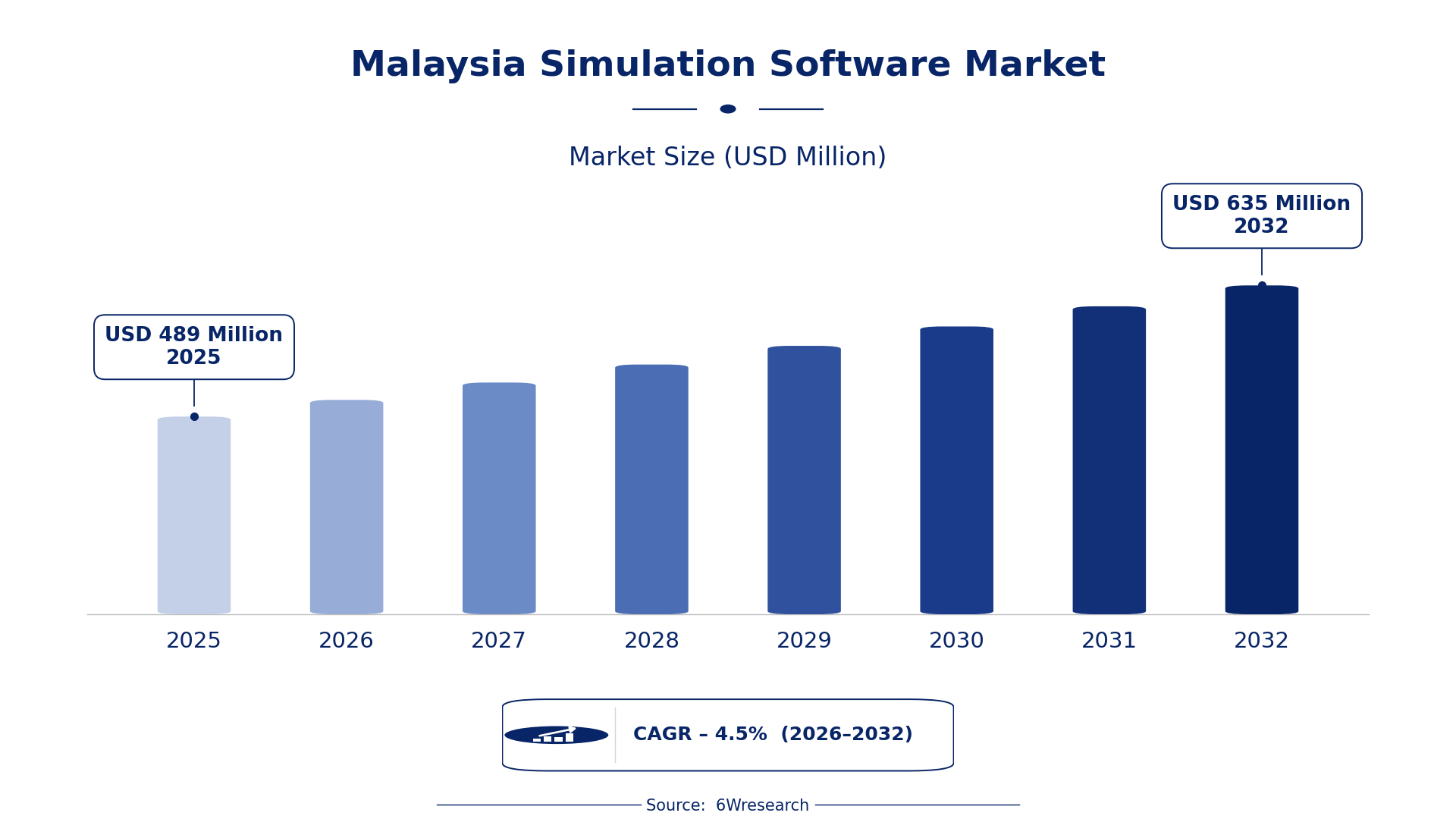
The Malaysia Simulation Software Market was estimated at USD 489 Million in 2025 and is projected to reach USD 635 Million by 2032, growing at a CAGR of 4.5% from 2026 to 2032.
Malaysia Simulation Software Market Synopsis
The Malaysia Simulation Software Market is experiencing notable expansion as industries increasingly adopt these tools for enhanced operational efficiency. The growing demand for cost-effective training and development solutions across sectors such as healthcare, manufacturing, and defense is a key driving force.
As organizations aim to model complex systems accurately, simulation software is becoming integral to decision-making processes. This trend not only reflects technological advancements but also signifies a shift towards data-driven strategies, propelling the market further.
Malaysia Simulation Software Market Year-wise Growth Rate and Key Drivers
This graph illustrates the annual growth rates of the Malaysia Simulation Software Market from 2021 to 2032, highlighting a steady upward trajectory and projected expansion over the forecast period.
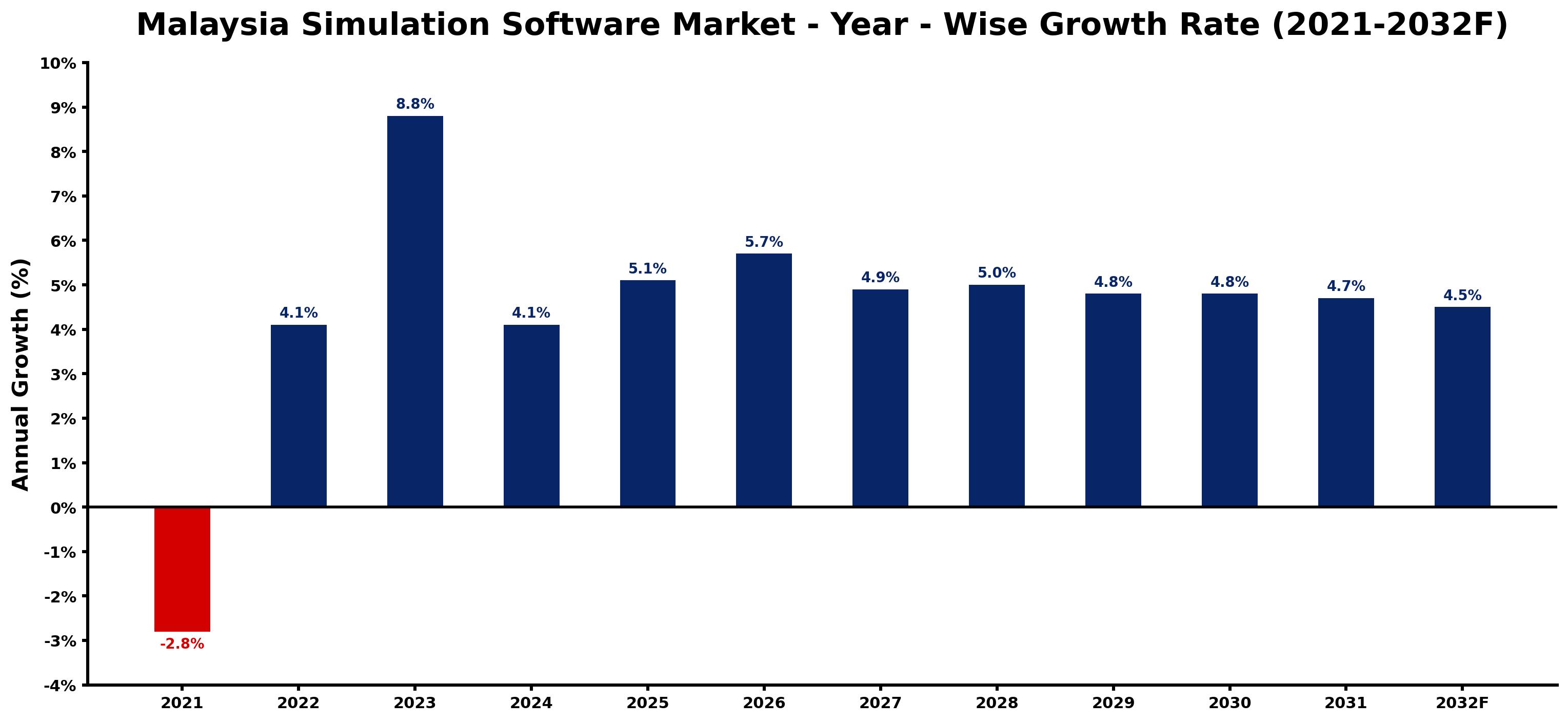
The table below presents the year‑wise growth rates along with the key drivers influencing the market
| Year | Growth Rate | Major Drivers |
| 2021 | -2.8% | MYR depreciation impacting software purchasing power. |
| 2022 | 4.1% | Government funding for aerospace innovations encourages simulation adoption. |
| 2023 | 8.8% | Increased remote learning initiatives boost educational simulation software. |
| 2024 | 4.1% | Rising healthcare investments drive medical simulation training programs. |
| 2025 | 5.1% | Emergence of smart manufacturing techniques enhances simulation needs. |
| 2026 | 5.7% | Local universities investing in advanced simulation research tools. |
| 2027 | 4.9% | Rapid growth in construction sector promotes project simulation solutions. |
| 2028 | 5.0% | Digital transformation efforts accelerate demand for simulation technologies. |
| 2029 | 4.8% | Government's Industry 4.0 agenda boosts simulation software usage. |
| 2030 | 4.8% | Increased awareness of environmental impact sparks simulation interest. |
| 2031 | 4.7% | Emerging niche markets need specialized simulation software applications. |
| 2032 | 4.5% | Proliferation of smart city initiatives drives urban simulation tools. |
Note: Market size estimations and growth projections presented in this report are based on 6Wresearch's proprietary forecasting methodology, utilizing the latest available industry data, government publications, and primary research inputs.
Malaysia Simulation Software Market Key Takeaways
Below are some of the specific key takeaways from the market, including:
- The increasing application of simulation software across multiple industries is driving market growth.
- Organizations seek innovative solutions to improve process efficiency and product design.
- Interoperability challenges remain a barrier to broader adoption of simulation technologies.
- COVID-19 accelerated the integration of simulation tools for virtual training and scenario analysis.
- Government initiatives are expected to bolster the development of this market segment.
Evaluation of Restraints in Malaysia Simulation Software Market
Despite the promising growth trajectory, several restraints continue to limit the full potential of the Malaysia Simulation Software Market. Interoperability issues with existing systems pose a considerable challenge, as businesses require simulation software to function effectively alongside their current hardware and software setups. The financial burden associated with both the acquisition and ongoing maintenance of simulation tools can deter small and medium enterprises from investing. on top of that, ensuring the accuracy and realism of simulations is crucial, particularly in sectors like healthcare and aerospace, where high-stakes decisions depend on precise modeling.
Malaysia Simulation Software Market Trends
The demand for real-time simulations is on the rise as industries seek to enhance their predictive capabilities. Companies are increasingly integrating artificial intelligence into simulation tools, resulting in smarter, more adaptive software solutions. Additionally, the trend towards remote work and online training solutions has led to a surge in interest for virtual simulation environments, especially in educational institutions. This shift is likely to further drive innovation and investment in simulation technologies.
Malaysia Simulation Software Market Opportunities
The ongoing digital transformation across various sectors presents substantial opportunities for the simulation software market. Investment in research and development is expected to grow, particularly in high-tech industries like aerospace and automotive, where simulation plays a crucial role in product development. on top of that, the increasing adoption of Industry 4.0 initiatives opens avenues for simulation tools that enhance manufacturing processes and supply chain management. As organizations continue to prioritize efficiency and cost reduction, the demand for sophisticated simulation solutions will likely increase.
Government Initiatives in the Malaysia Simulation Software Market
The Malaysian government is actively fostering an environment conducive to the growth of the simulation software sector. By implementing supportive policies and strategic initiatives, the government aims to position Malaysia as a hub for technological innovation. These initiatives are crucial for ensuring that local industries can harness the benefits of advanced simulation technologies and remain competitive globally.
- A national digital infrastructure upgrade programme launched recently aims to enhance the connectivity and capabilities of businesses using simulation software.
- Currently underway is a public-private partnership initiative focused on developing training programs that integrate simulation technology into vocational education.
- Upcoming legislation is expected to introduce a regulatory framework that encourages the adoption of simulation tools in compliance with industry standards.
- A recent initiative announced in early 2023 aims to provide grants for SMEs to adopt simulation software, facilitating broader access to these technologies.
- Another ongoing project focuses on research funding for universities to develop innovative simulation applications in healthcare and engineering fields.
Future Insights of the Malaysia Simulation Software Market
Looking ahead to 2026-2032, the Malaysia Simulation Software Market is set to evolve significantly. As industries increasingly recognize the importance of data-driven decision-making, the demand for sophisticated simulation tools will likely intensify. The integration of machine learning and advanced analytics into simulation software is expected to enhance functionality and user experience, ultimately driving adoption across various sectors. on top of that, as government initiatives continue to support digital transformation, the market will benefit from increased funding and collaboration opportunities.
Malaysia Simulation Software Market Latest Developments
Recent activity in the Malaysia Simulation Software Market has been characterized by a surge in innovation and investment. Companies are focusing on developing more interactive and immersive simulation solutions, reflecting a growing trend toward realism and user engagement. The COVID-19 pandemic has also catalyzed advancements, with many organizations re-evaluating their training and development strategies.
- A major technology vendor launched a new simulation platform in early 2023, designed to enhance real-time data analysis capabilities.
- An initiative that began in mid-2023 focuses on integrating virtual reality with simulation software to improve training outcomes in manufacturing sectors.
- A leading regional operator is currently collaborating with educational institutions to develop customized simulation-based learning modules, which remain underway.
- By late 2023, a rollout is expected for a cloud-based simulation solution aimed at small businesses, providing more accessible options for process optimization.
- A recent partnership between two tech firms aims to enhance simulation software functionalities by incorporating AI-driven predictive analytics, slated for completion by mid-2024.
Malaysia Simulation Software Market - Key Attractiveness of the Report
- 10 Years of Market Numbers
- Historical Data Starting from 2022 to 2025
- Base Year: 2025
- Forecast Data until 2032
- Key Performance Indicators Impacting the Market
- Major Upcoming Developments and Projects
Key Highlights of the Report:
- Malaysia Simulation Software Market Outlook
- Market Size of Malaysia Simulation Software Market, 2025
- Forecast of Malaysia Simulation Software Market, 2032
- Historical Data and Forecast of Malaysia Simulation Software Revenues & Volume for the Period 2022-2032F
- Malaysia Simulation Software Market Trend Evolution
- Malaysia Simulation Software Market Drivers and Challenges
- Malaysia Simulation Software Price Trends
- Malaysia Simulation Software Porter's Five Forces
- Malaysia Simulation Software Industry Life Cycle
- Historical Data and Forecast of Malaysia Simulation Software Market Revenues & Volume By Component for the Period 2022-2032F
- Historical Data and Forecast of Malaysia Simulation Software Market Revenues & Volume By Software for the Period 2022-2032F
- Historical Data and Forecast of Malaysia Simulation Software Market Revenues & Volume By Professional Services for the Period 2022-2032F
- Historical Data and Forecast of Malaysia Simulation Software Market Revenues & Volume By Deployment for the Period 2022-2032F
- Historical Data and Forecast of Malaysia Simulation Software Market Revenues & Volume By Cloud for the Period 2022-2032F
- Historical Data and Forecast of Malaysia Simulation Software Market Revenues & Volume By On-premises for the Period 2022-2032F
- Historical Data and Forecast of Malaysia Simulation Software Market Revenues & Volume By Application for the Period 2022-2032F
- Historical Data and Forecast of Malaysia Simulation Software Market Revenues & Volume By Product Engineering for the Period 2022-2032F
- Historical Data and Forecast of Malaysia Simulation Software Market Revenues & Volume By Research and Development for the Period 2022-2032F
- Historical Data and Forecast of Malaysia Simulation Software Market Revenues & Volume By Gamification for the Period 2022-2032F
- Historical Data and Forecast of Malaysia Simulation Software Market Revenues & Volume By Vertical Automobile for the Period 2022-2032F
- Historical Data and Forecast of Malaysia Simulation Software Market Revenues & Volume By Automobile for the Period 2022-2032F
- Historical Data and Forecast of Malaysia Simulation Software Market Revenues & Volume By Aerospace and Defense for the Period 2022-2032F
- Historical Data and Forecast of Malaysia Simulation Software Market Revenues & Volume By Electrical and Electronics for the Period 2022-2032F
- Historical Data and Forecast of Malaysia Simulation Software Market Revenues & Volume By Healthcare and Pharmaceuticals for the Period 2022-2032F
- Historical Data and Forecast of Malaysia Simulation Software Market Revenues & Volume By Oil and Gas and Mining for the Period 2022-2032F
- Historical Data and Forecast of Malaysia Simulation Software Market Revenues & Volume By Construction for the Period 2022-2032F
- Historical Data and Forecast of Malaysia Simulation Software Market Revenues & Volume By Ship Buildings and Marine for the Period 2022-2032F
- Historical Data and Forecast of Malaysia Simulation Software Market Revenues & Volume By Chemicals for the Period 2022-2032F
- Malaysia Simulation Software Import Export Trade Statistics
- Market Opportunity Assessment By Component
- Market Opportunity Assessment By Deployment
- Market Opportunity Assessment By Application
- Market Opportunity Assessment By Vertical Automobile
- Malaysia Simulation Software Top Companies Market Share
- Malaysia Simulation Software Competitive Benchmarking By Technical and Operational Parameters
- Malaysia Simulation Software Company Profiles
- Malaysia Simulation Software Key Strategic Recommendations






































