Malaysia Smokeless Tobacco Product Market Size, Share & Growth Rate
The Malaysia Smokeless Tobacco Product Market was estimated at USD 231 Million in 2025 and is projected to reach USD 301 Million by 2032, growing at a CAGR of 3.9% from 2026 to 2032. This steady growth can be attributed to a rising health consciousness among Malaysian consumers, who are increasingly seeking alternatives to traditional smoking. The government's strong regulatory framework, including taxation on cigarettes and smoking restrictions in public places, further propels the shift toward smokeless products.
Malaysia Smokeless Tobacco Product Market Year-wise Growth Rate and Key Drivers
This graph highlights how the Malaysia Smokeless Tobacco Product Market has steadily grown over the years, supported by major growth factors.
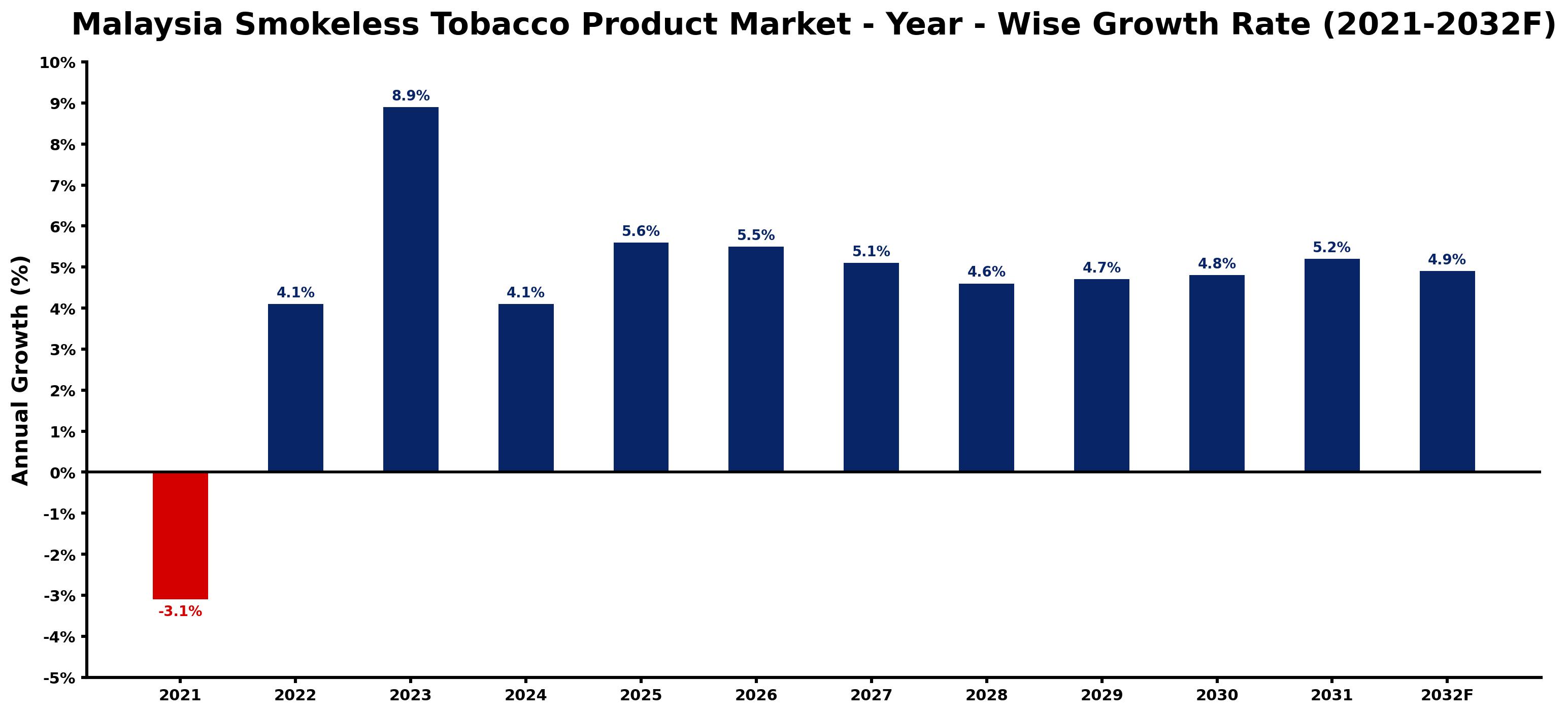
The table below presents the year‑wise growth rates along with the key drivers influencing the market
| Year | Growth Rate | Major Drivers |
| 2021 | -3.1% | Growing urbanization and commercial development |
| 2022 | 4.1% | Increasing smart city development projects |
| 2023 | 8.9% | Increasing industrial automation investments |
| 2024 | 4.1% | Increasing smart city development projects |
| 2025 | 5.6% | Growing renewable energy integration projects |
| 2026 | 5.5% | Increasing industrial infrastructure investments |
| 2027 | 5.1% | Growing urbanization and commercial development |
| 2028 | 4.6% | Growing urbanization and commercial development |
| 2029 | 4.7% | Growing renewable energy integration projects |
| 2030 | 4.8% | Expansion of manufacturing activities |
| 2031 | 5.2% | Increasing adoption of advanced technologies |
| 2032 | 4.9% | Expansion of transportation and logistics networks |
Note - Market size estimations and growth projections presented in this report are based on 6Wresearch’s advanced forecasting approach, validated with industry datasets as of June 2026.
Malaysia Smokeless Tobacco Product Market Synopsis
In recent years, the Malaysian smokeless tobacco market has witnessed a notable uptick in consumer interest and product availability. However, as the landscape evolves, we anticipate a significant shift towards more innovative product offerings to cater to changing preferences. Enhanced flavors and convenience formats are likely to attract a broader consumer base.
Despite the recent momentum, the market is poised for a transformation driven by both consumer trends and regulatory frameworks. The influx of disposable income among Malaysians aligns well with changing lifestyles, enhancing the appeal of smokeless tobacco products as a viable alternative to traditional smoking.
Malaysia Smokeless Tobacco Product Market Key Takeaways
- Health consciousness is increasingly influencing consumer choices, propelling demand for smokeless alternatives.
- Government policies favoring reduced smoking rates enhance the attractiveness of smokeless tobacco products.
- Product innovations, such as flavored snus and pre-portioned containers, are set to attract new users.
- The market is benefiting from a favorable economic environment, with rising disposable incomes.
- Awareness campaigns about the harms of smoking are contributing to the adoption of smokeless options.
Evaluation of Restraints in Malaysia Smokeless Tobacco Product Market
While the market shows promise, several factors could potentially restrain its growth. Regulatory scrutiny surrounding tobacco products continues to be a challenge, especially as health campaigns gain momentum. Additionally, traditional smoking remains deeply entrenched in cultural practices, which may slow the adoption of smokeless options. Competition from other nicotine delivery products, such as vaping, also presents a challenge, as consumers weigh their options amidst evolving preferences.
Malaysia Smokeless Tobacco Product Market Trends
Current trends indicate a significant shift towards flavored smokeless products, particularly snus and pouches. Consumers are increasingly drawn to unique flavor profiles that enhance the experience. Moreover, packaging innovations that emphasize convenience and discreet usage are emerging as key differentiators. This trend is particularly relevant among younger demographics who favor products that fit their on-the-go lifestyles.
Malaysia Smokeless Tobacco Product Market Opportunities
Emerging opportunities within the market include the potential for growth in online retail channels as consumer preferences shift towards digital shopping. Additionally, collaborations with local distributors could broaden market reach. The introduction of premium and niche products tailored to specific consumer segments presents further avenues for expansion, appealing to discerning users seeking differentiated experiences.
Government Initiatives in the Malaysia Smokeless Tobacco Product Market
The Malaysian government has implemented various initiatives aimed at reducing smoking rates and encouraging the use of less harmful alternatives. This includes taxation on traditional tobacco products, which serves as both a deterrent and a way to promote smokeless options. Additionally, strict regulations on advertising and public smoking foster an environment conducive to the adoption of smokeless tobacco products, aligning with public health objectives.
Future Insights of the Malaysia Smokeless Tobacco Product Market
Looking ahead to 2026-2032, the Malaysia Smokeless Tobacco Product Market is expected to capitalize on the growing trend of health awareness among consumers. Innovations in product formulation and packaging will be pivotal in capturing the interest of a diverse user base. As economic conditions continue to improve, the market is likely to expand, driven by increased disposable incomes and a cultural shift toward alternative tobacco consumption methods.
Malaysia Smokeless Tobacco Product Market Latest Developments (May 2025 - June 2026)
Recent industry developments have seen an uptick in the introduction of innovative smokeless tobacco products, aimed at meeting the evolving preferences of consumers. There's a noticeable trend toward the launch of flavored variants and convenient packaging solutions. Additionally, the regulatory landscape continues to adapt, with authorities refining policies that impact the marketing and sale of smokeless products.
Malaysia Smokeless Tobacco Product Market - Key Attractiveness of the Report
- 10 Years of Market Numbers
- Historical Data Starting from 2022 to 2025
- Base Year: 2025
- Forecast Data until 2032
- Key Performance Indicators Impacting the Market
- Major Upcoming Developments and Projects
Key Highlights of the Report:
- Malaysia Smokeless Tobacco Product Market Outlook
- Market Size of Malaysia Smokeless Tobacco Product Market, 2025
- Forecast of Malaysia Smokeless Tobacco Product Market, 2032F
- Historical Data and Forecast of Malaysia Smokeless Tobacco Product Revenues & Volume for the Period 2022-2032F
- Malaysia Smokeless Tobacco Product Market Trend Evolution
- Malaysia Smokeless Tobacco Product Market Drivers and Challenges
- Malaysia Smokeless Tobacco Product Price Trends
- Malaysia Smokeless Tobacco Product Porter's Five Forces
- Malaysia Smokeless Tobacco Product Industry Life Cycle
- Historical Data and Forecast of Malaysia Smokeless Tobacco Product Market Revenues & Volume By Product Type for the Period 2022-2032F
- Historical Data and Forecast of Malaysia Smokeless Tobacco Product Market Revenues & Volume By Chewing Tobacco for the Period 2022-2032F
- Historical Data and Forecast of Malaysia Smokeless Tobacco Product Market Revenues & Volume By Snuff for the Period 2022-2032F
- Historical Data and Forecast of Malaysia Smokeless Tobacco Product Market Revenues & Volume By Others for the Period 2022-2032F
- Historical Data and Forecast of Malaysia Smokeless Tobacco Product Market Revenues & Volume By Distribution Channel for the Period 2022-2032F
- Historical Data and Forecast of Malaysia Smokeless Tobacco Product Market Revenues & Volume By Online for the Period 2022-2032F
- Historical Data and Forecast of Malaysia Smokeless Tobacco Product Market Revenues & Volume By Offline for the Period 2022-2032F
- Malaysia Smokeless Tobacco Product Import Export Trade Statistics
- Market Opportunity Assessment By Product Type
- Market Opportunity Assessment By Distribution Channel
- Malaysia Smokeless Tobacco Product Top Companies Market Share
- Malaysia Smokeless Tobacco Product Competitive Benchmarking By Technical and Operational Parameters
- Malaysia Smokeless Tobacco Product Company Profiles
- Malaysia Smokeless Tobacco Product Key Strategic Recommendations






































