Malaysia Spun Yarn Market Size, Share & Growth Rate
The Malaysia Spun Yarn Market was estimated at USD 328 Million in 2025 and is projected to reach USD 427 Million by 2032, growing at a CAGR of 3.8% from 2026 to 2032. This growth is primarily fueled by the increasing demand for high-quality textile and apparel products both locally and in export markets. Additionally, innovations in spinning technologies and a burgeoning manufacturing ecosystem position Malaysia as a pivotal player in the Southeast Asian textile sector.
Malaysia Spun Yarn Market Year-wise Growth Rate and Key Drivers
This graph highlights how the Malaysia Spun Yarn Market has steadily grown over the years, supported by major growth factors.
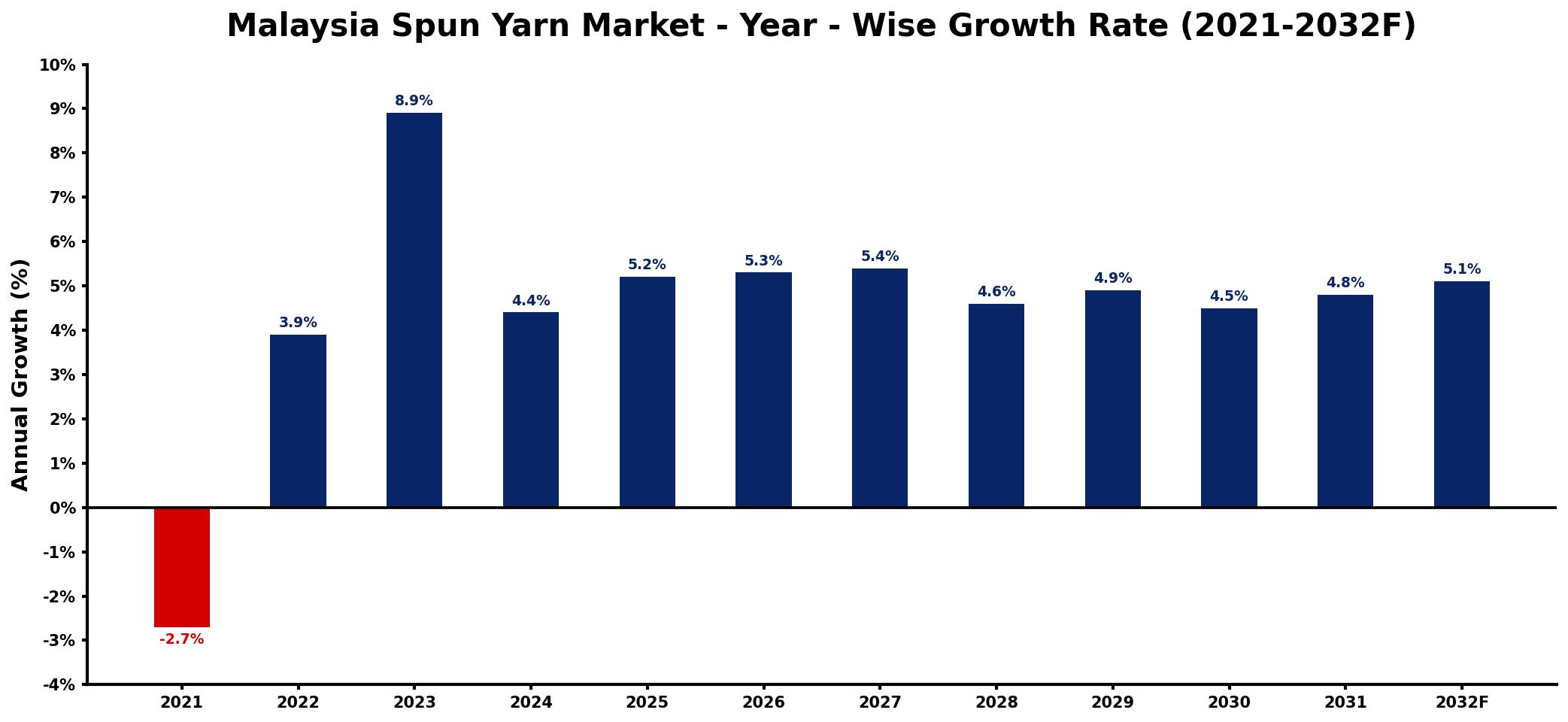
The table below presents the year‑wise growth rates along with the key drivers influencing the market
| Year | Growth Rate | Major Drivers |
| 2021 | -2.7% | decreased textile manufacturing output |
| 2022 | 3.9% | growing demand for apparel production |
| 2023 | 8.9% | expansion of export markets |
| 2024 | 4.4% | increase in domestic textile investments |
| 2025 | 5.2% | rising consumer fashion trends |
| 2026 | 5.3% | enhanced production capabilities adopted |
| 2027 | 5.4% | developing eco-friendly textile initiatives |
| 2028 | 4.6% | growing online retail platforms |
| 2029 | 4.9% | increased capital investment inflows |
| 2030 | 4.5% | increased automation in production |
| 2031 | 4.8% | rising demand for sustainable materials |
| 2032 | 5.1% | growing partnerships in textile industry |
Note: Market size estimations and growth projections presented in this report are based on 6Wresearch's proprietary forecasting methodology, utilizing the latest available industry data, government publications, and primary research inputs.
Malaysia Spun Yarn Market Synopsis
Recently, the Malaysia spun yarn market has demonstrated resilience despite global economic challenges. As we look toward the future, the market is poised for significant expansion, driven by an uptick in consumer preferences for diverse fabric options and higher quality standards.
The interplay between a robust domestic textile industry and increasing export opportunities is creating a favorable landscape for spun yarn manufacturers. As players in this market adopt advanced technologies and innovate their product offerings, the sector's growth trajectory appears robust and sustainable.
Malaysia Spun Yarn Market Key Takeaways
- Significant growth projected, driven by robust local and export demands.
- Technological advancements in spinning processes enhance product quality and competitiveness.
- Government support is fostering an environment conducive to industry growth.
- Increased disposable incomes and population growth are expected to boost consumption.
- Challenges like raw material price fluctuations remain, impacting cost structures.
Evaluation of Restraints in Malaysia Spun Yarn Market
Despite the promising growth trajectory, the Malaysia spun yarn market faces several significant constraints. Fluctuations in raw material prices can create unpredictability, impacting profit margins and operational efficiencies for manufacturers. Additionally, competition from neighboring textile-producing countries poses a challenge, pressuring local players to enhance their value propositions continually. The ongoing need for innovation and adaptation to global market dynamics will be crucial for maintaining a competitive edge.
Malaysia Spun Yarn Market Trends
Current trends in the Malaysia spun yarn market highlight a shift towards sustainable practices and eco-friendly materials. Consumers increasingly favor products that reflect ethical sourcing and minimal environmental impact, prompting manufacturers to explore organic fibers and sustainable production methods. Moreover, the integration of technology in spinning processes is leading to increased efficiency, quality improvement, and customization capabilities, catering to the evolving demands of the textile industry.
Malaysia Spun Yarn Market Opportunities
Significant opportunities lie in the expansion of export markets, particularly in Asia-Pacific regions where demand for Malaysian spun yarn is on the rise. As more global brands look towards Southeast Asia for sourcing, Malaysian manufacturers can capitalize on this trend by enhancing their production capabilities and product offerings. Additionally, investments in research and development focused on innovative yarn types and blending techniques are likely to open new avenues for growth and diversification.
Government Initiatives in the Malaysia Spun Yarn Market
The Malaysian government has introduced several initiatives aimed at boosting the textile and apparel sector, including the spun yarn market. Policies encouraging foreign direct investment and technology transfer are central to these efforts. Furthermore, various programs focused on skill development and workforce training are being implemented to ensure that the industry remains competitive on a global scale. Public spending on infrastructure improvements also enhances the logistical framework for manufacturers.
Future Insights of the Malaysia Spun Yarn Market
Looking ahead to the period between 2026 and 2032, the Malaysia spun yarn market is expected to continue on its upward trajectory. As the global economy stabilizes and consumer spending increases, demand for high-quality textiles is likely to surge. The ongoing innovation in production techniques will further refine product offerings, enabling Malaysian manufacturers to meet both local and international needs effectively. This period will also witness a greater emphasis on sustainability, aligning with global trends and consumer preferences.
Malaysia Spun Yarn Market Latest Developments (2025 - 2026)
Recent months have seen a notable shift towards advanced spinning technologies among Malaysian manufacturers, reflecting a commitment to maintaining quality standards. Many companies are investing in automation and smart manufacturing processes, which are expected to enhance production efficiency significantly. Additionally, collaborations between academic institutions and industry players are fostering innovation in product development, setting the stage for new offerings in the spun yarn segment.
Malaysia Spun Yarn Market - Key Attractiveness of the Report
- 10 Years of Market Numbers
- Historical Data Starting from 2022 to 2025
- Base Year: 2025
- Forecast Data until 2032
- Key Performance Indicators Impacting the Market
- Major Upcoming Developments and Projects
Key Highlights of the Report:
- Malaysia Spun Yarn Market Outlook
- Market Size of Malaysia Spun Yarn Market, 2025
- Forecast of Malaysia Spun Yarn Market, 2032
- Historical Data and Forecast of Malaysia Spun Yarn Revenues & Volume for the Period 2022-2032F
- Malaysia Spun Yarn Market Trend Evolution
- Malaysia Spun Yarn Market Drivers and Challenges
- Malaysia Spun Yarn Price Trends
- Malaysia Spun Yarn Porter's Five Forces
- Malaysia Spun Yarn Industry Life Cycle
- Historical Data and Forecast of Malaysia Spun Yarn Market Revenues & Volume By Application for the Period 2022-2032F
- Historical Data and Forecast of Malaysia Spun Yarn Market Revenues & Volume By Textile for the Period 2022-2032F
- Historical Data and Forecast of Malaysia Spun Yarn Market Revenues & Volume By Healthcare for the Period 2022-2032F
- Historical Data and Forecast of Malaysia Spun Yarn Market Revenues & Volume By Home Furnishing for the Period 2022-2032F
- Historical Data and Forecast of Malaysia Spun Yarn Market Revenues & Volume By Others for the Period 2022-2032F
- Malaysia Spun Yarn Import Export Trade Statistics
- Market Opportunity Assessment By Application
- Malaysia Spun Yarn Top Companies Market Share
- Malaysia Spun Yarn Competitive Benchmarking By Technical and Operational Parameters
- Malaysia Spun Yarn Company Profiles
- Malaysia Spun Yarn Key Strategic Recommendations






































