Malaysia Stainless Steel Round Bar Market Size, Share & Growth Rate
The Malaysia Stainless Steel Round Bar Market was estimated at USD 371 Million in 2025 and is projected to reach USD 555 Million by 2032, growing at a CAGR of 5.9% from 2026 to 2032. This projected growth trajectory is fueled by the ongoing investments in infrastructure and an expanding manufacturing sector. As Malaysia's construction activities ramp up, the demand for durable, corrosion-resistant materials like stainless steel round bars will continue to rise.
Malaysia Stainless Steel Round Bar Market Year-wise Growth Rate and Key Drivers
This graph highlights how the Malaysia Stainless Steel Round Bar Market has steadily grown over the years, supported by major growth factors.
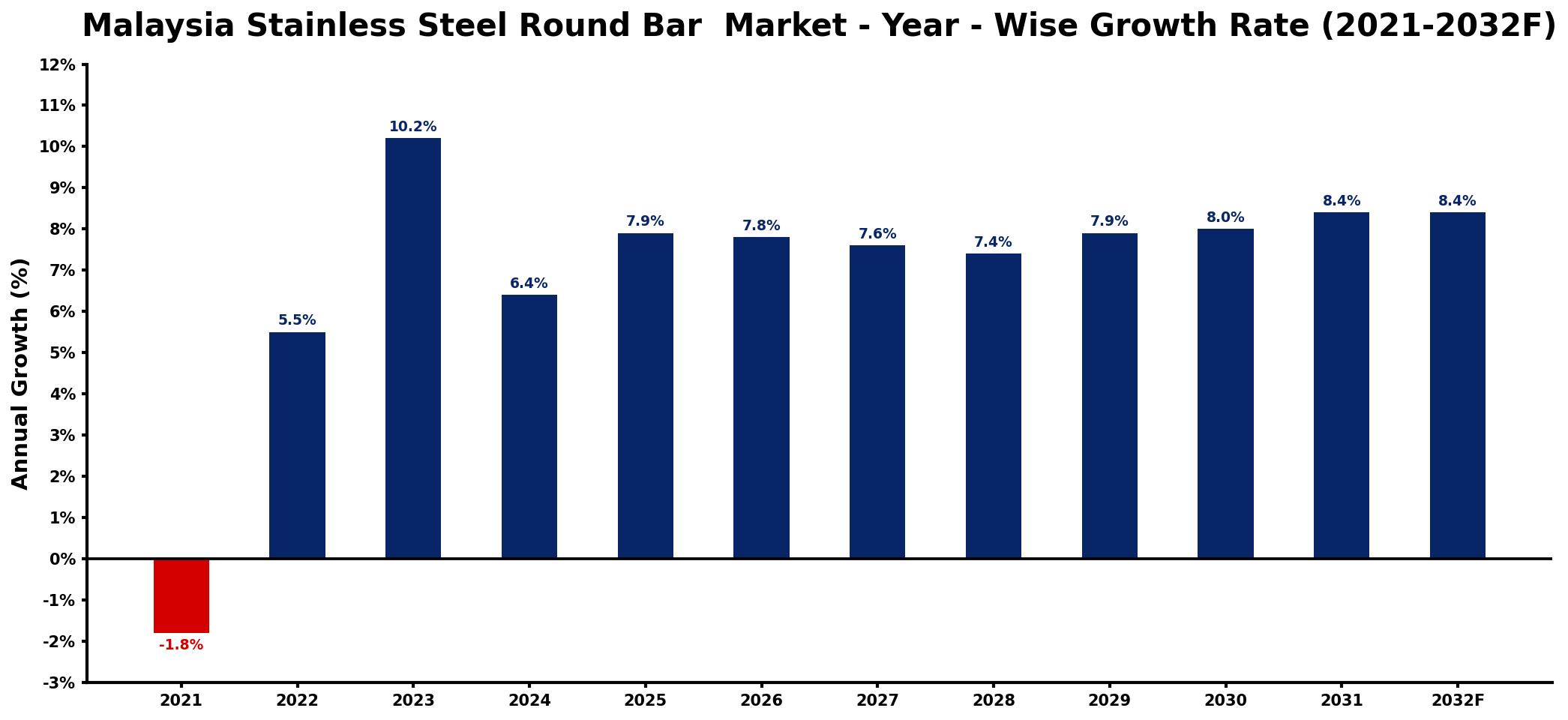
The table below presents the year‑wise growth rates along with the key drivers influencing the market
| Year | Growth Rate | Major Drivers |
| 2021 | -1.8% | decrease in construction activities |
| 2022 | 5.5% | increase in manufacturing investments |
| 2023 | 10.2% | rising demand from automotive sector |
| 2024 | 6.4% | expansion in infrastructure projects |
| 2025 | 7.9% | growth in renewable energy investments |
| 2026 | 7.8% | upsurge in export opportunities |
| 2027 | 7.6% | development of urban housing projects |
| 2028 | 7.4% | enhanced industrial automation trends |
| 2029 | 7.9% | growing aerospace and defense needs |
| 2030 | 8.0% | increased adoption of green technologies |
| 2031 | 8.4% | rising consumer electronics production |
| 2032 | 8.4% | strengthened regional trade agreements |
Note: Market size estimations and growth projections presented in this report are based on 6Wresearch's proprietary forecasting methodology, utilizing the latest available industry data, government publications, and primary research inputs.
Malaysia Stainless Steel Round Bar Market Synopsis
Despite the disruptions faced during the pandemic, the market for stainless steel round bars in Malaysia is set to rebound robustly. With a growing emphasis on infrastructure development and industrialization, the future appears bright for this segment. The increasing utilization in various sectors, including construction and food service, underscores the material's essential role in the economy.
As Malaysia positions itself for future growth, stainless steel round bars emerge as a pivotal component in numerous applications. From automotive manufacturing to food and beverage production, the versatility of stainless steel ensures that it remains a staple material, driving continuous market demand in the coming years.
Malaysia Stainless Steel Round Bar Market Key Takeaways
- Significant growth expected due to expansion in construction and manufacturing sectors.
- Stainless steel's properties make it essential for various applications including automotive and food service.
- Market challenges include raw material price volatility affecting production costs.
- COVID-19 had a temporary impact, but recovery is underway with renewed infrastructure investments.
- Strong customer relationships and cost-effective production methods are vital for market competitiveness.
Evaluation of Restraints in Malaysia Stainless Steel Round Bar Market
The stainless steel round bar market in Malaysia faces significant restraints primarily due to the volatility in raw material prices, particularly nickel and chromium. Fluctuations in these costs can directly impact production expenses, which may lead to increased prices for end-users. Additionally, the market is sensitive to global economic conditions, as international supply chain disruptions can affect material availability. Stakeholders will need to implement strategic measures to navigate these challenges effectively and maintain competitive pricing.
Malaysia Stainless Steel Round Bar Market Trends
Current trends show a growing preference for sustainable production practices within the stainless steel industry. Manufacturers are increasingly adopting eco-friendly processes to minimize environmental impact, which resonates well with consumers rising awareness regarding sustainability. Furthermore, technological advancements in manufacturing processes are enhancing product quality and efficiency, thus appealing to diverse sectors from construction to automotive.
Malaysia Stainless Steel Round Bar Market Opportunities
The market presents numerous opportunities for growth, particularly in niche applications where stainless steel is becoming the material of choice. Enhanced construction projects, alongside new manufacturing techniques, provide fertile ground for innovation. Investments in modern infrastructure can unlock new demands, while the food and beverage sector remains a constant driver of stainless steel usage, especially in kitchenware and tableware. Industry stakeholders should look to expand into these growing sectors to maximize their potential.
Government Initiatives in the Malaysia Stainless Steel Round Bar Market
The Malaysian government has been proactive in promoting local manufacturing through various initiatives aimed at boosting economic growth. Policies focusing on infrastructure development and incentives for sustainable manufacturing practices are encouraging investments in the steel sector. Public spending on infrastructure projects is anticipated to increase, thereby supporting demand for stainless steel round bars. Such initiatives reflect the government's commitment to fostering a resilient manufacturing environment.
Future Insights of the Malaysia Stainless Steel Round Bar Market
Looking ahead to 2026-2032, the Malaysia Stainless Steel Round Bar Market is likely to witness sustained growth, driven by ongoing industrialization and infrastructure development. With the anticipated rise in manufacturing and construction activities, coupled with advances in production technologies, the market is well-positioned for expansion. Stakeholders who adapt to evolving market dynamics and focus on sustainable practices will likely be best positioned to capitalize on emerging opportunities.
Malaysia Stainless Steel Round Bar Market Latest Developments (2025 - 2026)
In recent months, the Malaysian stainless steel round bar market has seen several developments aimed at enhancing production efficiency. Manufacturers are increasingly investing in innovative technologies to optimize production processes. Moreover, there is a notable shift towards sustainability, with companies looking to minimize their carbon footprint and respond to growing consumer demand for environmentally responsible products. Such shifts suggest an evolving landscape that prioritizes both quality and sustainability.
Malaysia Stainless Steel Round Bar Market - Key Attractiveness of the Report
- 10 Years of Market Numbers
- Historical Data Starting from 2022 to 2025
- Base Year: 2025
- Forecast Data until 2032
- Key Performance Indicators Impacting the Market
- Major Upcoming Developments and Projects
Key Highlights of the Report:
- Malaysia Stainless Steel Round Bar Market Outlook
- Market Size of Malaysia Stainless Steel Round Bar Market, 2025
- Forecast of Malaysia Stainless Steel Round Bar Market, 2032
- Historical Data and Forecast of Malaysia Stainless Steel Round Bar Revenues & Volume for the Period 2022-2032F
- Malaysia Stainless Steel Round Bar Market Trend Evolution
- Malaysia Stainless Steel Round Bar Market Drivers and Challenges
- Malaysia Stainless Steel Round Bar Price Trends
- Malaysia Stainless Steel Round Bar Porter's Five Forces
- Malaysia Stainless Steel Round Bar Industry Life Cycle
- Historical Data and Forecast of Malaysia Stainless Steel Round Bar Market Revenues & Volume By Product for the Period 2022-2032F
- Historical Data and Forecast of Malaysia Stainless Steel Round Bar Market Revenues & Volume By Cr-Ni for the Period 2022-2032F
- Historical Data and Forecast of Malaysia Stainless Steel Round Bar Market Revenues & Volume By Duplex & Super Duplex for the Period 2022-2032F
- Historical Data and Forecast of Malaysia Stainless Steel Round Bar Market Revenues & Volume By High Nickel Alloys for the Period 2022-2032F
- Malaysia Stainless Steel Round Bar Import Export Trade Statistics
- Market Opportunity Assessment By Product
- Malaysia Stainless Steel Round Bar Top Companies Market Share
- Malaysia Stainless Steel Round Bar Competitive Benchmarking By Technical and Operational Parameters
- Malaysia Stainless Steel Round Bar Company Profiles
- Malaysia Stainless Steel Round Bar Key Strategic Recommendations






































