Malaysia Sugar Refinery Machinery and Equipment Market Summary
The malaysia sugar refinery machinery and equipment market was estimated at USD 194 Million in 2025 and is projected to reach USD 251 Million by 2032, growing at a CAGR of 5.3% from 2026 to 2032.
Malaysia Sugar Refinery Machinery and Equipment Market Year-wise Growth Rate and Key Drivers
This graph highlights how the Malaysia Sugar Refinery Machinery and Equipment Market has steadily grown over the past five years, supported by major growth factors.
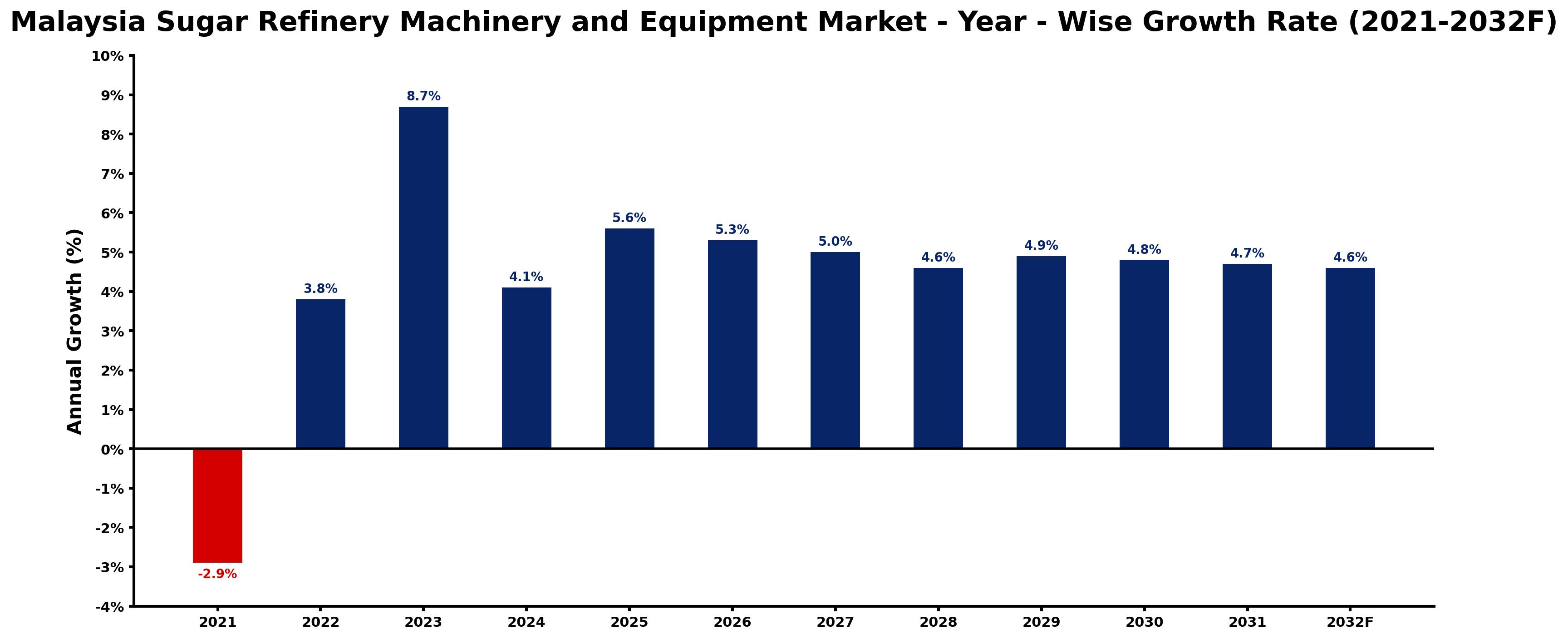
The table below presents the year wise growth rates along with the key drivers influencing the market
| Year | Growth Rate | Major Drivers |
| 2021 | -2.9% | Heightened import tariffs on machinery components hindered operational efficiency and increased production costs for local manufacturers. |
| 2022 | 3.8% | Emerging local manufacturers seek advanced machinery to enhance operational efficiency. |
| 2023 | 8.7% | Increased sugar consumption trends prompt refinery upgrades and modernization initiatives. |
| 2024 | 4.1% | Technological innovations draw interest in energy-efficient refining processes within the sector. |
| 2025 | 5.6% | Key players form partnerships to localize machinery production, reducing logistics costs. |
| 2026 | 5.3% | Sustainability concerns lead to growing demand for eco-friendly refining equipment innovations. |
| 2027 | 5.0% | A shift towards automation aligns with broader industrial advancements across Malaysia's manufacturing landscape. |
| 2028 | 4.6% | Investment in workforce training ensures skilled labor for operating new machinery technologies. |
| 2029 | 4.9% | Export opportunities for refined sugar drive demand for state-of-the-art refinery systems. |
| 2030 | 4.8% | Global market fluctuations necessitate adaptability in machinery to optimize product quality. |
| 2031 | 4.7% | Integration of IoT technologies enables real-time monitoring and efficiency in sugar production. |
| 2032 | 4.6% | Diversification in sugar products encourages technological evolution within the refining machinery market. |
Note - Market size estimations and growth projections presented in this report are based on 6Wresearch's advanced forecasting approach, validated with industry datasets as of June 2026.
Malaysia Sugar Refinery Machinery and Equipment Market Synopsis
The Malaysia Sugar Refinery Machinery and Equipment Market is projected to reach 5.3% and witness significant growth during the forecast period (2026-2032). As one of the largest consumers of sugar in Southeast Asia, Malaysia's total sugar consumption was approximately 1.6 million tons during the 2018-2019 period. This robust demand for sugar has catalyzed the expansion of the sugar refinery sector, which continues to thrive amid evolving consumer preferences and market dynamics.
Malaysia Sugar Refinery Machinery and Equipment Market Growth Drivers
Several factors are propelling the growth of the Malaysia Sugar Refinery Machinery and Equipment Market. Firstly, the increasing domestic demand for sugar fosters investment in refining capabilities to enhance production efficiency and quality. Secondly, advancements in technology are fostering innovation in machinery that optimizes production processes, thereby reducing operational costs. Additionally, rising health consciousness among consumers is driving the demand for high-quality refined sugar with fewer impurities, further stimulating the need for sophisticated refining equipment. Furthermore, Malaysia's strategic location and established trade networks enhance its potential as a regional hub for sugar processing and distribution, attracting investments into its machinery sector.
Malaysia Sugar Refinery Machinery and Equipment Market Challenges and Restraints
Despite the positive growth outlook, there are challenges facing the Malaysia Sugar Refinery Machinery and Equipment Market. One notable constraint is the fluctuation in raw sugar prices, which can impact profitability for refineries. Additionally, the industry faces increasing competition from imported sugars, which could pressure local producers to maintain cost-effective operations. Moreover, stringent regulatory environments regarding food safety and quality standards necessitate continuous investment in compliance, posing a financial burden on smaller players. Lastly, the market is also influenced by climate change, which can affect sugar cane yield and overall supply chain stability.
Malaysia Sugar Refinery Machinery and Equipment Market Trends and Opportunities
The Malaysia Sugar Refinery Machinery and Equipment Market presents various trends and opportunities that stakeholders can leverage. One significant trend is the shift towards automation and digitalization in refining processes, allowing for enhanced efficiency and data-driven decision-making. Companies are increasingly looking to integrate smart technologies to monitor and optimize production parameters. Another opportunity lies in the growing demand for organic and natural sugars, prompting refiners to invest in specialized machinery that can cater to this emerging market segment. Additionally, the government's focus on boosting the manufacturing sector offers potential support for infrastructure development and innovation within the sugar processing industry.
Malaysia Sugar Refinery Machinery and Equipment Market Government Investment and Initiatives
The Malaysian government has been actively investing in the sugar industry, which is crucial for ensuring self-sufficiency in sugar production. Various initiatives focus on enhancing technological capabilities within the sector, providing funding for research and development of machinery tailored for sugar refinement. Furthermore, policies aimed at supporting local sugar production, such as tariffs on imported sugar and incentives for modernizing equipment, aim to bolster domestic refineries. These governmental investments are designed to stimulate growth and ensure that Malaysia remains competitive in the global sugar market.
Malaysia Sugar Refinery Machinery and Equipment Market Latest Developments (May 2025 - June 2026)
Recent developments from May 2025 to June 2026 indicate a significant shift towards sustainability within the Malaysia Sugar Refinery Machinery and Equipment Market. A growing number of refiners are adopting energy-efficient machinery that aligns with global environmental standards. Innovations in equipment that reduce water usage and waste are becoming more prevalent as companies seek to minimize their ecological footprints. Moreover, there is an increasing emphasis on training and developing skilled labor to operate advanced refining technologies, addressing the industry's need for expertise in handling sophisticated machinery. The trend towards vertical integration is also emerging, with refiners exploring direct partnerships with farmers to secure a more stable supply chain.
Malaysia Sugar Refinery Machinery and Equipment Market - Key Attractiveness of the Report
- 10 Years of Market Numbers
- Historical Data Starting from 2022 to 2025
- Base Year: 2025
- Forecast Data until 2032
- Key Performance Indicators Impacting the Market
- Major Upcoming Developments and Projects
Key Highlights of the Report:
- Malaysia Sugar Refinery Machinery and Equipment Market Outlook
- Market Size of Malaysia Sugar Refinery Machinery and Equipment Market, 2025
- Forecast of Malaysia Sugar Refinery Machinery and Equipment Market, 2032F
- Historical Data and Forecast of Malaysia Sugar Refinery Machinery and Equipment Revenues & Volume for the Period 2022-2032F
- Malaysia Sugar Refinery Machinery and Equipment Market Trend Evolution
- Malaysia Sugar Refinery Machinery and Equipment Market Drivers and Challenges
- Malaysia Sugar Refinery Machinery and Equipment Price Trends
- Malaysia Sugar Refinery Machinery and Equipment Porter's Five Forces
- Malaysia Sugar Refinery Machinery and Equipment Industry Life Cycle
- Historical Data and Forecast of Malaysia Sugar Refinery Machinery and Equipment Market Revenues & Volume By Refineries Type for the Period 2022-2032F
- Historical Data and Forecast of Malaysia Sugar Refinery Machinery and Equipment Market Revenues & Volume By Front End Refineries for the Period 2022-2032F
- Historical Data and Forecast of Malaysia Sugar Refinery Machinery and Equipment Market Revenues & Volume By Back End Refineries for the Period 2022-2032F
- Historical Data and Forecast of Malaysia Sugar Refinery Machinery and Equipment Market Revenues & Volume By Machinery and Equipment Type for the Period 2022-2032F
- Historical Data and Forecast of Malaysia Sugar Refinery Machinery and Equipment Market Revenues & Volume By Cane Handling Equipment for the Period 2022-2032F
- Historical Data and Forecast of Malaysia Sugar Refinery Machinery and Equipment Market Revenues & Volume By Cutting & Grinding Equipment for the Period 2022-2032F
- Historical Data and Forecast of Malaysia Sugar Refinery Machinery and Equipment Market Revenues & Volume By Processing Equipment for the Period 2022-2032F
- Historical Data and Forecast of Malaysia Sugar Refinery Machinery and Equipment Market Revenues & Volume By Packaging Equipment for the Period 2022-2032F
- Malaysia Sugar Refinery Machinery and Equipment Import Export Trade Statistics
- Market Opportunity Assessment By Refineries Type
- Market Opportunity Assessment By Machinery and Equipment Type
- Malaysia Sugar Refinery Machinery and Equipment Top Companies Market Share
- Malaysia Sugar Refinery Machinery and Equipment Competitive Benchmarking By Technical and Operational Parameters
- Malaysia Sugar Refinery Machinery and Equipment Company Profiles
- Malaysia Sugar Refinery Machinery and Equipment Key Strategic Recommendations






































