Malaysia Television Market Summary
The malaysia television market was estimated at USD 1041 Million in 2025 and is projected to reach USD 1542 Million by 2032, growing at a CAGR of 7.6% from 2026 to 2032.
Malaysia Television Market Year-wise Growth Rate and Key Drivers
This graph highlights how the Malaysia Television Market has steadily grown over the past five years, supported by major growth factors.
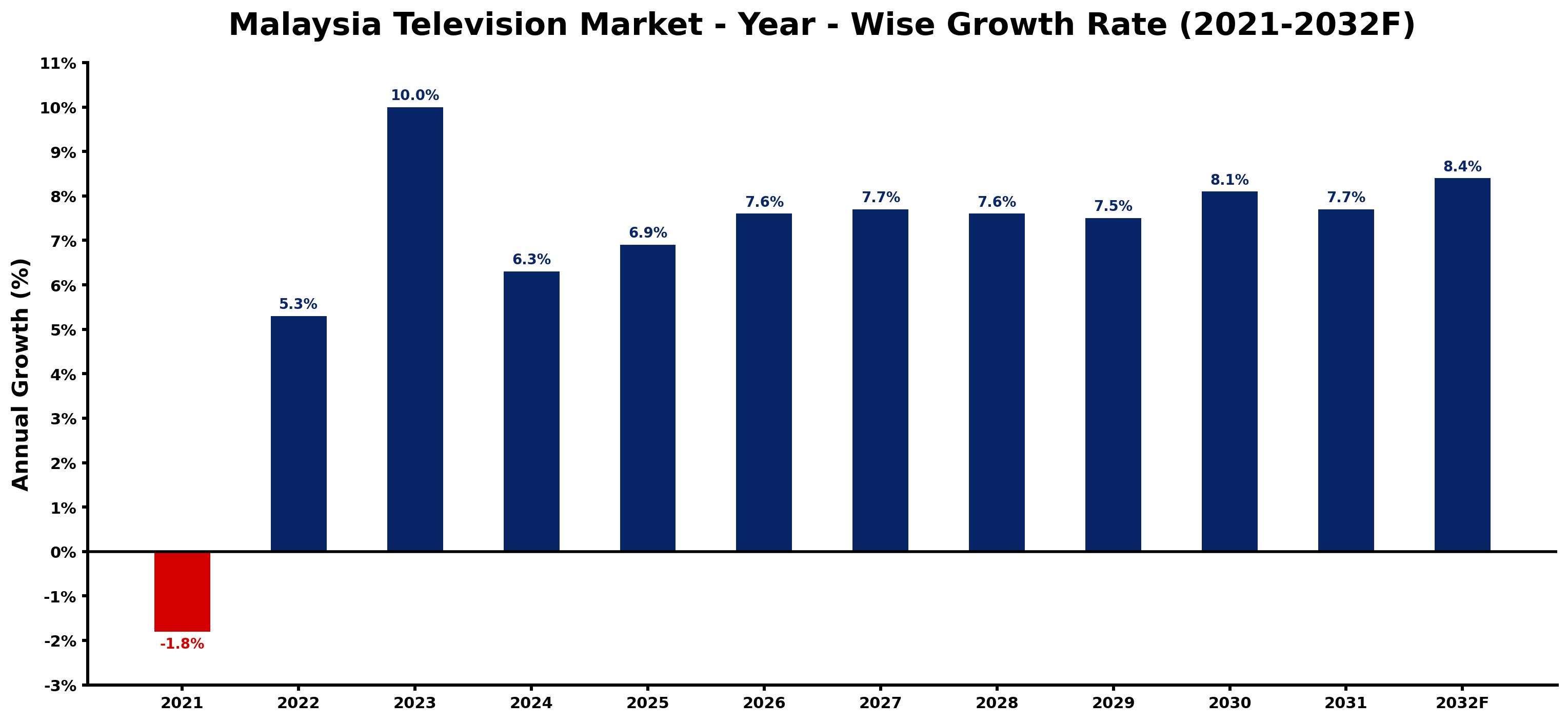
The table below presents the year wise growth rates along with the key drivers influencing the market
| Year | Growth Rate | Major Drivers |
| 2021 | -1.8% | Intensified competition from digital streaming services diminished traditional television viewership and subscription growth. |
| 2022 | 5.3% | Investment in local content production surged, enhancing viewer engagement and loyalty. |
| 2023 | 10.0% | The integration of AI technology improved content personalization, attracting diverse audiences. |
| 2024 | 6.3% | Television subscription models evolved, with bundle offerings appealing to families. |
| 2025 | 6.9% | Partnerships between broadcasters and tech companies led to innovative viewing experiences. |
| 2026 | 7.6% | Youth-centric programming expanded, tapping into the growing millennial and Gen Z segments. |
| 2027 | 7.7% | Regional collaborations emerged, boosting content sharing and broadening market reach. |
| 2028 | 7.6% | Emergence of niche channels attracted specific interest groups, enriching the content landscape. |
| 2029 | 7.5% | Enhanced broadband infrastructure enabled seamless streaming, increasing viewership significantly. |
| 2030 | 8.1% | Cultural diversity in programming resonated widely, fostering a sense of community among viewers. |
| 2031 | 7.7% | Advertisers shifted focus to digital platforms, enhancing revenue streams for local networks. |
| 2032 | 8.4% | Sustainability themes in content became prominent, reflecting societal values and expectations. |
Note - Market size estimations and growth projections presented in this report are based on 6Wresearch's advanced forecasting approach, validated with industry datasets as of June 2026.
Malaysia Television Market Synopsis
The Malaysia Television Market is projected to reach 7.6% and witness significant growth during the forecast period (2026-2032). The market is driven by several factors, including the increased demand for smart televisions, rising disposable income among consumers, and the growing adoption of digital services. These dynamics have positioned the Malaysia Television Market as one of the most promising sectors within the country's digital landscape.
Malaysia Television Market Growth Drivers
The growth of the Malaysia Television Market can be attributed to various interrelated factors that are shaping consumer behavior and market dynamics.
- The surge in demand for smart televisions is a primary driver, with consumers increasingly seeking devices that offer integrated streaming capabilities and enhanced viewing experiences.
- Rising disposable income is enabling consumers to invest in high-quality television sets, reflecting a shift towards premium products that support advanced technology and features.
- The expansion of digital services, including over-the-top (OTT) platforms, has significantly influenced television consumption patterns, leading to higher engagement with smart televisions.
- Technological advancements such as 4K resolution LED/LCD TVs and OLED displays with ultra-HD content are captivating consumer interest, thus driving sales in the premium segment.
- Increasing internet penetration further facilitates access to online streaming services like Netflix and YouTube, contributing to a booming television consumption landscape.
Malaysia Television Market Challenges and Restraints
Despite the optimistic growth projections for the Malaysia Television Market, several challenges could potentially hinder its development during the forecast period.
- The competitive nature of the market has resulted in falling prices, particularly from local manufacturers, which may adversely affect profit margins for certain product segments.
- Limited access to broadband infrastructure in certain areas poses a challenge, as consumers in those regions may not fully benefit from the rise of streaming platforms and smart television functionalities.
- Consumer trends can be volatile; shifts in preferences toward alternative entertainment options could impact traditional television viewing habits.
- The ongoing global economic uncertainties might affect consumers' purchasing power, further complicating market growth dynamics.
- Regulatory changes and policies related to broadcasting rights and content distribution may impose additional challenges for market participants.
Malaysia Television Market Government Investment and Initiatives
The Malaysian government has recognized the significance of the television market as a crucial component of the country's economic landscape. To support and stimulate the sector, several initiatives and investments have been introduced:
- Government policies aimed at promoting digital transformation in the media sector encourage investments in advanced broadcasting technologies and infrastructure enhancements.
- Public funding initiatives support the development of local content production, enhancing the quality and diversity of offerings available to Malaysian viewers.
- Investment in broadband expansion remains a priority, as improving internet connectivity is critical for enabling access to streaming services and digital platforms.
- The government is also focusing on regulatory frameworks that promote fair competition while safeguarding consumer interests in the rapidly changing television market.
- Initiatives encouraging public-private partnerships are designed to leverage resources for enhancing the television broadcasting landscape in Malaysia.
Malaysia Television Market Latest Developments (May 2025 - June 2026)
Recent developments in the Malaysia Television Market reflect a continued evolution in consumer preferences and technological advancements. During this period, several noteworthy trends have emerged:
- The introduction of next-generation television standards has seen an increase in the deployment of 8K resolution displays, sparking consumer interest in ultra-high-definition viewing experiences.
- The increasing prevalence of on-demand content has accelerated partnerships between content creators and streaming platforms, enhancing the availability of diverse programming options.
- A focus on sustainability and energy efficiency has led to the development and marketing of environmentally friendly television models, aligning with global sustainability movements.
- Innovations in user interface design for smart televisions have established a more intuitive viewing experience, simplifying navigation for consumers.
- Growing trends in subscription video-on-demand (SVOD) services have underscored the significance of flexible viewing options in shaping consumer behavior.
Malaysia Television Market - Key Attractiveness of the Report
- 10 Years of Market Numbers
- Historical Data Starting from 2022 to 2025
- Base Year: 2025
- Forecast Data until 2032
- Key Performance Indicators Impacting the Market
- Major Upcoming Developments and Projects
Key Highlights of the Report:
- Malaysia Television Market Outlook
- Market Size of Malaysia Television Market, 2025
- Forecast of Malaysia Television Market, 2032F
- Historical Data and Forecast of Malaysia Television Revenues & Volume for the Period 2022-2032F
- Malaysia Television Market Trend Evolution
- Malaysia Television Market Drivers and Challenges
- Malaysia Television Price Trends
- Malaysia Television Porter's Five Forces
- Malaysia Television Industry Life Cycle
- Historical Data and Forecast of Malaysia Television Market Revenues & Volume By Resolution for the Period 2022-2032F
- Historical Data and Forecast of Malaysia Television Market Revenues & Volume By LCD TVs for the Period 2022-2032F
- Historical Data and Forecast of Malaysia Television Market Revenues & Volume By OLED TVs for the Period 2022-2032F
- Historical Data and Forecast of Malaysia Television Market Revenues & Volume By Types for the Period 2022-2032F
- Historical Data and Forecast of Malaysia Television Market Revenues & Volume By 2D TVs for the Period 2022-2032F
- Historical Data and Forecast of Malaysia Television Market Revenues & Volume By 3D TVs for the Period 2022-2032F
- Malaysia Television Import Export Trade Statistics
- Market Opportunity Assessment By Resolution
- Market Opportunity Assessment By Types
- Malaysia Television Top Companies Market Share
- Malaysia Television Competitive Benchmarking By Technical and Operational Parameters
- Malaysia Television Company Profiles
- Malaysia Television Key Strategic Recommendations






































