Singapore Television Market Summary
The singapore television market was estimated at USD 1364 Million in 2025 and is projected to reach USD 2364 Million by 2032, growing at a CAGR of 9.4% from 2026 to 2032.
Singapore Television Market Year-wise Growth Rate and Key Drivers
This graph highlights how the Singapore Television Market has steadily grown over the past five years, supported by major growth factors.
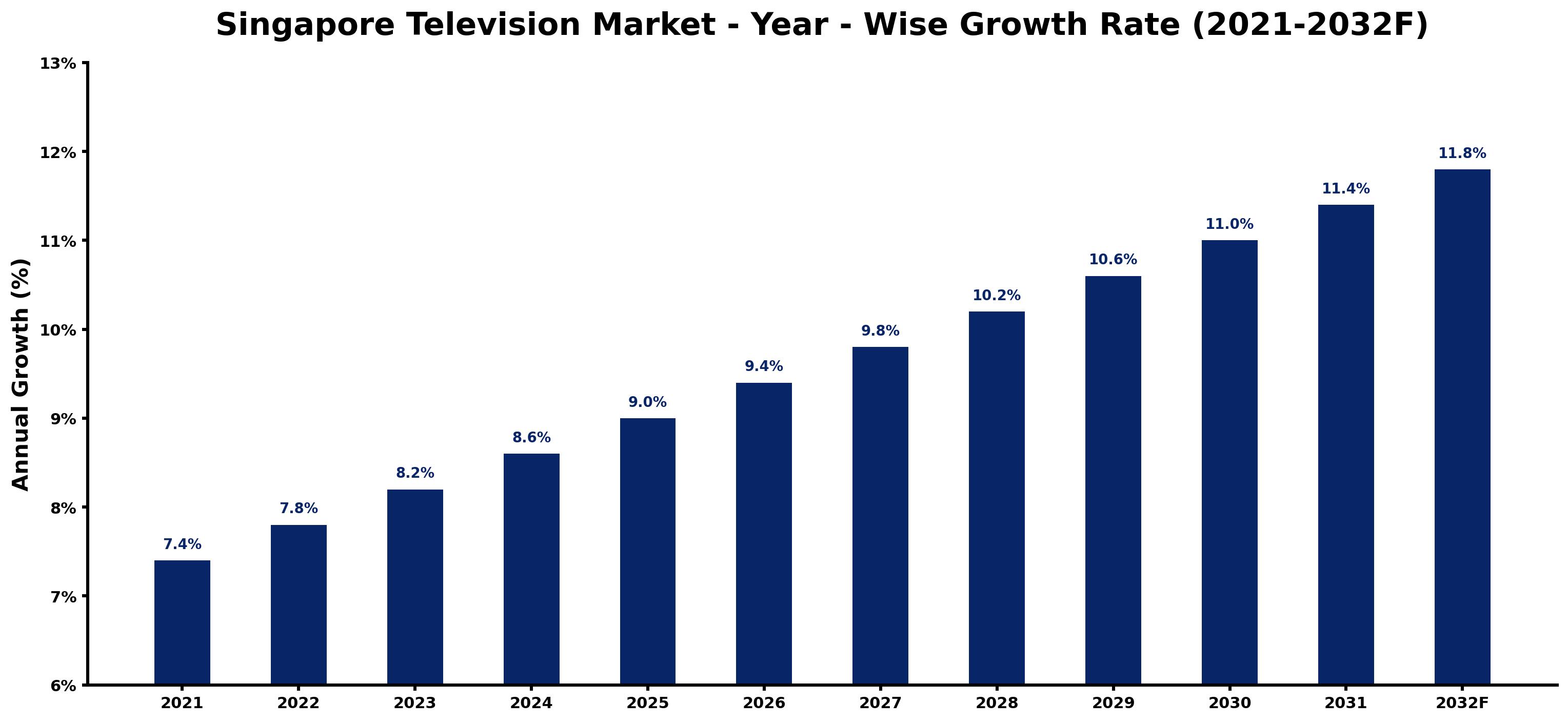
The table below presents the year wise growth rates along with the key drivers influencing the market
| Year | Growth Rate | Major Drivers |
| 2021 | 7.4% | High smartphone penetration influences content consumption through mobile streaming platforms. |
| 2022 | 7.8% | Hybrid viewing preferences emerge as audiences balance traditional TV and online platforms. |
| 2023 | 8.2% | Investment in local productions boosts unique content catering to Singaporean audiences. |
| 2024 | 8.6% | OTT platforms expand offerings, attracting viewers seeking diverse programming options. |
| 2025 | 9.0% | Emerging technologies enhance viewer engagement through interactive and immersive experiences. |
| 2026 | 9.4% | Partnerships between telecom companies and broadcasters improve streaming quality and access. |
| 2027 | 9.8% | Evolving consumer behaviors shift focus towards personalized content recommendations for viewers. |
| 2028 | 10.2% | Sustainability themes gain traction as broadcasters prioritize eco-friendly production practices. |
| 2029 | 10.6% | Digital advertising revenue surpasses traditional models, reshaping market dynamics among competitors. |
| 2030 | 11.0% | Data analytics tools enable broadcasters to refine strategies based on viewer habits. |
| 2031 | 11.4% | Content delivery networks evolve, ensuring smooth streaming experiences during peak usage times. |
| 2032 | 11.8% | Emergence of niche channels caters to specific interests, diversifying overall market offerings. |
Note - Market size estimations and growth projections presented in this report are based on 6Wresearch's advanced forecasting approach, validated with industry datasets as of June 2026.
Singapore Television Market Synopsis
The Singapore Television Market is projected to reach 9.4% and witness significant growth during the forecast period (2026-2032). This growth is largely driven by several key factors, including an increase in internet penetration, rising demand for digital content services, and the growing adoption of smart televisions and connected devices. Additionally, ongoing advancements in technology, such as the introduction of 4K and 8K resolution images, coupled with rising disposable incomes, are set to enhance the market landscape. Furthermore, robust government initiatives aimed at promoting digitization are bolstering the overall outlook for the Singapore television market.
Singapore Television Market Growth Drivers
Several critical drivers are contributing to the growth trajectory of the Singapore television market. First, the increasing internet penetration across the nation facilitates greater accessibility to online streaming services, which are rapidly becoming a preferred option for consumers. This shift not only influences consumption patterns but also creates substantial revenue opportunities for service providers.
- The proliferation of smart TVs and connected devices allows consumers to access a wide range of content effortlessly, thereby driving demand for high-quality digital content delivery.
- The growing availability and affordability of high-speed broadband connections further support the increasing consumption of digital video content, allowing more subscribers to engage with platforms offering diverse media.
- Technological advancements, including enhanced picture and audio quality from 4K/8K resolution, significantly attract consumers seeking superior viewing experiences.
- Rising disposable incomes among the population allow consumers to invest in premium television equipment and services, reinforcing market demand.
- Government initiatives promoting digitization and technological infrastructure improvement also contribute significantly to the growth of the Singapore television market.
Singapore Television Market Trends and Opportunities
The Singapore television market is witnessing notable trends that indicate promising opportunities for growth. The rapid evolution of consumer preferences towards streaming services is leading to a decrease in traditional cable subscriptions. Consumers increasingly seek on-demand viewing experiences, driving content providers to innovate and expand their offerings.
- The shift towards subscription-based services is anticipated to increase revenue for providers, as more users opt for ad-free experiences, creating a lucrative market segment.
- Original content production is gaining traction, with local media companies focusing on creating culturally relevant programming that resonates with audiences, enhancing viewer engagement.
- Interactive features offered by streaming platforms, such as live voting and real-time social media integration during broadcasts, are expected to attract tech-savvy consumers.
- Collaborations between telecom and media firms to bundle subscription services with high-speed internet packages present new avenues for market penetration.
- The rise of augmented and virtual reality applications in content delivery is anticipated to transform viewer engagement, offering immersive experiences that draw in tech enthusiasts.
Singapore Television Market Challenges and Restraints
Despite the optimistic growth outlook, the Singapore television market faces several challenges. One of the primary issues is the high cost of equipment and maintenance associated with setting up television and cable networks. Although there has been a gradual decline in hardware costs, the expenses related to installation and upkeep remain significant.
- Potential customers in lower income brackets may find it challenging to invest in the necessary hardware for cable networks, limiting market accessibility.
- Urban living conditions in Singapore, marked by limited space, often deter households from purchasing larger television setups, impacting overall sales.
- The competitive landscape of digital streaming services poses threats to traditional television models, resulting in pressure to innovate constantly.
- Rapid technological advancements necessitate continuous investment in infrastructure to keep pace with evolving consumer expectations, which may strain company resources.
- Consumer concerns regarding data privacy and security with online streaming services can hinder market growth, as trust must be established for sustained engagement.
Singapore Television Market Government Investment and Initiatives
The Singapore government has actively promoted initiatives aimed at enhancing the television and media landscape. Public spending on digital infrastructure improvements has facilitated increased broadband connectivity across the nation, enabling greater access to television services. Initiatives to encourage innovation in digital content creation are also evident, with funding provided for local productions and regional collaborations.
- Investment in research and development for advanced broadcasting technologies reflects the government's commitment to modernizing the television sector.
- Policies supporting media literacy and the expansion of digital platforms aim to equip the population with skills necessary for navigating the evolving media landscape.
- Government partnerships with technology firms focus on integrating cutting-edge solutions into the broadcasting sector, aligning with global best practices.
- The development of smart city initiatives also encompasses efforts to enhance media consumption experiences through improved accessibility and user engagement.
- Through various initiatives, the government aims to position Singapore as a regional hub for media and entertainment, appealing to global investors and innovators in the space.
Singapore Television Market Latest Developments (May 2025 - June 2026)
Recent developments in the Singapore television market highlight a shift towards more diversified content offerings and the integration of advanced technologies. During this period, there has been a noticeable increase in collaborations between content creators and streaming platforms, resulting in a richer variety of programming that caters to diverse audience segments.
- The emergence of local production houses focusing on high-quality original content has enhanced the competitive landscape against international players.
- Technological advancements in broadcasting, including improvements in user interface and viewer engagement tools, have been widely adopted by existing providers.
- Consumer feedback mechanisms are increasingly being utilized for content curation, allowing platforms to tailor offerings more effectively.
- The regulatory framework has evolved to accommodate new types of digital content and service models, fostering a more flexible environment for innovation.
- Sustainability initiatives are gaining traction, with industry participants exploring eco-friendly practices in the production and distribution of television content.
Singapore Television Market - Key Attractiveness of the Report
- 10 Years of Market Numbers
- Historical Data Starting from 2022 to 2025
- Base Year: 2025
- Forecast Data until 2032
- Key Performance Indicators Impacting the Market
- Major Upcoming Developments and Projects
Key Highlights of the Report:
- Singapore Television Market Outlook
- Market Size of Singapore Television Market, 2025
- Forecast of Singapore Television Market, 2032F
- Historical Data and Forecast of Singapore Television Revenues & Volume for the Period 2022-2032F
- Singapore Television Market Trend Evolution
- Singapore Television Market Drivers and Challenges
- Singapore Television Price Trends
- Singapore Television Porter's Five Forces
- Singapore Television Industry Life Cycle
- Historical Data and Forecast of Singapore Television Market Revenues & Volume By Resolution for the Period 2022-2032F
- Historical Data and Forecast of Singapore Television Market Revenues & Volume By LCD TVs for the Period 2022-2032F
- Historical Data and Forecast of Singapore Television Market Revenues & Volume By OLED TVs for the Period 2022-2032F
- Historical Data and Forecast of Singapore Television Market Revenues & Volume By Types for the Period 2022-2032F
- Historical Data and Forecast of Singapore Television Market Revenues & Volume By 2D TVs for the Period 2022-2032F
- Historical Data and Forecast of Singapore Television Market Revenues & Volume By 3D TVs for the Period 2022-2032F
- Singapore Television Import Export Trade Statistics
- Market Opportunity Assessment By Resolution
- Market Opportunity Assessment By Types
- Singapore Television Top Companies Market Share
- Singapore Television Competitive Benchmarking By Technical and Operational Parameters
- Singapore Television Company Profiles
- Singapore Television Key Strategic Recommendations






































