Cambodia Television Market Summary
The cambodia television market was estimated at USD 1412 Million in 2025 and is projected to reach USD 2556 Million by 2032, growing at a CAGR of 10.2% from 2026 to 2032.
Cambodia Television Market Year-wise Growth Rate and Key Drivers
This graph highlights how the Cambodia Television Market has steadily grown over the past five years, supported by major growth factors.
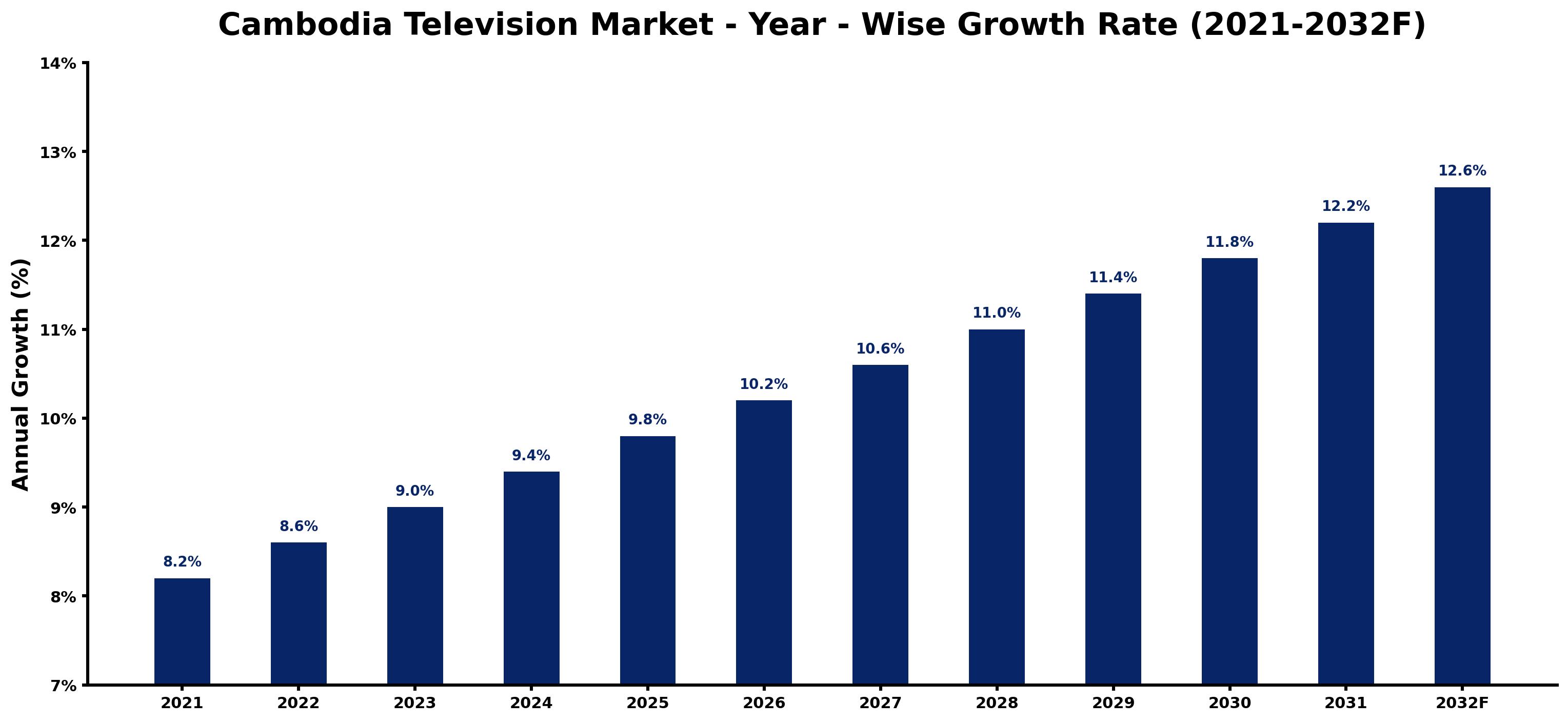
The table below presents the year wise growth rates along with the key drivers influencing the market
| Year | Growth Rate | Major Drivers |
| 2021 | 8.2% | Cambodia's youth population increasingly turns to streaming platforms for entertainment. |
| 2022 | 8.6% | Local content production emerges, appealing to national pride and cultural relevance. |
| 2023 | 9.0% | Smartphone penetration expands, increasing accessibility to digital television options. |
| 2024 | 9.4% | Advertisers recognize digital TV's potential, reallocating budgets from traditional media channels. |
| 2025 | 9.8% | Foreign investments in media production enhance competitive quality of local television offerings. |
| 2026 | 10.2% | Regional partnerships develop, allowing cross-border content sharing and audience expansion. |
| 2027 | 10.6% | Internet infrastructure improvements facilitate better streaming experiences in rural areas. |
| 2028 | 11.0% | Niche content creators gain traction, catering to diverse audience preferences and interests. |
| 2029 | 11.4% | Advertising models evolve, including interactive and targeted ads boosting viewer engagement. |
| 2030 | 11.8% | Diversification into esports and gaming content attracts younger demographics to traditional TV. |
| 2031 | 12.2% | Sustainability trends influence programming, focusing on eco-friendly storytelling and practices. |
| 2032 | 12.6% | Convergence of technologies leads to innovative viewing experiences across various platforms. |
Note - Market size estimations and growth projections presented in this report are based on 6Wresearch's advanced forecasting approach, validated with industry datasets as of June 2026.
Cambodia Television Market Synopsis
The Cambodia Television Market is projected to reach 10.2% and witness significant growth during the forecast period (2026-2032). The combination of rising disposable incomes, improved technological infrastructure, and an escalating demand for diverse digital content are pivotal factors contributing to this expansion. Free-to-air channels currently dominate the landscape, with major players capturing the attention of viewers across urban and rural demographics. Meanwhile, the pay-TV segment is also gaining momentum, supported by a demand for international programming and on-demand services that reflect evolving consumer preferences.
Cambodia Television Market Growth Drivers
Several key drivers are fueling the growth of the Cambodia Television Market. Firstly, increased disposable incomes among the population are allowing more consumers to invest in quality entertainment options. Secondly, advancements in infrastructure, particularly in urban areas, enhance access to television services, facilitating the shift from traditional to digital formats. Thirdly, the burgeoning demand for digital content—including streaming services—reflects a significant change in viewer behavior, prompting broadcasters to adapt their offerings. Furthermore, the increasing penetration of smart TVs and mobile devices is reshaping content consumption patterns, making it easier for audiences to access a variety of viewing options. Lastly, advertisers are recognizing the reach of television, making it a vital channel for marketing efforts, thus increasing competitive intensity among broadcasters.
Cambodia Television Market Trends and Opportunities
The Cambodia Television Market is witnessing notable trends that present numerous opportunities for growth. The shift towards digital platforms is marked by a rising preference for on-demand content and subscription-based services, which cater to a more discerning audience. Local broadcasters are actively investing in high-quality production to appeal to Cambodian viewers' tastes, indicating a stronger focus on regional content. The increasing popularity of larger screen sizes and high-resolution displays is also evident, with consumers opting for 4K and even 8K televisions. Additionally, the expansion of internet connectivity is enabling consumers to engage more widely with streaming services, which continues to reshape the media landscape. This digital transformation indicates promising avenues for both local and international content creators looking to penetrate the market.
Cambodia Television Market Challenges and Restraints
Despite its growth, the Cambodia Television Market faces several challenges and restraints. One significant barrier is the limited advertising revenue due to the relatively small market size and consumers' purchasing power constraints. Additionally, the market remains highly fragmented, with varying levels of regulation leading to issues such as content piracy and intellectual property rights infringements. Infrastructure challenges, particularly in rural areas where internet connectivity and electricity access are limited, hinder the growth of subscription services. Moreover, the competition from online streaming services and social media platforms poses a significant threat to traditional broadcasters, necessitating adaptation to keep pace with changing consumer preferences. Overcoming these obstacles will be crucial for the sustainability and expansion of the industry.
Cambodia Television Market Investment Opportunities
The Cambodia Television Market presents various investment opportunities in light of the country's growing middle class and increasing disposable incomes. With a population exceeding 16 million and a youthful demographic, there is a rising demand for quality television content and entertainment options. Investments in local production companies and content creation initiatives can yield substantial returns, especially as local audiences increasingly favor homegrown narratives. Additionally, the burgeoning demand for digital television services and streaming platforms represents a lucrative area for investment, particularly as internet penetration improves. Partnering with local broadcasters to enhance infrastructure and broadcasting quality can also be a strategic move to capture an expanding audience in the Cambodian television market.
Cambodia Television Market Government Investment and Initiatives
The Cambodian government has made strides in regulating the television market, implementing various policies to foster industry growth. Oversight is provided by the Ministry of Information, ensuring that TV stations comply with relevant licensing and operational standards. To bolster local content production, the government offers incentives and subsidies aimed at nurturing Cambodian media. There are also regulations limiting foreign ownership of television stations, designed to protect national interests while promoting local media development. Moreover, the government is actively encouraging the adoption of advanced digital broadcasting technologies to enhance service quality and accessibility. These initiatives aim to cultivate a competitive and diverse television landscape that reflects cultural values while driving local content production.
Cambodia Television Market Latest Developments (May 2025 - June 2026)
Recent developments in the Cambodia Television Market indicate a continued shift towards a more digital-first approach. This transition reflects changing viewer habits, as audiences increasingly gravitate towards streaming and on-demand services over traditional television offerings. Investment in infrastructure to support high-definition and internet-based services has become a priority for many broadcasters. Additionally, numerous local television stations have begun collaborating with content creators to enhance the quality of localized programming, providing a richer viewing experience for Cambodian audiences. Advertising strategies are also evolving, with a greater focus on engaging younger demographics through the use of social media and interactive content, signalling a transformation in how advertisers approach their markets.
Cambodia Television Market - Key Attractiveness of the Report
- 10 Years of Market Numbers
- Historical Data Starting from 2022 to 2025
- Base Year: 2025
- Forecast Data until 2032
- Key Performance Indicators Impacting the Market
- Major Upcoming Developments and Projects
Key Highlights of the Report:
- Cambodia Television Market Outlook
- Market Size of Cambodia Television Market, 2025
- Forecast of Cambodia Television Market, 2032F
- Historical Data and Forecast of Cambodia Television Revenues & Volume for the Period 2022-2032F
- Cambodia Television Market Trend Evolution
- Cambodia Television Market Drivers and Challenges
- Cambodia Television Price Trends
- Cambodia Television Porter's Five Forces
- Cambodia Television Industry Life Cycle
- Historical Data and Forecast of Cambodia Television Market Revenues & Volume By Resolution for the Period 2022-2032F
- Historical Data and Forecast of Cambodia Television Market Revenues & Volume By LCD TVs for the Period 2022-2032F
- Historical Data and Forecast of Cambodia Television Market Revenues & Volume By OLED TVs for the Period 2022-2032F
- Historical Data and Forecast of Cambodia Television Market Revenues & Volume By Types for the Period 2022-2032F
- Historical Data and Forecast of Cambodia Television Market Revenues & Volume By 2D TVs for the Period 2022-2032F
- Historical Data and Forecast of Cambodia Television Market Revenues & Volume By 3D TVs for the Period 2022-2032F
- Cambodia Television Import Export Trade Statistics
- Market Opportunity Assessment By Resolution
- Market Opportunity Assessment By Types
- Cambodia Television Top Companies Market Share
- Cambodia Television Competitive Benchmarking By Technical and Operational Parameters
- Cambodia Television Company Profiles
- Cambodia Television Key Strategic Recommendations






































