Malaysia Tripod Jack For Civil Aircraft Market Size, Share & Growth Rate
The Malaysia Tripod Jack For Civil Aircraft Market was estimated at USD 502 Million in 2025 and is projected to reach USD 755 Million by 2032, growing at a CAGR of 6.0% from 2026 to 2032. This robust growth trajectory is primarily fueled by the increasing demand for air travel and the subsequent need for efficient maintenance solutions in the civil aviation sector. As more airlines emerge and existing ones expand, the necessity for reliable ground support equipment like tripod jacks becomes ever more critical.
Malaysia Tripod Jack For Civil Aircraft Market Year-wise Growth Rate and Key Drivers
This graph highlights how the Malaysia Tripod Jack For Civil Aircraft Market has steadily grown over the years, supported by major growth factors.
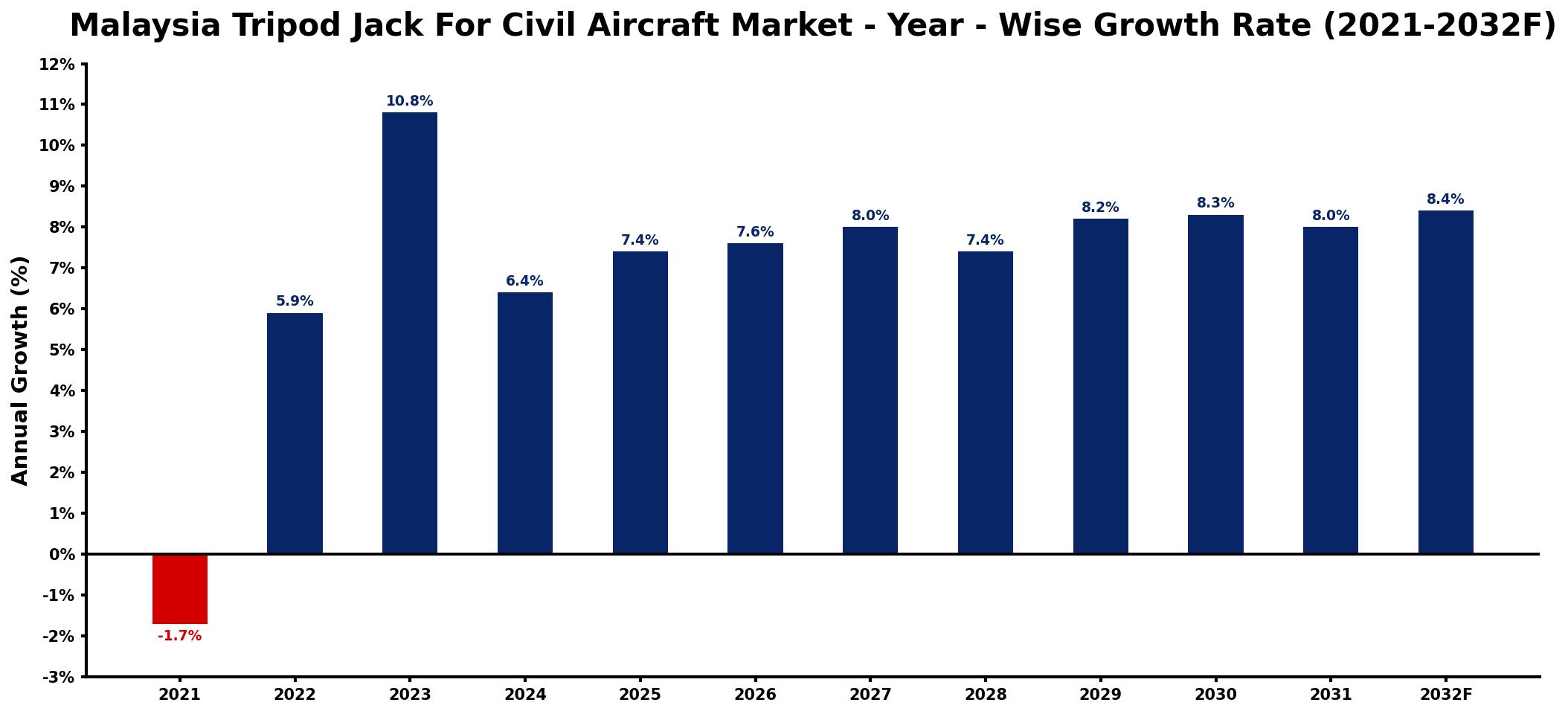
The table below presents the year‑wise growth rates along with the key drivers influencing the market
| Year | Growth Rate | Major Drivers |
| 2021 | -1.7% | decreased maintenance spending by airlines |
| 2022 | 5.9% | revival of travel industry investments |
| 2023 | 10.8% | growing fleet expansion initiatives |
| 2024 | 6.4% | increased safety regulations adoption |
| 2025 | 7.4% | rising demand for ground support |
| 2026 | 7.6% | enhanced technology integration trends |
| 2027 | 8.0% | expansion of regional airport facilities |
| 2028 | 7.4% | surge in aviation training programs |
| 2029 | 8.2% | increased focus on sustainability efforts |
| 2030 | 8.3% | growing international tourism recovery |
| 2031 | 8.0% | boost in aerospace manufacturing capacity |
| 2032 | 8.4% | heightened collaboration among stakeholders |
Note: Market size estimations and growth projections presented in this report are based on 6Wresearch's proprietary forecasting methodology, utilizing the latest available industry data, government publications, and primary research inputs.
Malaysia Tripod Jack For Civil Aircraft Market Synopsis
The Malaysia Tripod Jack for Civil Aircraft market is intricately linked to the broader aviation landscape. Positioned as a pivotal transportation hub in Southeast Asia, Malaysia's civil aviation sector is poised for significant growth, reflecting increased passenger traffic and airline activities. Within this context, tripod jacks have become indispensable tools for ensuring that maintenance operations are conducted safely and effectively.
Innovations in design and a focus on enhanced safety measures are transforming the tripod jack market. As aviation maintenance standards tighten, manufacturers are being called upon to deliver products that not only meet but exceed regulatory compliance. This drive for improvement, combined with the booming tourism sector, underscores the ongoing relevance of tripod jacks in sustaining aircraft operational readiness.
Malaysia Tripod Jack For Civil Aircraft Market Key Takeaways
- The market is expected to grow due to the booming civil aviation sector in Malaysia.
- Technological advancements are enhancing the safety and efficiency of tripod jacks.
- Rising airline operations fuel the demand for aircraft maintenance equipment.
- Compliance with strict safety standards is a significant driver for product development.
- The market is sensitive to economic fluctuations, affecting demand for ground support equipment.
Evaluation of Restraints in Malaysia Tripod Jack For Civil Aircraft Market
Despite its promising growth trajectory, the Malaysia Tripod Jack market faces several constraints. Economic instability poses a notable risk, as downturns can lead to reduced air travel and, consequently, less frequent aircraft maintenance operations. Compliance with stringent safety regulations also demands that manufacturers invest in higher-quality materials and advanced technologies, which can constrain operational margins. Furthermore, the competitive landscape is characterized by established and emerging players, putting pressure on pricing and innovation. Geopolitical tensions and trade disputes can further complicate supply chains, influencing both availability and cost of tripod jacks in the region.
Malaysia Tripod Jack For Civil Aircraft Market Trends
The market is witnessing several trends that are reshaping the demand for tripod jacks. Firstly, there's a marked shift towards lightweight, more versatile jacks that facilitate easier handling and improved efficiency in maintenance operations. Additionally, manufacturers are increasingly integrating smart technologies into jack systems, allowing for real-time monitoring and data analysis during servicing. This trend towards digitalization is expected to enhance safety protocols and operational efficiency, responding to the evolving needs of the aviation industry.
Malaysia Tripod Jack For Civil Aircraft Market Opportunities
Investment opportunities abound within the Malaysia Tripod Jack market. As the aviation sector expands, so too does the potential for manufacturers to innovate and diversify their product offerings. Developing jacks equipped with advanced features such as automated adjustment mechanisms or enhanced stability systems could capture market interest. Furthermore, collaboration with airlines to tailor solutions for specific maintenance needs can foster valuable partnerships and drive sales growth in a competitive environment.
Government Initiatives in the Malaysia Tripod Jack For Civil Aircraft Market
The Malaysian government has implemented various initiatives aimed at enhancing the aviation sector's competitiveness. These include investments in airport infrastructure and incentives for airlines to upgrade their fleets, thereby indirectly boosting the demand for maintenance equipment like tripod jacks. Additionally, government bodies are working to streamline regulations and promote safety standards, ensuring that local manufacturers remain compliant with international benchmarks.
Future Insights of the Malaysia Tripod Jack For Civil Aircraft Market
Looking ahead to 2026-2032, the Malaysia Tripod Jack market is set to evolve significantly, driven by ongoing innovations and regulatory changes. As the aviation industry rebounds from previous downturns, the need for robust ground support equipment will intensify. Manufacturers who adapt quickly to technological trends and maintain strict compliance with safety regulations will likely emerge as market leaders, positioning themselves advantageously as the sector grows.
Malaysia Tripod Jack For Civil Aircraft Market Latest Developments (2025 - 2026)
In recent months, the market has seen a flurry of activity centered around innovations in tripod jack designs, with several manufacturers showcasing new lightweight models at industry expos. Additionally, collaborative efforts between airlines and equipment providers have been initiated to develop bespoke solutions that address specific maintenance challenges faced by fleet operators. These developments indicate a vibrant market response to the pressing needs of the aviation sector as it continues to grow.
Malaysia Tripod Jack For Civil Aircraft Market - Key Attractiveness of the Report
- 10 Years of Market Numbers
- Historical Data Starting from 2022 to 2025
- Base Year: 2025
- Forecast Data until 2032
- Key Performance Indicators Impacting the Market
- Major Upcoming Developments and Projects
Key Highlights of the Report:
- Malaysia Tripod Jack For Civil Aircraft Market Outlook
- Market Size of Malaysia Tripod Jack For Civil Aircraft Market, 2025
- Forecast of Malaysia Tripod Jack For Civil Aircraft Market, 2032
- Historical Data and Forecast of Malaysia Tripod Jack For Civil Aircraft Revenues & Volume for the Period 2022-2032F
- Malaysia Tripod Jack For Civil Aircraft Market Trend Evolution
- Malaysia Tripod Jack For Civil Aircraft Market Drivers and Challenges
- Malaysia Tripod Jack For Civil Aircraft Price Trends
- Malaysia Tripod Jack For Civil Aircraft Porter's Five Forces
- Malaysia Tripod Jack For Civil Aircraft Industry Life Cycle
- Historical Data and Forecast of Malaysia Tripod Jack For Civil Aircraft Market Revenues & Volume By Product for the Period 2022-2032F
- Historical Data and Forecast of Malaysia Tripod Jack For Civil Aircraft Market Revenues & Volume By Single Stage for the Period 2022-2032F
- Historical Data and Forecast of Malaysia Tripod Jack For Civil Aircraft Market Revenues & Volume By Multi Stage for the Period 2022-2032F
- Historical Data and Forecast of Malaysia Tripod Jack For Civil Aircraft Market Revenues & Volume By Application for the Period 2022-2032F
- Historical Data and Forecast of Malaysia Tripod Jack For Civil Aircraft Market Revenues & Volume By Jetliners for the Period 2022-2032F
- Historical Data and Forecast of Malaysia Tripod Jack For Civil Aircraft Market Revenues & Volume By Business Jet for the Period 2022-2032F
- Historical Data and Forecast of Malaysia Tripod Jack For Civil Aircraft Market Revenues & Volume By Regional Aircraft for the Period 2022-2032F
- Historical Data and Forecast of Malaysia Tripod Jack For Civil Aircraft Market Revenues & Volume By Commericial Jetliner for the Period 2022-2032F
- Malaysia Tripod Jack For Civil Aircraft Import Export Trade Statistics
- Market Opportunity Assessment By Product
- Market Opportunity Assessment By Application
- Malaysia Tripod Jack For Civil Aircraft Top Companies Market Share
- Malaysia Tripod Jack For Civil Aircraft Competitive Benchmarking By Technical and Operational Parameters
- Malaysia Tripod Jack For Civil Aircraft Company Profiles
- Malaysia Tripod Jack For Civil Aircraft Key Strategic Recommendations






































