Malaysia Video Game Accessories Market Summary
The malaysia video game accessories market was estimated at USD 242 Million in 2025 and is projected to reach USD 315 Million by 2032, growing at a CAGR of 5.4% from 2026 to 2032.
Malaysia Video Game Accessories Market Year-wise Growth Rate and Key Drivers
This graph highlights how the Malaysia Video Game Accessories Market has steadily grown over the past five years, supported by major growth factors.
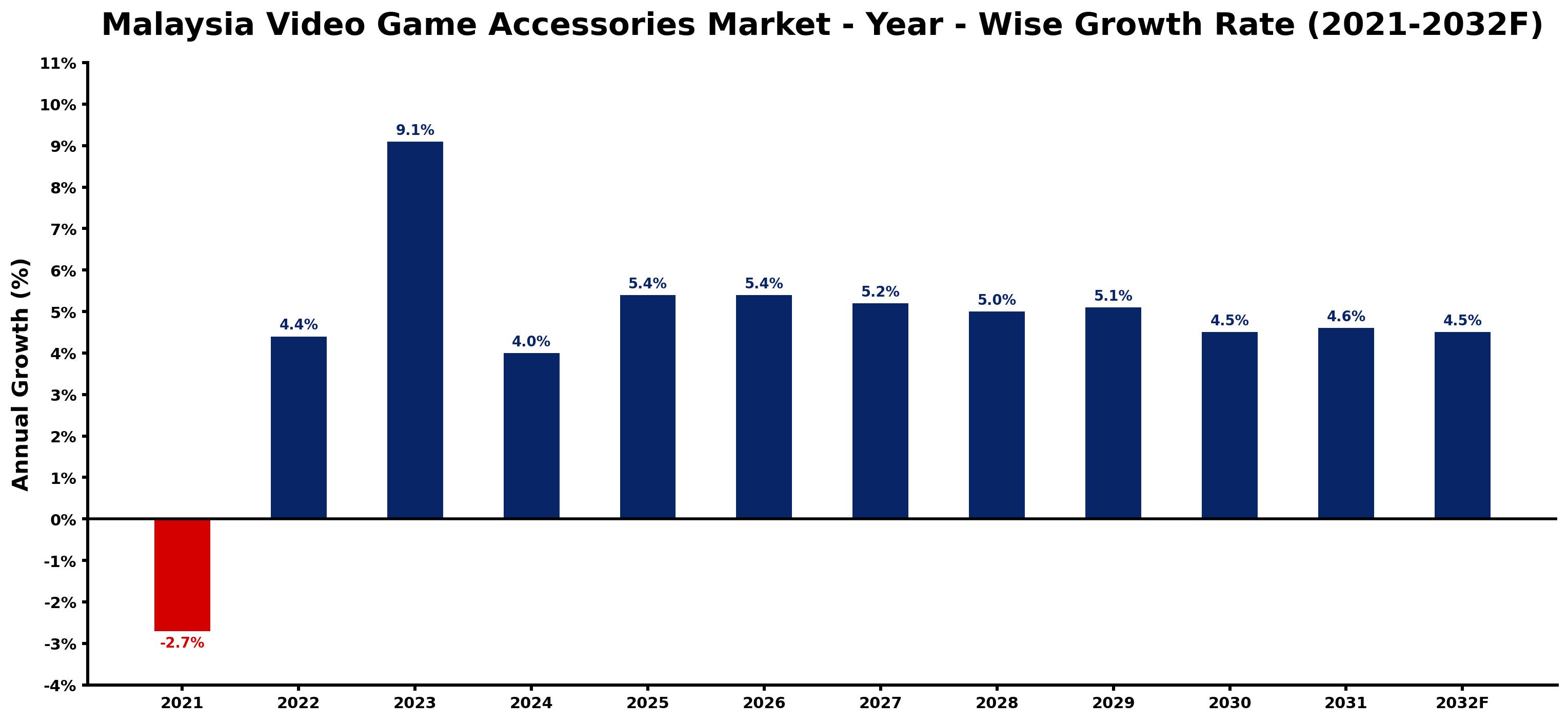
The table below presents the year wise growth rates along with the key drivers influencing the market
| Year | Growth Rate | Major Drivers |
| 2021 | -2.7% | Supply chain disruptions caused by the pandemic led to product shortages, hindering market performance in 2021. |
| 2022 | 4.4% | Emerging trends in esports prompted a demand for specialized gaming peripherals. |
| 2023 | 9.1% | Gamers sought high-quality accessories for enhanced gameplay experiences and performance. |
| 2024 | 4.0% | Local manufacturers began introducing competitive pricing for native gaming products. |
| 2025 | 5.4% | Consumer preferences shifted towards customizable and ergonomic gaming setups. |
| 2026 | 5.4% | Social media influencers increasingly endorsed gaming accessories, boosting brand visibility. |
| 2027 | 5.2% | Virtual reality technology gained traction, driving accessory innovation and diversification. |
| 2028 | 5.0% | E-commerce platforms expanded, creating wider access to gaming products nationwide. |
| 2029 | 5.1% | Gaming cafes emerged, further fueling demand for shared accessory usage among players. |
| 2030 | 4.5% | Collaborations with popular game developers enhanced accessory appeal and functionality. |
| 2031 | 4.6% | Sustainability trends influenced the production of eco-friendly gaming accessories. |
| 2032 | 4.5% | Technological convergence led to the integration of gaming accessories with smart devices. |
Note - Market size estimations and growth projections presented in this report are based on 6Wresearch's advanced forecasting approach, validated with industry datasets as of June 2026.
Malaysia Video Game Accessories Market Synopsis
The Malaysia Video Game Accessories Market is projected to reach 5.4% and witness significant growth during the forecast period (2026-2032). The country has rapidly emerged as a vital hub for gaming accessories in the Asia Pacific region, spurred by several pivotal factors. Increased disposable income levels among the Malaysian population, along with a burgeoning youth demographic that is increasingly inclined towards mobile gaming, are major drivers of this market. Furthermore, enhanced internet penetration across the nation has led to a surge in online video game sales, prompting consumers to invest in various gaming accessories, including controllers, headsets, and more.
Malaysia Video Game Accessories Market Growth Drivers
Key factors contributing to the expansion of the Malaysia Video Game Accessories Market encompass both socio-economic and technological advancements. Firstly, rising disposable incomes have allowed consumers to allocate more resources towards recreational activities, including gaming. Secondly, the growing young population is significantly influencing market dynamics, as this demographic tends to embrace mobile gaming trends more fervently. Thirdly, the rapid advancements in technology have resulted in the development of more sophisticated and user-friendly gaming accessories, further enticing consumers to enhance their gaming experience.
- Improved disposable income levels have enabled consumers to invest in higher-quality gaming accessories, leading to market growth.
- The youthful demographic, which is more inclined towards gaming and technology, is a primary source of demand for these products.
- Technological advancements in product design and functionality enhance customer engagement and satisfaction.
- The increasing popularity of e-sports and competitive gaming is driving demand for specialized accessories.
- The rise of gaming as a socially accepted pastime is fostering a more substantial consumer base for gaming products.
Malaysia Video Game Accessories Market Trends and Opportunities
Several trends are shaping the Malaysia Video Game Accessories Market, presenting numerous opportunities for growth. The shift towards mobile gaming has led to an increase in the demand for accessories that complement handheld devices. Additionally, the integration of augmented reality (AR) and virtual reality (VR) technologies is creating new markets for innovative gaming gear. There is also a growing preference for wireless accessories, driven by advancements in battery technology and connectivity options.
- The focus on mobile gaming has spurred demand for portable and compact gaming accessories.
- AR and VR technologies are expected to create niche markets for specialized accessories tailored to these experiences.
- Increasing interest in health and fitness gaming is driving demand for accessories that enhance interaction.
- Consumer preferences are shifting towards wireless accessories, emphasizing convenience and mobility.
- Online shopping trends are influencing accessory sales, with e-commerce becoming a significant sales channel.
Malaysia Video Game Accessories Market Challenges and Restraints
Despite the promising growth prospects, the Malaysia Video Game Accessories Market faces several challenges. One primary concern is the prevalence of counterfeit products that undermine consumer trust and hamper sales of genuine accessories. Furthermore, rapid technological changes necessitate continuous innovation from manufacturers, which can strain resources. Additionally, market saturation with numerous products can lead to intense price competition, affecting overall profitability.
- The presence of counterfeit products can damage the reputation of legitimate brands and erode consumer trust.
- Fast-paced technological advancements require constant innovation, posing challenges for manufacturers.
- Price competition due to a saturated market can squeeze profit margins for accessory manufacturers.
- Stringent regulations regarding product safety and quality may pose additional compliance challenges.
- Economic fluctuations could impact consumer spending in the gaming sector, leading to unpredictable market dynamics.
Malaysia Video Game Accessories Market Government Investment and Initiatives
The Malaysian government recognizes the potential of the video gaming industry, including accessories, as a significant contributor to economic growth. Policies encouraging the development of digital economy initiatives and investments in technology infrastructure are pivotal to this sector's advancement. Public funding has been directed toward promoting creative digital industries, offering incentives to local manufacturers and distributors. Moreover, strategic partnerships between government bodies and private sectors aim to foster innovation and expand the market. These initiatives demonstrate the government's commitment to bolstering the Malaysia Video Game Accessories Market.
Malaysia Video Game Accessories Market Latest Developments (May 2025 - June 2026)
Recent developments in the Malaysia Video Game Accessories Market indicate a robust trajectory toward innovation and consumer engagement. Businesses have been increasingly investing in marketing strategies that focus on creating awareness about the benefits of high-quality accessories. Collaborations between local retailers and international brands are becoming more prevalent, aiming to enhance product offerings and broaden consumer reach. The trend of online shopping has also gained momentum, leading to a shift in how accessories are marketed and sold to consumers. Moreover, an emphasis on sustainability is starting to influence product design, with companies exploring eco-friendly materials for manufacturing gaming accessories.
Malaysia Video Game Accessories Market - Key Attractiveness of the Report
- 10 Years of Market Numbers
- Historical Data Starting from 2022 to 2025
- Base Year: 2025
- Forecast Data until 2032
- Key Performance Indicators Impacting the Market
- Major Upcoming Developments and Projects
Key Highlights of the Report:
- Malaysia Video Game Accessories Market Outlook
- Market Size of Malaysia Video Game Accessories Market, 2025
- Forecast of Malaysia Video Game Accessories Market, 2032F
- Historical Data and Forecast of Malaysia Video Game Accessories Revenues & Volume for the Period 2022-2032F
- Malaysia Video Game Accessories Market Trend Evolution
- Malaysia Video Game Accessories Market Drivers and Challenges
- Malaysia Video Game Accessories Price Trends
- Malaysia Video Game Accessories Porter's Five Forces
- Malaysia Video Game Accessories Industry Life Cycle
- Historical Data and Forecast of Malaysia Video Game Accessories Market Revenues & Volume By Product Type for the Period 2022-2032F
- Historical Data and Forecast of Malaysia Video Game Accessories Market Revenues & Volume By Gamepads for the Period 2022-2032F
- Historical Data and Forecast of Malaysia Video Game Accessories Market Revenues & Volume By Keyboards for the Period 2022-2032F
- Historical Data and Forecast of Malaysia Video Game Accessories Market Revenues & Volume By Mice for the Period 2022-2032F
- Historical Data and Forecast of Malaysia Video Game Accessories Market Revenues & Volume By Headset for the Period 2022-2032F
- Historical Data and Forecast of Malaysia Video Game Accessories Market Revenues & Volume By Surfaces for the Period 2022-2032F
- Historical Data and Forecast of Malaysia Video Game Accessories Market Revenues & Volume By Controllers/Joysticks for the Period 2022-2032F
- Historical Data and Forecast of Malaysia Video Game Accessories Market Revenues & Volume By Virtual Reality Devices for the Period 2022-2032F
- Historical Data and Forecast of Malaysia Gamepads Video Game Accessories Market Revenues & Volume By Others for the Period 2022-2032F
- Historical Data and Forecast of Malaysia Video Game Accessories Market Revenues & Volume By End-users for the Period 2022-2032F
- Historical Data and Forecast of Malaysia Video Game Accessories Market Revenues & Volume By Casual Gaming? for the Period 2022-2032F
- Historical Data and Forecast of Malaysia Video Game Accessories Market Revenues & Volume By Professional Gaming for the Period 2022-2032F
- Malaysia Video Game Accessories Import Export Trade Statistics
- Market Opportunity Assessment By Product Type
- Market Opportunity Assessment By End-users
- Malaysia Video Game Accessories Top Companies Market Share
- Malaysia Video Game Accessories Competitive Benchmarking By Technical and Operational Parameters
- Malaysia Video Game Accessories Company Profiles
- Malaysia Video Game Accessories Key Strategic Recommendations






































