Malaysia Warm Air Heating Equipment Market Size, Share & Growth Rate
The Malaysia Warm Air Heating Equipment Market was estimated at USD 773 Million in 2025 and is projected to reach USD 1173 Million by 2032, growing at a CAGR of 6.1% from 2026 to 2032. This growth trajectory is driven by the increasing demand for efficient heating solutions in commercial and industrial applications, particularly as urbanization accelerates and infrastructure development expands. The shift towards energy-efficient systems is also a key factor propelling the market forward, as stakeholders prioritize sustainability and cost-effectiveness in their heating strategies.
Malaysia Warm Air Heating Equipment Market Year-wise Growth Rate and Key Drivers
This graph highlights how the Malaysia Warm Air Heating Equipment Market has steadily grown over the years, supported by major growth factors.
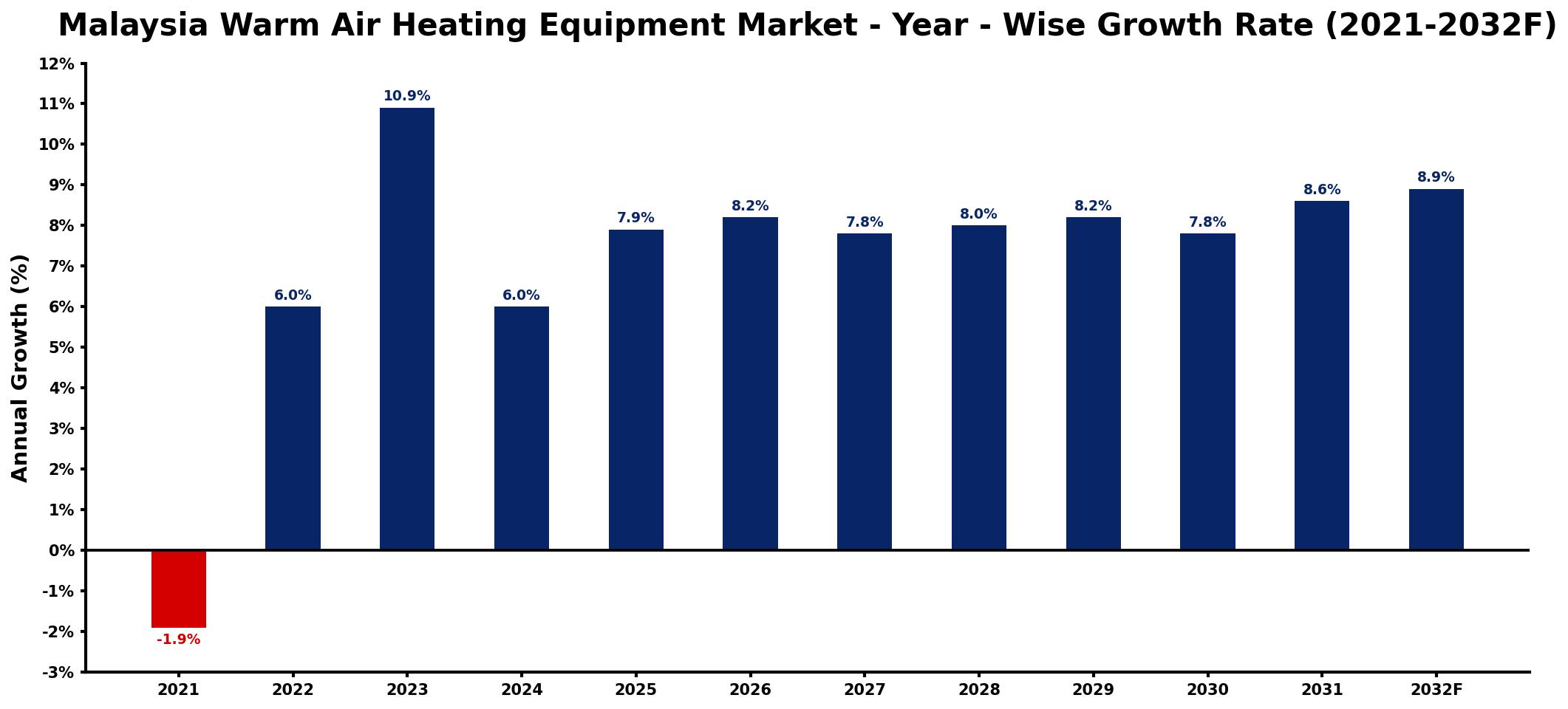
The table below presents the year‑wise growth rates along with the key drivers influencing the market
| Year | Growth Rate | Major Drivers |
| 2021 | -1.9% | decreased consumer purchasing power |
| 2022 | 6.0% | rising demand for residential comfort |
| 2023 | 10.9% | increased investments in infrastructure |
| 2024 | 6.0% | growing focus on energy efficiency |
| 2025 | 7.9% | expansion of commercial construction projects |
| 2026 | 8.2% | surge in renovation activities |
| 2027 | 7.8% | enhanced government sustainability initiatives |
| 2028 | 8.0% | rising disposable income levels |
| 2029 | 8.2% | increased awareness of climate control |
| 2030 | 7.8% | expanding healthcare application demand |
| 2031 | 8.6% | improved raw material availability |
| 2032 | 8.9% | increased demand for eco-friendly solutions |
Note: Market size estimations and growth projections presented in this report are based on 6Wresearch's proprietary forecasting methodology, utilizing the latest available industry data, government publications, and primary research inputs.
Malaysia Warm Air Heating Equipment Market Synopsis
The warm air heating equipment in Malaysia is becoming indispensable for creating and maintaining comfortable indoor environments across various sectors. With the ongoing growth in the construction sector, there is a noticeable uptick in demand for advanced heating solutions designed to efficiently serve large commercial and industrial spaces.
Moreover, the emphasis on sustainability is driving the adoption of innovative technologies, such as heat pumps and solar-assisted systems. This trend not only addresses energy efficiency concerns but also aligns with Malaysias commitment to environmentally friendly practices in its industrial and commercial heating applications.
Malaysia Warm Air Heating Equipment Market Key Takeaways
- The market is expected to grow significantly due to rising demands from the construction and industrial sectors.
- Energy-efficient heating solutions are increasingly prioritized to meet environmental regulations.
- Retrofitting older buildings with modern heating systems presents substantial opportunities.
- Urbanization and infrastructure growth directly correlate with increased heating equipment requirements.
- Technological advancements continue to foster innovative and sustainable heating solutions.
Evaluation of Restraints in Malaysia Warm Air Heating Equipment Market
Despite its promising outlook, the Malaysia warm air heating equipment market faces several significant restraints. The stringent energy efficiency regulations imposed by the government compel manufacturers to innovate continuously, which can drive up production costs. Moreover, growing competition from alternative heating technologies like heat pumps and solar systems challenges traditional warm air heating methods. As consumers become more environmentally conscious, balancing affordability with innovative, eco-friendly solutions becomes crucial for market players aiming to capture and retain customer interest.
Malaysia Warm Air Heating Equipment Market Trends
Several trends are shaping the Malaysia warm air heating equipment market today. Firstly, the integration of smart technology into heating systems is gaining traction, enabling users to program and control their heating solutions efficiently. Secondly, theres a noticeable shift towards using renewable energy sources in heating systems, reflecting broader sustainability goals. Additionally, the focus on creating healthier indoor environments is becoming a key priority, driving demand for systems that improve air quality along with heating capabilities.
Malaysia Warm Air Heating Equipment Market Opportunities
The future holds numerous growth opportunities for the Malaysia warm air heating equipment market. The expanding industrial sector, especially in manufacturing, presents significant avenues for deploying advanced heating solutions. Additionally, theres an emerging trend toward retrofitting existing structures with modern heating systems that emphasize energy efficiency. As Malaysian businesses seek to lower operational costs through enhanced heating solutions, the demand for innovative, cost-effective technologies will likely surge.
Government Initiatives in the Malaysia Warm Air Heating Equipment Market
The Malaysian government is increasingly investing in energy efficiency initiatives and sustainable practices across various sectors, including heating equipment. Policies encouraging the adoption of renewable energy sources and energy-efficient technologies are being implemented. Furthermore, government spending on infrastructure projects and public building retrofits fosters a favorable environment for warm air heating solutions, as businesses look to comply with regulations while maximizing energy efficiency.
Future Insights of the Malaysia Warm Air Heating Equipment Market
Looking forward, the Malaysia warm air heating equipment market is set to evolve significantly by 2032. The continued expansion of urban areas and infrastructure will drive demand, particularly in the commercial and industrial segments. Additionally, as technological advancements lead to more efficient and eco-friendly heating solutions, market participants who embrace innovation will likely gain a competitive edge. The integration of smart technologies and renewable energy in heating systems will not only redefine product offerings but also align with Malaysia's goals of enhancing sustainability within its industrial framework.
Malaysia Warm Air Heating Equipment Market Latest Developments (2025 - 2026)
In recent months, the Malaysia warm air heating equipment market has witnessed a surge in product launches featuring advanced energy-efficient technologies. Innovations aimed at improving user interfaces and programmability are becoming more common. Additionally, partnerships between technology providers and construction firms are on the rise, aiming to integrate cutting-edge heating solutions into new projects. These developments reflect a growing recognition of the importance of heating systems in achieving both comfort and efficiency in industrial applications.
Malaysia Warm Air Heating Equipment Market - Key Attractiveness of the Report
- 10 Years of Market Numbers
- Historical Data Starting from 2022 to 2025
- Base Year: 2025
- Forecast Data until 2032
- Key Performance Indicators Impacting the Market
- Major Upcoming Developments and Projects
Key Highlights of the Report:
- Malaysia Warm Air Heating Equipment Market Outlook
- Market Size of Malaysia Warm Air Heating Equipment Market, 2025
- Forecast of Malaysia Warm Air Heating Equipment Market, 2032
- Historical Data and Forecast of Malaysia Warm Air Heating Equipment Revenues & Volume for the Period 2022-2032F
- Malaysia Warm Air Heating Equipment Market Trend Evolution
- Malaysia Warm Air Heating Equipment Market Drivers and Challenges
- Malaysia Warm Air Heating Equipment Price Trends
- Malaysia Warm Air Heating Equipment Porter's Five Forces
- Malaysia Warm Air Heating Equipment Industry Life Cycle
- Historical Data and Forecast of Malaysia Warm Air Heating Equipment Market Revenues & Volume By Product Type for the Period 2022-2032F
- Historical Data and Forecast of Malaysia Warm Air Heating Equipment Market Revenues & Volume By Heat Pumps for the Period 2022-2032F
- Historical Data and Forecast of Malaysia Warm Air Heating Equipment Market Revenues & Volume By Humidifying Equipment for the Period 2022-2032F
- Historical Data and Forecast of Malaysia Warm Air Heating Equipment Market Revenues & Volume By Fuel Type for the Period 2022-2032F
- Historical Data and Forecast of Malaysia Warm Air Heating Equipment Market Revenues & Volume By Electric Powered for the Period 2022-2032F
- Historical Data and Forecast of Malaysia Warm Air Heating Equipment Market Revenues & Volume By Gas-Powered for the Period 2022-2032F
- Historical Data and Forecast of Malaysia Warm Air Heating Equipment Market Revenues & Volume By Hybrid for the Period 2022-2032F
- Historical Data and Forecast of Malaysia Warm Air Heating Equipment Market Revenues & Volume By Solar Powered for the Period 2022-2032F
- Historical Data and Forecast of Malaysia Warm Air Heating Equipment Market Revenues & Volume By Application for the Period 2022-2032F
- Historical Data and Forecast of Malaysia Warm Air Heating Equipment Market Revenues & Volume By Air to Air for the Period 2022-2032F
- Historical Data and Forecast of Malaysia Warm Air Heating Equipment Market Revenues & Volume By Air to Water for the Period 2022-2032F
- Historical Data and Forecast of Malaysia Warm Air Heating Equipment Market Revenues & Volume By Implementation for the Period 2022-2032F
- Historical Data and Forecast of Malaysia Warm Air Heating Equipment Market Revenues & Volume By New Construction for the Period 2022-2032F
- Historical Data and Forecast of Malaysia Warm Air Heating Equipment Market Revenues & Volume By Maintenance for the Period 2022-2032F
- Historical Data and Forecast of Malaysia Warm Air Heating Equipment Market Revenues & Volume By End User Industry for the Period 2022-2032F
- Historical Data and Forecast of Malaysia Warm Air Heating Equipment Market Revenues & Volume By Residential for the Period 2022-2032F
- Historical Data and Forecast of Malaysia Warm Air Heating Equipment Market Revenues & Volume By Commercial for the Period 2022-2032F
- Historical Data and Forecast of Malaysia Warm Air Heating Equipment Market Revenues & Volume By Industrial for the Period 2022-2032F
- Historical Data and Forecast of Malaysia Warm Air Heating Equipment Market Revenues & Volume By Business Type for the Period 2022-2032F
- Historical Data and Forecast of Malaysia Warm Air Heating Equipment Market Revenues & Volume By Original Equipment Manufacturer (OEM) for the Period 2022-2032F
- Historical Data and Forecast of Malaysia Warm Air Heating Equipment Market Revenues & Volume By Aftermarket for the Period 2022-2032F
- Malaysia Warm Air Heating Equipment Import Export Trade Statistics
- Market Opportunity Assessment By Product Type
- Market Opportunity Assessment By Fuel Type
- Market Opportunity Assessment By Application
- Market Opportunity Assessment By Implementation
- Market Opportunity Assessment By End User Industry
- Market Opportunity Assessment By Business Type
- Malaysia Warm Air Heating Equipment Top Companies Market Share
- Malaysia Warm Air Heating Equipment Competitive Benchmarking By Technical and Operational Parameters
- Malaysia Warm Air Heating Equipment Company Profiles
- Malaysia Warm Air Heating Equipment Key Strategic Recommendations






































