Malaysia Window Covering Market Size, Share & Growth Rate
The Malaysia Window Covering Market was estimated at USD 211 Million in 2025 and is projected to reach USD 273 Million by 2032, growing at a CAGR of 3.7% from 2026 to 2032. This growth trajectory is propelled by a burgeoning focus on interior design, particularly as homeowners seek to enhance their living spaces with stylish and functional window treatments. Furthermore, the ongoing expansion in the construction and real estate sectors is fostering an environment conducive to increased demand for various window covering solutions.
Malaysia Window Covering Market Year-wise Growth Rate and Key Drivers
This graph highlights how the Malaysia Window Covering Market has steadily grown over the years, supported by major growth factors.
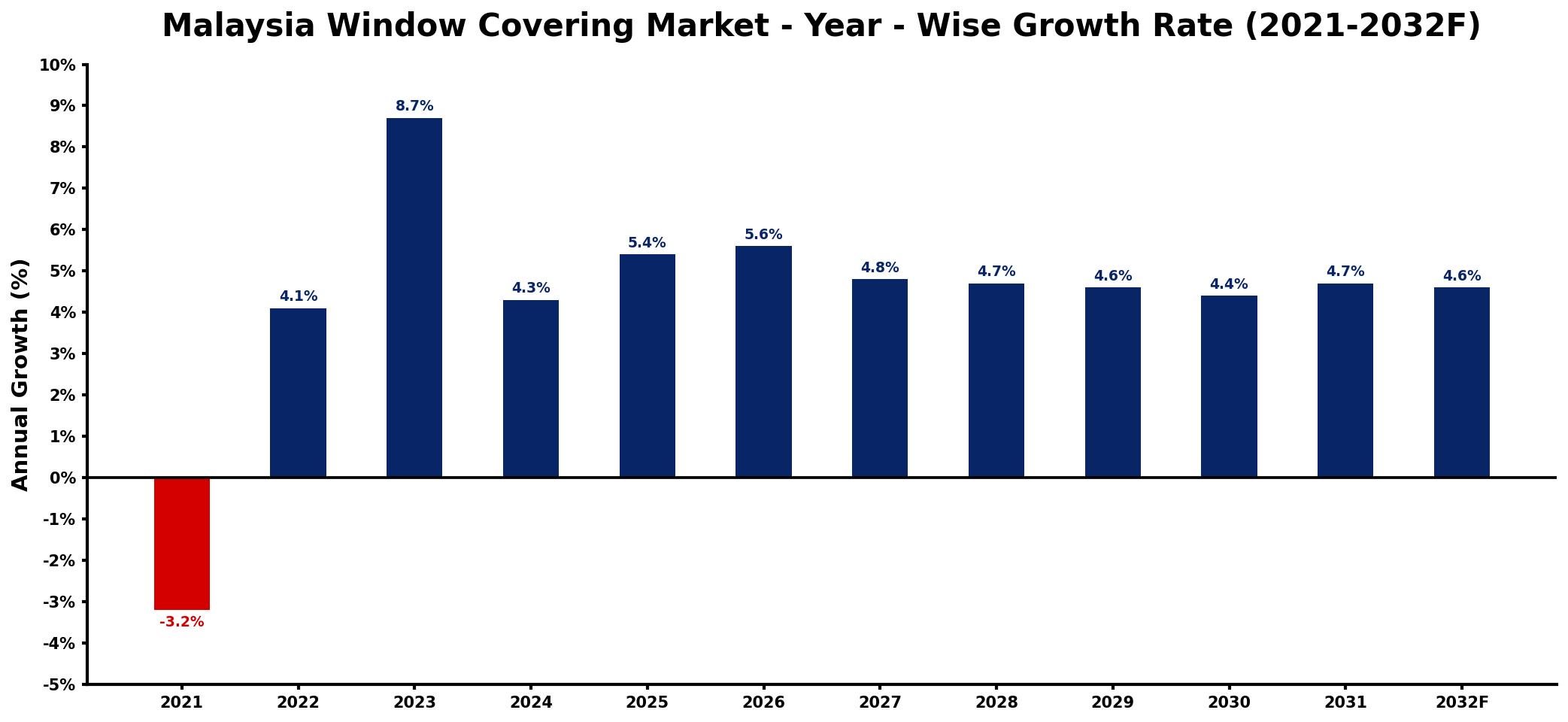
The table below presents the year‑wise growth rates along with the key drivers influencing the market
| Year | Growth Rate | Major Drivers |
| 2021 | -3.2% | Economic slowdown affects consumer spending |
| 2022 | 4.1% | Increased demand for home renovation |
| 2023 | 8.7% | Growing interest in energy efficiency |
| 2024 | 4.3% | Rising disposable income among consumers |
| 2025 | 5.4% | Expansion of real estate projects |
| 2026 | 5.6% | Surge in interior design trends |
| 2027 | 4.8% | Higher investments in residential properties |
| 2028 | 4.7% | Boom in smart home technology |
| 2029 | 4.6% | Increased focus on sustainability initiatives |
| 2030 | 4.4% | Growth in urbanization and housing |
| 2031 | 4.7% | Rising popularity of DIY projects |
| 2032 | 4.6% | Continued demand for aesthetic enhancements |
Note: Market size estimations and growth projections presented in this report are based on 6Wresearch's proprietary forecasting methodology, utilizing the latest available industry data, government publications, and primary research inputs.
Malaysia Window Covering Market Synopsis
The window covering market in Malaysia is thriving as a vital element of interior decoration and sun protection. With the construction and real estate industries flourishing, both residential and commercial sectors are increasingly investing in quality window coverings that align with modern design trends.
Additionally, the dynamic architectural landscape of Malaysia is shaping consumer preferences, compelling manufacturers to innovate and offer customized solutions. As aesthetics and functionality become paramount, the demand for curtains, blinds, and shades is set to rise, opening new avenues for market players.
Malaysia Window Covering Market Key Takeaways
- The market is driven by increasing consumer spending on home improvement and interior design.
- Urbanization and evolving design preferences are pivotal in shaping market dynamics.
- Customization remains a key factor for manufacturers to meet diverse consumer needs.
- Stable market conditions following the pandemic suggest resilience and potential for rebound.
- Key suppliers are establishing stronger ties with contractors and interior designers, enhancing market reach.
Evaluation of Restraints in Malaysia Window Covering Market
Despite the optimistic outlook, the Malaysia Window Covering Market faces several challenges. Competition from imported products poses a significant threat to local manufacturers, particularly in terms of pricing and variety. Additionally, the need for customization to cater to diverse consumer preferences can limit scalability for some companies. These challenges necessitate a strategic approach from market players to maintain competitiveness and address evolving consumer demands effectively.
Malaysia Window Covering Market Trends
Emerging trends in the Malaysia Window Covering Market reflect a growing consumer inclination towards sustainable and energy-efficient products. Eco-friendly materials and smart window solutions are gaining traction as consumers become more environmentally conscious. Furthermore, minimalist and modern designs are leading preferences, with an emphasis on functionality and ease of maintenance. Digital tools for customization and online purchasing are also reshaping the landscape, allowing for a more personalized shopping experience.
Malaysia Window Covering Market Opportunities
The market is brimming with opportunities for businesses willing to innovate and adapt. With the rise of urban living, there is a growing demand for compact and multifunctional window covering solutions suitable for smaller living spaces. Additionally, collaboration with interior designers offers avenues for businesses to tap into new markets. As the trend towards home automation continues, integrating smart technologies into window coverings presents a lucrative prospect for forward-thinking companies.
Government Initiatives in the Malaysia Window Covering Market
The Malaysian government is increasingly recognizing the importance of the construction and interior design sectors, leading to initiatives that may indirectly benefit the window covering market. Programs aimed at promoting sustainable building practices and improving urban infrastructure could drive demand for innovative window solutions. Additionally, public spending on residential and commercial developments is expected to bolster the market further, creating a favorable environment for growth.
Future Insights of the Malaysia Window Covering Market
Looking ahead to the period between 2026 and 2032, the Malaysia Window Covering Market is poised for significant evolution. The convergence of urbanization, rising disposable incomes, and a heightened focus on aesthetics will likely sustain demand. Companies that prioritize customization and sustainability will emerge as market leaders. As technology continues to evolve, integrating smart features into window coverings may redefine consumer expectations, signaling a new era for the industry.
Malaysia Window Covering Market Latest Developments (2025 - 2026)
Recent trends in the Malaysia Window Covering Market indicate a shift towards digitalization, with many companies enhancing their online platforms to facilitate e-commerce. Simultaneously, there is a noticeable uptick in collaborations between window covering manufacturers and tech firms to develop smart window solutions. Industry events and trade shows are also fostering innovation, allowing players to showcase the latest design trends and technological advancements.
Malaysia Window Covering Market - Key Attractiveness of the Report
- 10 Years of Market Numbers
- Historical Data Starting from 2022 to 2025
- Base Year: 2025
- Forecast Data until 2032
- Key Performance Indicators Impacting the Market
- Major Upcoming Developments and Projects
Key Highlights of the Report:
- Malaysia Window Covering Market Outlook
- Market Size of Malaysia Window Covering Market, 2025
- Forecast of Malaysia Window Covering Market, 2032
- Historical Data and Forecast of Malaysia Window Covering Revenues & Volume for the Period 2022-2032F
- Malaysia Window Covering Market Trend Evolution
- Malaysia Window Covering Market Drivers and Challenges
- Malaysia Window Covering Price Trends
- Malaysia Window Covering Porter's Five Forces
- Malaysia Window Covering Industry Life Cycle
- Historical Data and Forecast of Malaysia Window Covering Market Revenues & Volume By Type for the Period 2022-2032F
- Historical Data and Forecast of Malaysia Window Covering Market Revenues & Volume By Blinds & Shades for the Period 2022-2032F
- Historical Data and Forecast of Malaysia Window Covering Market Revenues & Volume By Curtains for the Period 2022-2032F
- Historical Data and Forecast of Malaysia Window Covering Market Revenues & Volume By Shutters for the Period 2022-2032F
- Historical Data and Forecast of Malaysia Window Covering Market Revenues & Volume By Others for the Period 2022-2032F
- Historical Data and Forecast of Malaysia Window Covering Market Revenues & Volume By Application for the Period 2022-2032F
- Historical Data and Forecast of Malaysia Window Covering Market Revenues & Volume By Residential for the Period 2022-2032F
- Historical Data and Forecast of Malaysia Window Covering Market Revenues & Volume By Commercial for the Period 2022-2032F
- Historical Data and Forecast of Malaysia Window Covering Market Revenues & Volume By Distribution Channel for the Period 2022-2032F
- Historical Data and Forecast of Malaysia Window Covering Market Revenues & Volume By Online for the Period 2022-2032F
- Historical Data and Forecast of Malaysia Window Covering Market Revenues & Volume By Offline for the Period 2022-2032F
- Historical Data and Forecast of Malaysia Window Covering Market Revenues & Volume By Supermarkets/Hypermarkets for the Period 2022-2032F
- Historical Data and Forecast of Malaysia Window Covering Market Revenues & Volume By Specialty Stores for the Period 2022-2032F
- Historical Data and Forecast of Malaysia Window Covering Market Revenues & Volume By Multi Brand Stores for the Period 2022-2032F
- Malaysia Window Covering Import Export Trade Statistics
- Market Opportunity Assessment By Type
- Market Opportunity Assessment By Application
- Market Opportunity Assessment By Distribution Channel
- Malaysia Window Covering Top Companies Market Share
- Malaysia Window Covering Competitive Benchmarking By Technical and Operational Parameters
- Malaysia Window Covering Company Profiles
- Malaysia Window Covering Key Strategic Recommendations






































