Malta Ascorbic Acid Market Size (2020-2030)
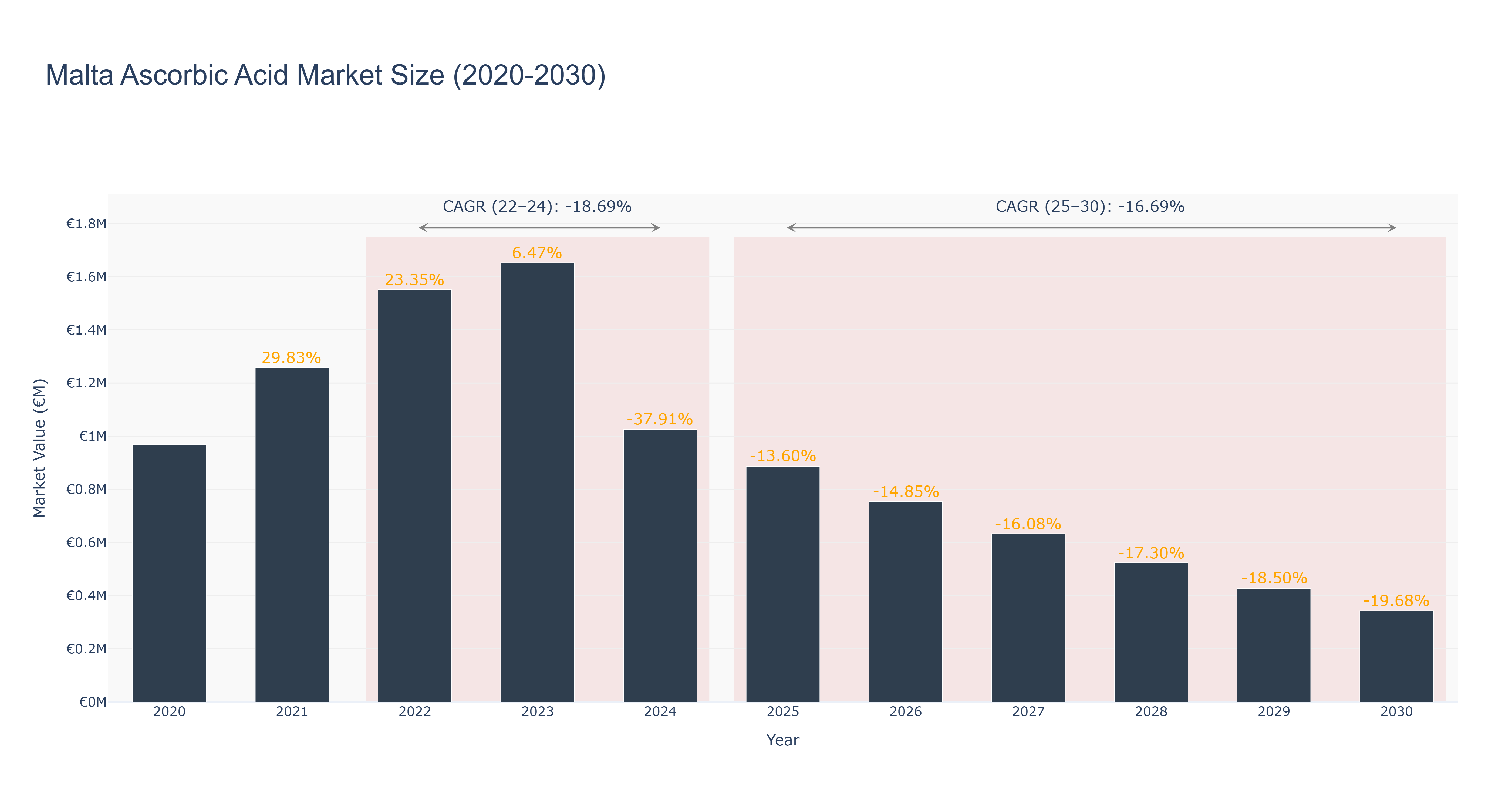
Malta Ascorbic Acid Market has experienced a fluctuating trend over the past decade. The peak market size of €1.65 million was recorded in 2023, followed by a significant decline to €0.89 million in 2025. The market is forecasted to continue shrinking, reaching an estimated size of €0.34 million by 2030, with a CAGR of -16.69% from 2025 to 2030. The downward trajectory can be attributed to various factors such as changing consumer preferences, increased competition, and economic uncertainties. Despite the current challenges, the market is expected to witness new developments in sustainable production methods and innovative product offerings in the coming years, aimed at revitalizing growth. Industry drivers include the growing demand for natural and healthy ingredients in the food and pharmaceutical sectors.
Malta Ascorbic Acid Market: Production & Trade Performance (2019-2025)
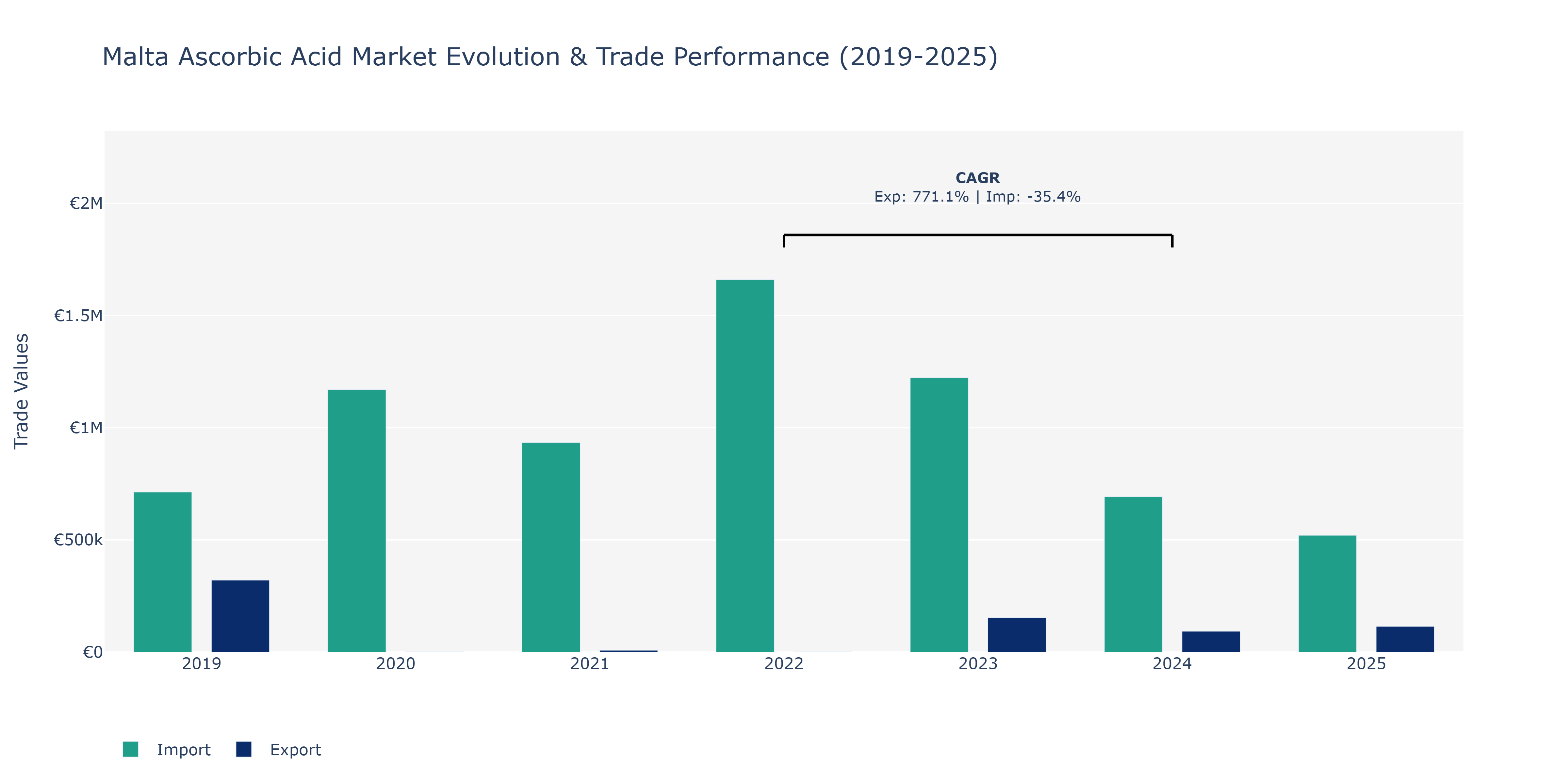
The Malta Ascorbic Acid Market exhibited varying trends in exports and imports from 2019 to 2025. In 2019, imports stood notably higher than exports, with imports at €713.16 thousand and exports at €320.88 thousand. However, a significant shift occurred in 2020, where exports dropped to €924 thousand while imports soared to €1.17 million, indicating a substantial increase in imports. This trend continued in 2021 with exports at €8.1 thousand and imports at €934.22 thousand. A peak in exports was observed in 2023 at €153.68 thousand, followed by a slight decline in 2024 to €92.95 thousand. Conversely, imports peaked in 2022 at €1.66 million and experienced a notable decrease to €692.56 thousand in 2024. These fluctuations can be attributed to evolving global supply chain dynamics, changes in domestic production capacities, and shifts in consumer demand patterns for ascorbic acid in Malta. Such movements highlight the market's sensitivity to external factors and underline the importance of strategic planning to navigate uncertainties effectively.
Key Highlights of the Report:
- Malta Ascorbic Acid Market Outlook
- Market Size of Malta Ascorbic Acid Market, 2025
- Forecast of Malta Ascorbic Acid Market, 2032
- Historical Data and Forecast of Malta Ascorbic Acid Revenues & Volume for the Period 2022 - 2032F
- Malta Ascorbic Acid Market Trend Evolution
- Malta Ascorbic Acid Market Drivers and Challenges
- Malta Ascorbic Acid Price Trends
- Malta Ascorbic Acid Porter`s Five Forces
- Malta Ascorbic Acid Industry Life Cycle
- Historical Data and Forecast of Malta Ascorbic Acid Market Revenues & Volume By Grade for the Period 2022 - 2032F
- Historical Data and Forecast of Malta Ascorbic Acid Market Revenues & Volume By Food & Pharmaceutical for the Period 2022 - 2032F
- Historical Data and Forecast of Malta Ascorbic Acid Market Revenues & Volume By Industrial for the Period 2022 - 2032F
- Historical Data and Forecast of Malta Ascorbic Acid Market Revenues & Volume By Application for the Period 2022 - 2032F
- Historical Data and Forecast of Malta Ascorbic Acid Market Revenues & Volume By Food & Beverages for the Period 2022 - 2032F
- Historical Data and Forecast of Malta Ascorbic Acid Market Revenues & Volume By Pharmaceutical for the Period 2022 - 2032F
- Historical Data and Forecast of Malta Ascorbic Acid Market Revenues & Volume By Cosmetics for the Period 2022 - 2032F
- Historical Data and Forecast of Malta Ascorbic Acid Market Revenues & Volume By Chemicals for the Period 2022 - 2032F
- Historical Data and Forecast of Malta Ascorbic Acid Market Revenues & Volume By Agriculture for the Period 2022 - 2032F
- Historical Data and Forecast of Malta Ascorbic Acid Market Revenues & Volume By Others for the Period 2022 - 2032F
- Malta Ascorbic Acid Import Export Trade Statistics
- Market Opportunity Assessment By Grade
- Market Opportunity Assessment By Application
- Malta Ascorbic Acid Top Companies Market Share
- Malta Ascorbic Acid Competitive Benchmarking By Technical and Operational Parameters
- Malta Ascorbic Acid Company Profiles
- Malta Ascorbic Acid Key Strategic Recommendations






































