Mexico Aircraft Seat Upholstery Market Size, Share & Growth Rate
The Mexico Aircraft Seat Upholstery Market was estimated at USD 361 Million in 2025 and is projected to reach USD 484 Million by 2032, growing at a CAGR of 4.3% from 2026 to 2032. This growth trajectory is driven by an expanding aviation sector, where airlines increasingly prioritize passenger comfort and aesthetic appeal in their cabin interiors. Additionally, the push for lightweight and eco-friendly materials is further propelling investment in innovative upholstery solutions.
Mexico Aircraft Seat Upholstery Market Year-wise Growth Rate and Key Drivers
This graph highlights how the Mexico Aircraft Seat Upholstery Market has steadily grown over the years, supported by major growth factors.
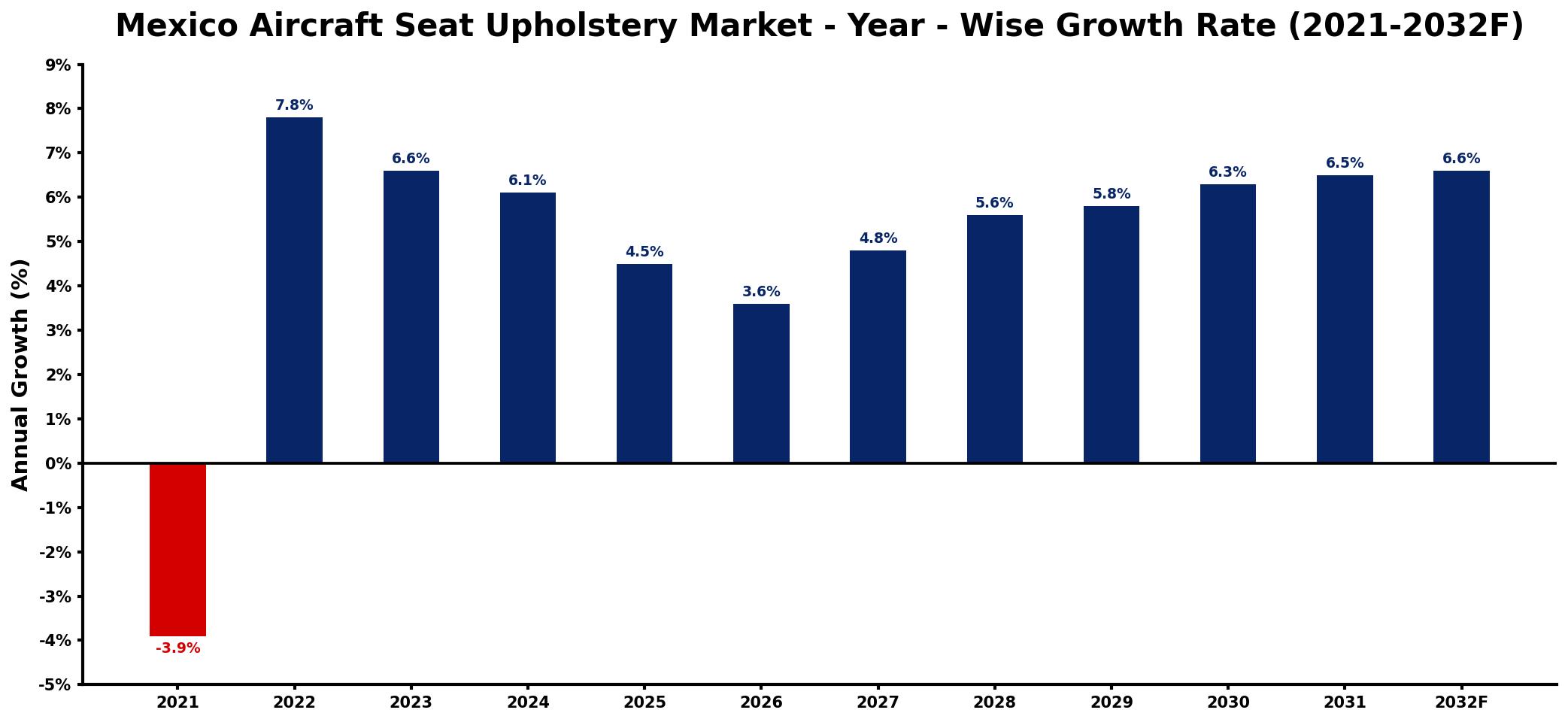
The table below presents the year‑wise growth rates along with the key drivers influencing the market
| Year | Growth Rate | Major Drivers |
| 2021 | -3.9% | decreased demand from airlines |
| 2022 | 7.8% | increased investments in aviation |
| 2023 | 6.6% | growing preference for comfort |
| 2024 | 6.1% | expansion of regional airlines |
| 2025 | 4.5% | rising passenger travel volumes |
| 2026 | 3.6% | enhanced focus on sustainability |
| 2027 | 4.8% | development of new technologies |
| 2028 | 5.6% | growing international tourism sector |
| 2029 | 5.8% | increased collaborations with manufacturers |
| 2030 | 6.3% | enhanced product quality standards |
| 2031 | 6.5% | emphasis on passenger experience |
| 2032 | 6.6% | growing demand for customization |
Note: Market size estimations and growth projections presented in this report are based on 6Wresearch's proprietary forecasting methodology, utilizing the latest available industry data, government publications, and primary research inputs.
Mexico Aircraft Seat Upholstery Market Synopsis
The expanding aviation industry is the most potent force shaping the Mexico Aircraft Seat Upholstery Market. With a significant rise in passenger traffic and the corresponding demand for enhanced onboard experiences, airlines are investing heavily in seat upgrades, notably upholstery. This trend not only enhances comfort but also aims to improve fuel efficiency through the adoption of lighter materials.
Another key driver is the heightened awareness surrounding sustainability. Airlines and manufacturers alike are leaning towards eco-friendly upholstery solutions, aligning with global initiatives to reduce carbon footprints. This shift not only meets consumer demand but also positions companies favorably within an industry increasingly focused on environmental stewardship.
Mexico Aircraft Seat Upholstery Market Key Takeaways
- The market is anticipated to experience steady growth, driven by the rising passenger demand for air travel.
- Lightweight and durable materials are becoming standard, enhancing comfort while reducing operational costs for airlines.
- There is a noticeable trend towards customization, with airlines seeking unique upholstery designs to differentiate their services.
- Eco-friendly materials are gaining traction, reflecting a broader industry commitment to sustainability.
- Technological innovations, including smart textiles, are being integrated into seat upholstery to improve hygiene and comfort.
Evaluation of Restraints in Mexico Aircraft Seat Upholstery Market
Despite its promising growth, the Mexico Aircraft Seat Upholstery Market faces significant restraints. Increased competition from international manufacturers places pressure on local firms to innovate continually and manage costs effectively. Fluctuating raw material prices can disrupt supply chains and impact product pricing. Moreover, adherence to stringent safety and quality regulations necessitates constant vigilance and investment, which can be a hurdle for smaller players. These factors collectively challenge manufacturers to maintain a competitive edge in a rapidly evolving market landscape.
Mexico Aircraft Seat Upholstery Market Trends
The market is currently witnessing a robust trend towards lightweight and durable upholstery materials, essential for improving fuel efficiency while lowering maintenance costs. Innovations such as antimicrobial fabrics are gaining popularity, enhancing hygiene on board, which is particularly relevant in a post-pandemic landscape. Additionally, airlines are increasingly investing in customization options, seeking to create unique cabin experiences that resonate with their brand identity and passenger expectations. As sustainability becomes paramount, the demand for eco-friendly upholstery made from recycled or sustainable materials is also surging.
Mexico Aircraft Seat Upholstery Market Opportunities
Investment opportunities abound in the Mexico Aircraft Seat Upholstery Market, particularly as airlines expand their fleets and upgrade interiors. Providers of advanced materials—such as fire-resistant fabrics and customizable designs—stand to gain significantly. Furthermore, focusing on research and development to create lightweight, durable, and easy-to-maintain upholstery solutions offers a pathway to gaining a competitive edge. The emphasis on sustainability opens new avenues for companies specializing in eco-friendly materials, thereby aligning with the evolving preferences of both airlines and passengers.
Government Initiatives in the Mexico Aircraft Seat Upholstery Market
Government policies play a crucial role in shaping the Mexico Aircraft Seat Upholstery Market. The General Directorate of Civil Aeronautics (DGAC) and the International Civil Aviation Organization (ICAO) have established regulations that ensure safety standards for materials used in aircraft seat upholstery. These regulations focus on fire safety and durability, critical for passenger safety. The Mexican government also supports the aerospace industry through various incentives and initiatives, which, while primarily targeting aircraft manufacturing, indirectly boost the demand for upholstery by promoting the growth of the aviation sector.
Future Insights of the Mexico Aircraft Seat Upholstery Market
Looking ahead to the period from 2026 to 2032, the Mexico Aircraft Seat Upholstery Market is expected to maintain its growth trajectory, bolstered by rising disposable income levels and the expanding tourism sector. The introduction of new aircraft models with advanced seating technologies will further drive demand for high-quality upholstery materials. Additionally, the push for sustainable practices will continue to influence purchasing decisions, paving the way for innovative upholstery solutions that align with the industry's environmental goals. Overall, the market is positioned for significant advancements in both technology and design, all aimed at elevating passenger experiences.
Mexico Aircraft Seat Upholstery Market Latest Developments (2025 - 2026)
Recent developments in the Mexico Aircraft Seat Upholstery Market indicate a shift towards incorporating smart textiles in upholstery designs. This evolution is driven by technological advancements that focus on enhancing passenger comfort and safety. Additionally, sustainability initiatives are prompting manufacturers to explore new eco-friendly materials that not only meet regulatory standards but also appeal to environmentally conscious airlines. Partnerships between upholstery manufacturers and airlines are becoming more common as both parties seek innovative solutions that satisfy safety, comfort, and aesthetic criteria.
Mexico Aircraft Seat Upholstery Market - Key Attractiveness of the Report
- 10 Years of Market Numbers
- Historical Data Starting from 2022 to 2025
- Base Year: 2025
- Forecast Data until 2032
- Key Performance Indicators Impacting the Market
- Major Upcoming Developments and Projects
Key Highlights of the Report:
- Mexico Aircraft Seat Upholstery Market Outlook
- Market Size of Mexico Aircraft Seat Upholstery Market, 2025
- Forecast of Mexico Aircraft Seat Upholstery Market, 2032
- Historical Data and Forecast of Mexico Aircraft Seat Upholstery Revenues & Volume for the Period 2022-2032F
- Mexico Aircraft Seat Upholstery Market Trend Evolution
- Mexico Aircraft Seat Upholstery Market Drivers and Challenges
- Mexico Aircraft Seat Upholstery Price Trends
- Mexico Aircraft Seat Upholstery Porter's Five Forces
- Mexico Aircraft Seat Upholstery Industry Life Cycle
- Historical Data and Forecast of Mexico Aircraft Seat Upholstery Market Revenues & Volume By Material Type for the Period 2022-2032F
- Historical Data and Forecast of Mexico Aircraft Seat Upholstery Market Revenues & Volume By Fabric for the Period 2022-2032F
- Historical Data and Forecast of Mexico Aircraft Seat Upholstery Market Revenues & Volume By Leather for the Period 2022-2032F
- Historical Data and Forecast of Mexico Aircraft Seat Upholstery Market Revenues & Volume By Vinyl for the Period 2022-2032F
- Historical Data and Forecast of Mexico Aircraft Seat Upholstery Market Revenues & Volume By Seat Cover Type for the Period 2022-2032F
- Historical Data and Forecast of Mexico Aircraft Seat Upholstery Market Revenues & Volume By Bottom Covers for the Period 2022-2032F
- Historical Data and Forecast of Mexico Aircraft Seat Upholstery Market Revenues & Volume By Back Rest for the Period 2022-2032F
- Historical Data and Forecast of Mexico Aircraft Seat Upholstery Market Revenues & Volume By Armrests for the Period 2022-2032F
- Historical Data and Forecast of Mexico Aircraft Seat Upholstery Market Revenues & Volume By Headrests for the Period 2022-2032F
- Historical Data and Forecast of Mexico Aircraft Seat Upholstery Market Revenues & Volume By Seat Rear Pockets for the Period 2022-2032F
- Historical Data and Forecast of Mexico Aircraft Seat Upholstery Market Revenues & Volume By Seat Type for the Period 2022-2032F
- Historical Data and Forecast of Mexico Aircraft Seat Upholstery Market Revenues & Volume By First Class for the Period 2022-2032F
- Historical Data and Forecast of Mexico Aircraft Seat Upholstery Market Revenues & Volume By Business Class for the Period 2022-2032F
- Historical Data and Forecast of Mexico Aircraft Seat Upholstery Market Revenues & Volume By Premium Economy Class for the Period 2022-2032F
- Historical Data and Forecast of Mexico Aircraft Seat Upholstery Market Revenues & Volume By Economy Class for the Period 2022-2032F
- Historical Data and Forecast of Mexico Aircraft Seat Upholstery Market Revenues & Volume By Aircraft Type for the Period 2022-2032F
- Historical Data and Forecast of Mexico Aircraft Seat Upholstery Market Revenues & Volume By Narrow-body Aircraft for the Period 2022-2032F
- Historical Data and Forecast of Mexico Aircraft Seat Upholstery Market Revenues & Volume By Wide-body Aircraft for the Period 2022-2032F
- Historical Data and Forecast of Mexico Aircraft Seat Upholstery Market Revenues & Volume By Very Large Aircraft for the Period 2022-2032F
- Historical Data and Forecast of Mexico Aircraft Seat Upholstery Market Revenues & Volume By Regional Transport Aircraft for the Period 2022-2032F
- Historical Data and Forecast of Mexico Aircraft Seat Upholstery Market Revenues & Volume By Business Jets for the Period 2022-2032F
- Historical Data and Forecast of Mexico Aircraft Seat Upholstery Market Revenues & Volume By General Aviation Aircraft for the Period 2022-2032F
- Historical Data and Forecast of Mexico Aircraft Seat Upholstery Market Revenues & Volume By Helicopters for the Period 2022-2032F
- Mexico Aircraft Seat Upholstery Import Export Trade Statistics
- Market Opportunity Assessment By Material Type
- Market Opportunity Assessment By Seat Cover Type
- Market Opportunity Assessment By Seat Type
- Market Opportunity Assessment By Aircraft Type
- Mexico Aircraft Seat Upholstery Top Companies Market Share
- Mexico Aircraft Seat Upholstery Competitive Benchmarking By Technical and Operational Parameters
- Mexico Aircraft Seat Upholstery Company Profiles
- Mexico Aircraft Seat Upholstery Key Strategic Recommendations






































