Mexico Automotive Wheel Rims Market Size, Share & Growth Rate
The Mexico Automotive Wheel Rims Market was estimated at USD 225 Million in 2025 and is projected to reach USD 258 Million by 2032, growing at a CAGR of 2.0% from 2026 to 2032. This growth trajectory is largely driven by the robust automotive manufacturing sector in Mexico, where the production of passenger vehicles and commercial trucks is surging. Factors such as increasing consumer demand for lightweight materials and advanced manufacturing processes are further contributing to this positive outlook, enhancing both vehicle performance and fuel efficiency.
Mexico Automotive Wheel Rims Market Year-wise Growth Rate and Key Drivers
This graph highlights how the Mexico Automotive Wheel Rims Market has steadily grown over the years, supported by major growth factors.
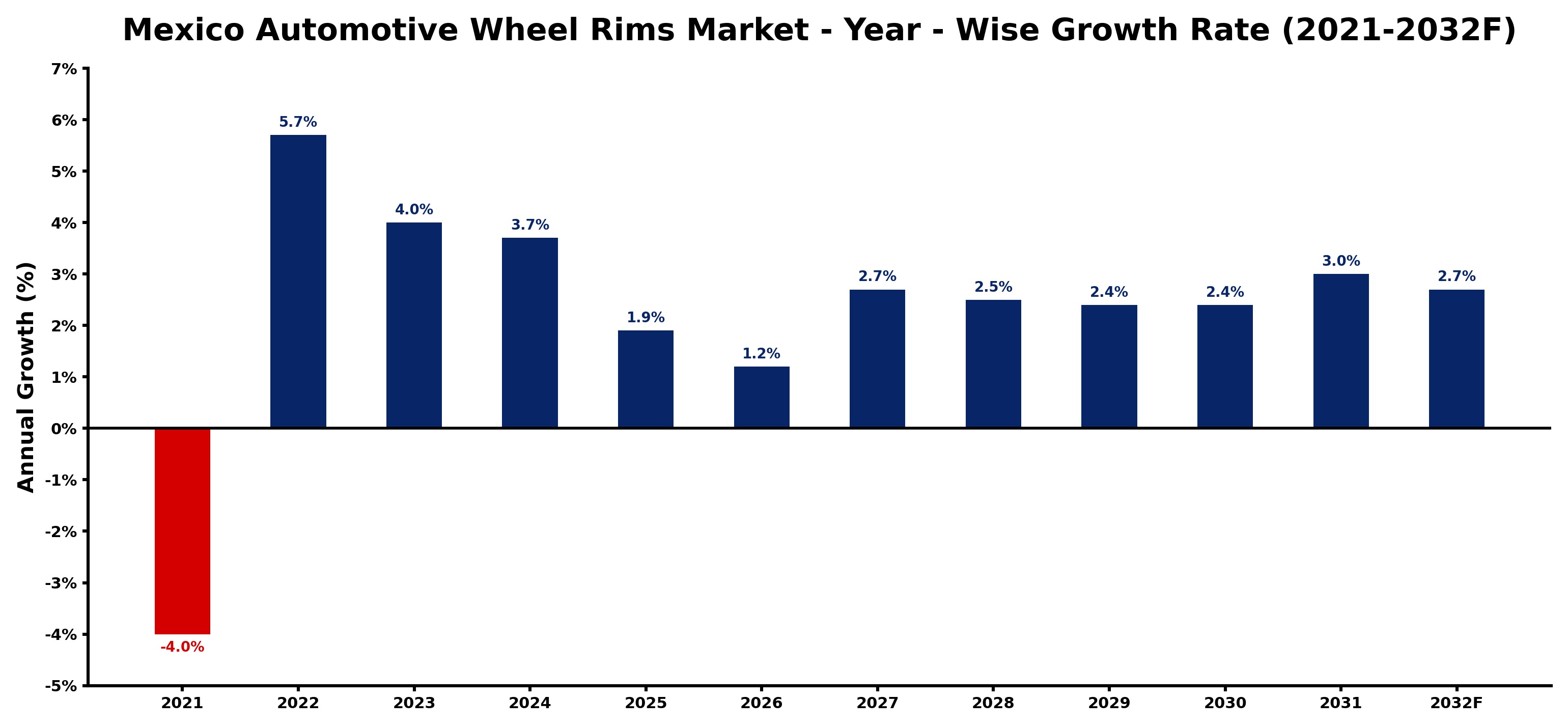
The table below presents the year‑wise growth rates along with the key drivers influencing the market
| Year | Growth Rate | Major Drivers |
| 2021 | -4.0% | Supply chain disruptions limited production |
| 2022 | 5.7% | Electric vehicle adoption increased demand |
| 2023 | 4.0% | Manufacturing capacity expansion supported growth |
| 2024 | 3.7% | Technological advancements enhanced efficiency |
| 2025 | 1.9% | Sustainability initiatives attracted consumers |
| 2026 | 1.2% | Automotive sector recovery strengthened sales |
| 2027 | 2.7% | Rising disposable income fueled purchases |
| 2028 | 2.5% | Customization trends drove consumer interest |
| 2029 | 2.4% | Export opportunities expanded market reach |
| 2030 | 2.4% | Partnerships with automakers increased collaboration |
| 2031 | 3.0% | Innovative designs attracted new customers |
| 2032 | 2.7% | Digital marketing strategies enhanced visibility |
Note - Market size estimations and growth projections presented in this report are based on 6Wresearch’s advanced forecasting approach, validated with industry datasets as of June 2026.
Mexico Automotive Wheel Rims Market Synopsis
In recent years, the Mexico Automotive Wheel Rims Market has experienced substantial momentum, bolstered by rising vehicle production and a burgeoning automotive sector. As domestic and international manufacturers ramp up operations, the market is poised for consistent growth, driven by evolving consumer preferences towards premium and stylish wheel rims.
Looking ahead, while the market momentum remains positive, it faces emerging challenges from low-cost imports and raw material price volatility. These factors could potentially affect manufacturers' pricing strategies, necessitating a focus on innovation and efficiency to sustain growth amid these pressures.
Mexico Automotive Wheel Rims Market Key Takeaways
- Significant growth potential driven by increased vehicle production and higher consumer demand.
- Focus on lightweight and durable materials to improve fuel efficiency and performance.
- Emergence of aesthetic preferences among consumers leading to demand for customized wheel rims.
- Competitive landscape influenced by low-cost imports and raw material pricing fluctuations.
- Regulatory standards imposed by the Mexican government ensure product safety and reliability.
Evaluation of Restraints in Mexico Automotive Wheel Rims Market
Despite the growth potential, the Mexico Automotive Wheel Rims Market is restrained by multiple factors. The rising competition from low-cost imports creates pricing pressures, compelling local manufacturers to reconsider their cost structures. Additionally, fluctuations in raw material prices pose significant challenges, impacting profitability and operational stability. Disruptions in the supply chain, such as logistics bottlenecks and material shortages, further complicate market dynamics, making it imperative for companies to implement agile strategies to navigate these challenges effectively.
Mexico Automotive Wheel Rims Market Trends
Current trends in the Mexico Automotive Wheel Rims Market highlight a growing inclination towards lightweight materials, driven by the automotive industry's push for enhanced fuel efficiency. Furthermore, advancements in manufacturing technologies are enabling the creation of bespoke and visually appealing wheel designs, resonating with consumer desires for personalization. As aftermarket sales flourish, the trend of customization is likely to become even more pronounced, shaping demand in the years ahead.
Mexico Automotive Wheel Rims Market Opportunities
Genuine growth opportunities lie in the development of innovative materials and technologies that cater to evolving market demands. As manufacturers increasingly focus on eco-friendly and sustainable solutions, there is substantial potential for introducing new lightweight materials into the market. Additionally, tapping into the aftermarket sector by offering customized wheel rims can further drive revenue growth, as consumers seek unique products that reflect their personal style and enhance vehicle aesthetics.
Government Initiatives in the Mexico Automotive Wheel Rims Market
The Mexican government actively supports the automotive sector through regulations that ensure compliance with safety and quality standards. Agencies such as the Mexican Institute of Standardization and Certification (IMNC) and the Federal Consumer Protection Agency (PROFECO) oversee the enforcement of these standards. Moreover, government initiatives may include trade policies designed to bolster domestic production, providing a protective framework that enhances the competitiveness of local manufacturers in the automotive wheel rims market.
Future Insights of the Mexico Automotive Wheel Rims Market
Looking forward to 2026-2032, the Mexico Automotive Wheel Rims Market is expected to witness steady growth supported by continued advancements in automotive technology and design. As consumer preferences shift towards premium products, manufacturers will need to innovate to meet these demands. The integration of sustainable practices and materials in wheel rim production will likely emerge as a critical factor for success, aligning with global trends toward environmental responsibility and consumer consciousness.
Mexico Automotive Wheel Rims Market Latest Developments (May 2025 - June 2026)
Recent developments in the Mexico Automotive Wheel Rims Market reflect an industry adapting to both consumer demands and technological advancements. Manufacturers are increasingly investing in R&D to develop lighter, more durable rims that enhance vehicle performance and fuel efficiency. Additionally, there is a noticeable shift towards more localized supply chains, aimed at mitigating disruptions and ensuring product availability in response to fluctuating demand. The push for sustainable practices has also garnered attention, with companies exploring eco-friendly material options to appeal to environmentally conscious consumers.
Mexico Automotive Wheel Rims Market - Key Attractiveness of the Report
- 10 Years of Market Numbers
- Historical Data Starting from 2022 to 2025
- Base Year: 2025
- Forecast Data until 2032
- Key Performance Indicators Impacting the Market
- Major Upcoming Developments and Projects
Key Highlights of the Report:
- Mexico Automotive Wheel Rims Market Outlook
- Market Size of Mexico Automotive Wheel Rims Market, 2025
- Forecast of Mexico Automotive Wheel Rims Market, 2032
- Historical Data and Forecast of Mexico Automotive Wheel Rims Revenues & Volume for the Period 2022-2032F
- Mexico Automotive Wheel Rims Market Trend Evolution
- Mexico Automotive Wheel Rims Market Drivers and Challenges
- Mexico Automotive Wheel Rims Price Trends
- Mexico Automotive Wheel Rims Porter's Five Forces
- Mexico Automotive Wheel Rims Industry Life Cycle
- Historical Data and Forecast of Mexico Automotive Wheel Rims Market Revenues & Volume By Material Type for the Period 2022-2032F
- Historical Data and Forecast of Mexico Automotive Wheel Rims Market Revenues & Volume By Alloy for the Period 2022-2032F
- Historical Data and Forecast of Mexico Automotive Wheel Rims Market Revenues & Volume By Steel for the Period 2022-2032F
- Historical Data and Forecast of Mexico Automotive Wheel Rims Market Revenues & Volume By Carbon Fiber for the Period 2022-2032F
- Historical Data and Forecast of Mexico Automotive Wheel Rims Market Revenues & Volume By Sales Channel for the Period 2022-2032F
- Historical Data and Forecast of Mexico Automotive Wheel Rims Market Revenues & Volume By OEM for the Period 2022-2032F
- Historical Data and Forecast of Mexico Automotive Wheel Rims Market Revenues & Volume By Aftermarket for the Period 2022-2032F
- Historical Data and Forecast of Mexico Automotive Wheel Rims Market Revenues & Volume By Vehicle Type for the Period 2022-2032F
- Historical Data and Forecast of Mexico Automotive Wheel Rims Market Revenues & Volume By Passenger Cars for the Period 2022-2032F
- Historical Data and Forecast of Mexico Automotive Wheel Rims Market Revenues & Volume By Commercial Vehicles for the Period 2022-2032F
- Mexico Automotive Wheel Rims Import Export Trade Statistics
- Market Opportunity Assessment By Material Type
- Market Opportunity Assessment By Sales Channel
- Market Opportunity Assessment By Vehicle Type
- Mexico Automotive Wheel Rims Top Companies Market Share
- Mexico Automotive Wheel Rims Competitive Benchmarking By Technical and Operational Parameters
- Mexico Automotive Wheel Rims Company Profiles
- Mexico Automotive Wheel Rims Key Strategic Recommendations






































