Mexico Drill Pipe Market Size Growth Rate
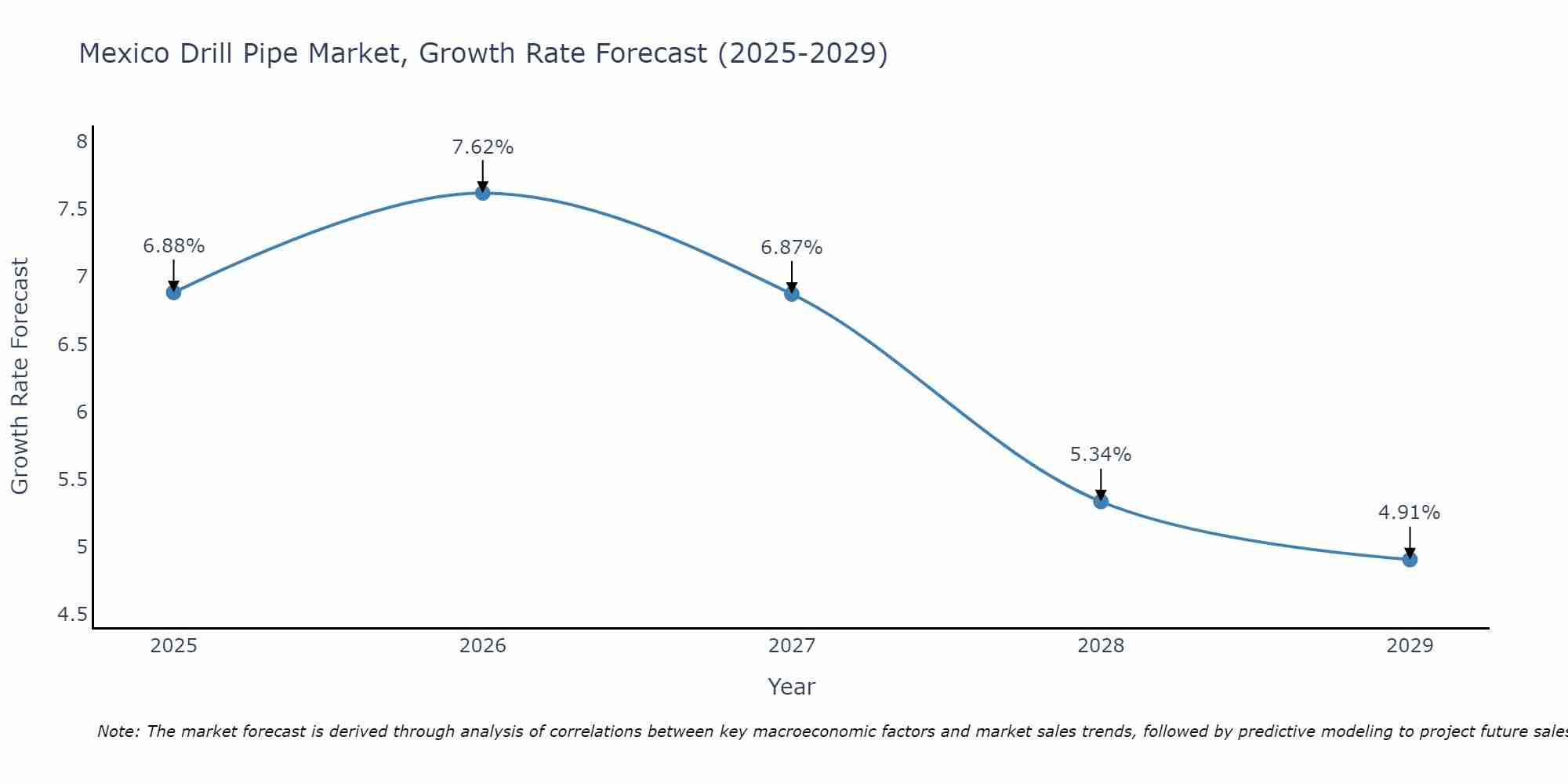
The Mexico Drill Pipe Market is projected to witness mixed growth rate patterns during 2025 to 2029. Growth accelerates to 7.62% in 2026, following an initial rate of 6.88%, before easing to 4.91% at the end of the period.
Mexico Drill Pipe Market Synopsis
The Mexico drill pipe market is experiencing steady growth driven by the country`s active oil and gas exploration and production activities. The demand for drill pipes in Mexico is primarily fueled by the increasing investment in offshore exploration projects in the Gulf of Mexico and onshore projects in various regions. The market is characterized by key players such as Tenaris, TMK Group, and Vallourec, offering a wide range of drill pipe products to cater to the diverse needs of the industry. Technological advancements in drill pipe manufacturing, such as the use of premium materials and enhanced performance capabilities, are further contributing to market expansion. With the government`s initiatives to attract foreign investments in the energy sector, the Mexico drill pipe market is poised for continuous growth in the coming years.
Mexico Drill Pipe Market Trends
The Mexico drill pipe market is experiencing several key trends. One notable trend is the increasing demand for high-quality drill pipe due to the growth in offshore drilling activities in the Gulf of Mexico. This has led to a rise in the adoption of advanced drill pipe technologies that offer improved durability and performance in challenging drilling environments. Additionally, there is a growing focus on sustainability and environmental responsibility, driving the development of eco-friendly drill pipe materials and practices. Market players are also investing in research and development to introduce innovative solutions that enhance drilling efficiency and reduce operational costs. Overall, the Mexico drill pipe market is witnessing a shift towards advanced technologies and sustainable practices to meet the evolving needs of the oil and gas industry in the region.
Mexico Drill Pipe Market Challenges
The Mexico drill pipe market faces several challenges, including fluctuations in oil prices that impact drilling activity and investment in the sector. Additionally, competition from other countries, particularly the United States, can put pressure on Mexican drill pipe manufacturers and suppliers. Regulatory uncertainties and changes in government policies related to the energy sector can also create challenges for companies operating in the market. Moreover, the need for continuous technological advancements and innovation to meet the evolving requirements of drilling operations poses a challenge for market players in Mexico. Overall, navigating these challenges requires market participants to stay agile, innovative, and adaptable to the changing dynamics of the industry to maintain a competitive edge in the Mexico drill pipe market.
Mexico Drill Pipe Market Investment Opportunities
The Mexico drill pipe market presents promising investment opportunities due to the growing oil and gas exploration activities in the region. As Mexico aims to increase its energy production and reduce reliance on imports, there is a rising demand for drill pipe equipment used in drilling operations. Investing in companies that manufacture or supply drill pipes in Mexico could be lucrative, especially with the government`s push to attract foreign investment in the energy sector. Additionally, advancements in technology and the adoption of innovative drilling techniques are driving the need for high-quality, durable drill pipe materials. With the potential for increased exploration and production activities in Mexico`s oil and gas sector, investing in the drill pipe market could offer significant returns for investors looking to capitalize on the country`s energy industry growth.
Jordan Agar Market Government Policies
The Mexico Drill Pipe Market is influenced by government policies aimed at promoting the oil and gas industry in the country. Key policies include regulations set by the National Hydrocarbons Commission (CNH) to oversee exploration and production activities, as well as the Energy Reform implemented in 2013 to attract foreign investment and encourage competition in the sector. Additionally, the Mexican government`s focus on increasing domestic production and reducing dependence on oil imports has led to initiatives to support local manufacturing of drill pipe and other equipment. These policies create both opportunities and challenges for companies operating in the Mexico Drill Pipe Market, as they navigate regulatory requirements and strive to align with the government`s objectives for the industry.
Mexico Drill Pipe Market Future Outlook
The future outlook for the Mexico Drill Pipe Market appears promising with steady growth anticipated in the coming years. This can be attributed to the increasing exploration and production activities in the oil and gas sector in Mexico, driven by government initiatives to attract foreign investment and technological advancements in drilling techniques. Additionally, the country`s vast untapped reserves offer significant opportunities for market expansion. With a focus on enhancing operational efficiency, reducing costs, and ensuring environmental sustainability, the demand for high-quality drill pipes is expected to rise. Market players are likely to invest in research and development to introduce innovative products that cater to the evolving needs of the industry, further fueling market growth in Mexico.
Key Highlights of the Report:
- Mexico Drill Pipe Market Outlook
- Market Size of Mexico Drill Pipe Market, 2021
- Forecast of Mexico Drill Pipe Market, 2031
- Historical Data and Forecast of Mexico Drill Pipe Revenues & Volume for the Period 2018 - 2031
- Mexico Drill Pipe Market Trend Evolution
- Mexico Drill Pipe Market Drivers and Challenges
- Mexico Drill Pipe Price Trends
- Mexico Drill Pipe Porter's Five Forces
- Mexico Drill Pipe Industry Life Cycle
- Historical Data and Forecast of Mexico Drill Pipe Market Revenues & Volume By Type for the Period 2018 - 2031
- Historical Data and Forecast of Mexico Drill Pipe Market Revenues & Volume By Standard Drill Pipe for the Period 2018 - 2031
- Historical Data and Forecast of Mexico Drill Pipe Market Revenues & Volume By Heavy Weight Drill Pipe for the Period 2018 - 2031
- Historical Data and Forecast of Mexico Drill Pipe Market Revenues & Volume By Drill Collar for the Period 2018 - 2031
- Historical Data and Forecast of Mexico Drill Pipe Market Revenues & Volume By Deployment for the Period 2018 - 2031
- Historical Data and Forecast of Mexico Drill Pipe Market Revenues & Volume By Onshore for the Period 2018 - 2031
- Historical Data and Forecast of Mexico Drill Pipe Market Revenues & Volume By Offshore for the Period 2018 - 2031
- Mexico Drill Pipe Import Export Trade Statistics
- Market Opportunity Assessment By Type
- Market Opportunity Assessment By Deployment
- Mexico Drill Pipe Top Companies Market Share
- Mexico Drill Pipe Competitive Benchmarking By Technical and Operational Parameters
- Mexico Drill Pipe Company Profiles
- Mexico Drill Pipe Key Strategic Recommendations






































