Mexico Frozen Fruit & Vegetables Market Summary
The mexico frozen fruit & vegetables market was estimated at USD 165 Million in 2025 and is projected to reach USD 190 Million by 2032, growing at a CAGR of 1.3% from 2026 to 2032.
Mexico Frozen Fruit & Vegetables Market Year-wise Growth Rate and Key Drivers
This graph highlights how the Mexico Frozen Fruit & Vegetables Market has steadily grown over the past five years, supported by major growth factors.
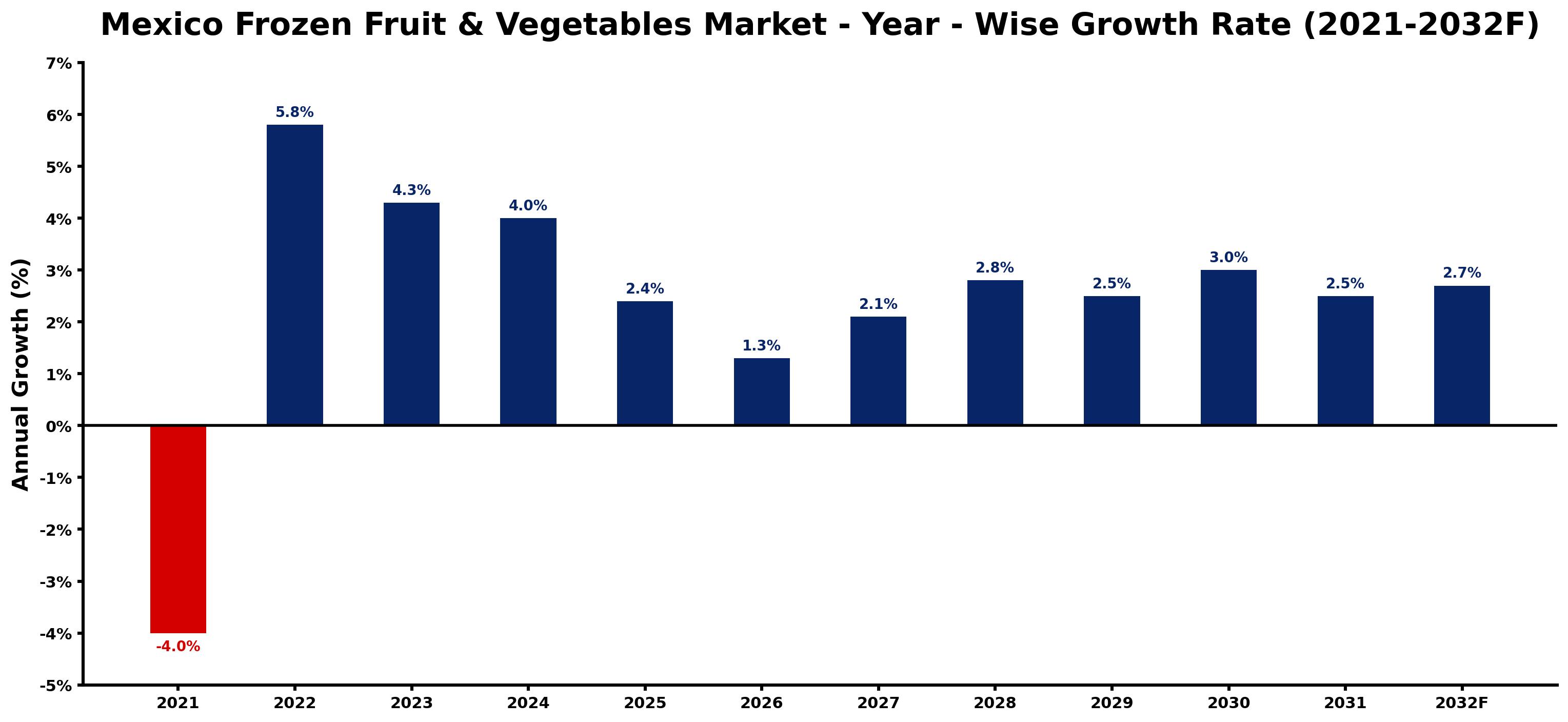
The table below presents the year wise growth rates along with the key drivers influencing the market
| Year | Growth Rate | Major Drivers |
| 2021 | -4.0% | Supply chain disruptions due to pandemicrelated restrictions hindered product availability and drove down sales volumes. |
| 2022 | 5.8% | Health-conscious consumer behavior shifted focus to nutritious frozen food options. |
| 2023 | 4.3% | Innovative packaging solutions appealed to environmentally aware millennial shoppers. |
| 2024 | 4.0% | Increased agricultural investment led to better frozen produce supply chain efficiency. |
| 2025 | 2.4% | Local sourcing initiatives bolstered the appeal of regional frozen fruits and vegetables. |
| 2026 | 1.3% | Foodservice sector expansion provided a new avenue for frozen vegetable growth. |
| 2027 | 2.1% | Technological advancements in freezing methods enhanced product quality and shelf life. |
| 2028 | 2.8% | Urbanization trends prompted higher demand for convenient frozen meal solutions. |
| 2029 | 2.5% | E-commerce platforms made frozen produce more accessible to remote consumers. |
| 2030 | 3.0% | Culinary trends favored plant-based diets, increasing frozen vegetable product lines. |
| 2031 | 2.5% | Sustainability movements influenced brands to adopt eco-friendly frozen food practices. |
| 2032 | 2.7% | Continued economic stability encouraged higher disposable incomes for premium frozen options. |
Note - Market size estimations and growth projections presented in this report are based on 6Wresearch's advanced forecasting approach, validated with industry datasets as of June 2026.
Mexico Frozen Fruit & Vegetables Market Synopsis
The Mexico Frozen Fruit Vegetables Market is projected to reach 1.3% and witness significant growth during the forecast period (2026-2032). The market exhibits a robust upward trajectory fueled by changing consumer preferences, a rising inclination towards healthy eating, and advancements in freezing technologies that enhance product quality and taste. With consumers increasingly seeking convenience without compromising nutritional value, the demand for frozen fruits and vegetables continues to expand, shaping a dynamic market landscape.
Mexico Frozen Fruit & Vegetables Market Growth Drivers
The growth of the Mexico Frozen Fruit & Vegetables Market can be attributed to several key drivers, which include:
- The rising preference for convenience among consumers, who are increasingly looking for quick meal solutions that do not sacrifice nutritional content, positions frozen produce as an ideal choice.
- Growing awareness regarding the health benefits of frozen fruits and vegetables is enhancing their appeal, as they retain essential vitamins and minerals equivalent to fresh produce.
- Technological advancements in freezing methods have significantly improved the quality of frozen goods, reducing the perception that they are inferior to fresh options.
- Urbanization and busy lifestyles are propelling the demand for ready-to-cook foods, which boosts the consumption of frozen fruits and vegetables.
- Retailers are increasingly expanding their frozen food sections, making these products more accessible to consumers and stimulating market growth.
Mexico Frozen Fruit & Vegetables Market Challenges and Restraints
Despite its growth potential, the Mexico Frozen Fruit & Vegetables Market encounters several challenges that could impact its expansion:
- The lack of a robust cold chain infrastructure poses a significant challenge, as ensuring the proper storage and transportation of frozen products is crucial for maintaining quality and safety.
- Investments in cold storage and logistics are necessary, but they can be substantial, potentially hindering smaller players in the market from competing effectively.
- Consumer misconceptions that frozen produce is of lower quality compared to fresh may affect purchasing decisions, necessitating targeted marketing and education initiatives.
- Fluctuating agricultural yield due to climate change could impact the supply of raw materials for frozen fruits and vegetables, posing risks to market stability.
- Regulatory hurdles and compliance with food safety standards can be cumbersome, particularly for new entrants looking to establish themselves in this competitive landscape.
Mexico Frozen Fruit & Vegetables Market Trends and Opportunities
Current trends within the Mexico Frozen Fruit & Vegetables Market suggest a variety of opportunities for growth and innovation:
- An increasing focus on organic and sustainably sourced frozen produce is gaining traction among health-conscious consumers, opening avenues for differentiation in the market.
- Expansion of online grocery shopping and delivery services is enhancing accessibility, further driving the sales of frozen fruits and vegetables.
- The introduction of value-added products, such as pre-cut and pre-packaged options, caters to the demand for convenience, thereby attracting busy consumers.
- Collaborations between market players and health organizations for nutritional education can help overcome consumer misconceptions and boost sales.
- Innovations in packaging technology aimed at extending shelf life and reducing waste can contribute to improved consumer acceptance and market viability.
Mexico Frozen Fruit & Vegetables Market Government Investment and Initiatives
The Mexican government plays a vital role in shaping the Mexico Frozen Fruit & Vegetables Market through various initiatives aimed at enhancing agricultural productivity and ensuring food safety:
- Government policies focused on improving agricultural technologies and practices aim to increase the yield and quality of fruits and vegetables, directly benefiting the frozen market segment.
- Public investments in infrastructure development, specifically in cold chain logistics, are crucial for maintaining product quality and enhancing market efficiency.
- Incentives for sustainable farming practices contribute to a more resilient agricultural sector, positively affecting the supply chain for frozen products.
- Regulatory frameworks governing food safety and quality are continually updated to ensure that frozen produce adheres to domestic and international standards, fostering consumer confidence.
- Programs aimed at raising consumer awareness about the benefits of frozen fruits and vegetables are being initiated to combat stereotypes and promote healthy eating habits.
Mexico Frozen Fruit & Vegetables Market Latest Developments (May 2025 - June 2026)
In the period from May 2025 to June 2026, the Mexico Frozen Fruit & Vegetables Market has witnessed several notable developments:
- There has been an uptick in the number of retailers incorporating frozen sections in their stores, catering to the burgeoning demand for convenient meal options.
- Innovative freezing technologies have launched, enhancing product quality and extending shelf life while preserving nutritional value.
- Consumer awareness campaigns have gained momentum, focusing on the health benefits of frozen produce, which has resulted in increased sales.
- Collaborations among agricultural producers and technology providers have aimed at improving cold chain logistics, ensuring fresher products reach the market.
- The market is seeing a rising interest in organic and non-GMO frozen fruit and vegetable options, aligning with broader health and wellness trends.
Mexico Frozen Fruit & Vegetables Market - Key Attractiveness of the Report
- 10 Years of Market Numbers
- Historical Data Starting from 2022 to 2025
- Base Year: 2025
- Forecast Data until 2032
- Key Performance Indicators Impacting the Market
- Major Upcoming Developments and Projects
Key Highlights of the Report:
- Mexico Frozen Fruit & Vegetables Market Outlook
- Market Size of Mexico Frozen Fruit & Vegetables Market, 2025
- Forecast of Mexico Frozen Fruit & Vegetables Market, 2032
- Historical Data and Forecast of Mexico Frozen Fruit & Vegetables Revenues & Volume for the Period 2022-2032F
- Mexico Frozen Fruit & Vegetables Market Trend Evolution
- Mexico Frozen Fruit & Vegetables Market Drivers and Challenges
- Mexico Frozen Fruit & Vegetables Price Trends
- Mexico Frozen Fruit & Vegetables Porter's Five Forces
- Mexico Frozen Fruit & Vegetables Industry Life Cycle
- Historical Data and Forecast of Mexico Frozen Fruit & Vegetables Market Revenues & Volume By Product Type for the Period 2022-2032F
- Historical Data and Forecast of Mexico Frozen Fruit & Vegetables Market Revenues & Volume By Frozen Vegetables for the Period 2022-2032F
- Historical Data and Forecast of Mexico Frozen Fruit & Vegetables Market Revenues & Volume By Frozen Fruits for the Period 2022-2032F
- Historical Data and Forecast of Mexico Frozen Fruit & Vegetables Market Revenues & Volume By Applications for the Period 2022-2032F
- Historical Data and Forecast of Mexico Frozen Fruit & Vegetables Market Revenues & Volume By Fruits for the Period 2022-2032F
- Historical Data and Forecast of Mexico Frozen Fruit & Vegetables Market Revenues & Volume By Vegetables for the Period 2022-2032F
- Historical Data and Forecast of Mexico Frozen Fruit & Vegetables Market Revenues & Volume By Distribution Channel for the Period 2022-2032F
- Historical Data and Forecast of Mexico Frozen Fruit & Vegetables Market Revenues & Volume By Hypermarkets/Supermarkets for the Period 2022-2032F
- Historical Data and Forecast of Mexico Frozen Fruit & Vegetables Market Revenues & Volume By Convenience Stores for the Period 2022-2032F
- Historical Data and Forecast of Mexico Frozen Fruit & Vegetables Market Revenues & Volume By E-commerce for the Period 2022-2032F
- Mexico Frozen Fruit & Vegetables Import Export Trade Statistics
- Market Opportunity Assessment By Product Type
- Market Opportunity Assessment By Applications
- Market Opportunity Assessment By Distribution Channel
- Mexico Frozen Fruit & Vegetables Top Companies Market Share
- Mexico Frozen Fruit & Vegetables Competitive Benchmarking By Technical and Operational Parameters
- Mexico Frozen Fruit & Vegetables Company Profiles
- Mexico Frozen Fruit & Vegetables Key Strategic Recommendations






































