Mexico Fruit Pulp Market Size, Share & Growth Rate
The Mexico Fruit Pulp Market was estimated at USD 216 Million in 2025 and is projected to reach USD 249 Million by 2032, growing at a CAGR of 2.1% from 2026 to 2032. This growth trajectory is fueled by an increasing consumer preference for natural food ingredients and the escalating demand for fruit-based beverages, which are becoming staples in many households. Additionally, the rise in the popularity of organic and minimally processed foods is further propelling the market's expansion.
Mexico Fruit Pulp Market Year-wise Growth Rate and Key Drivers
This graph highlights how the Mexico Fruit Pulp Market has steadily grown over the years, supported by major growth factors.
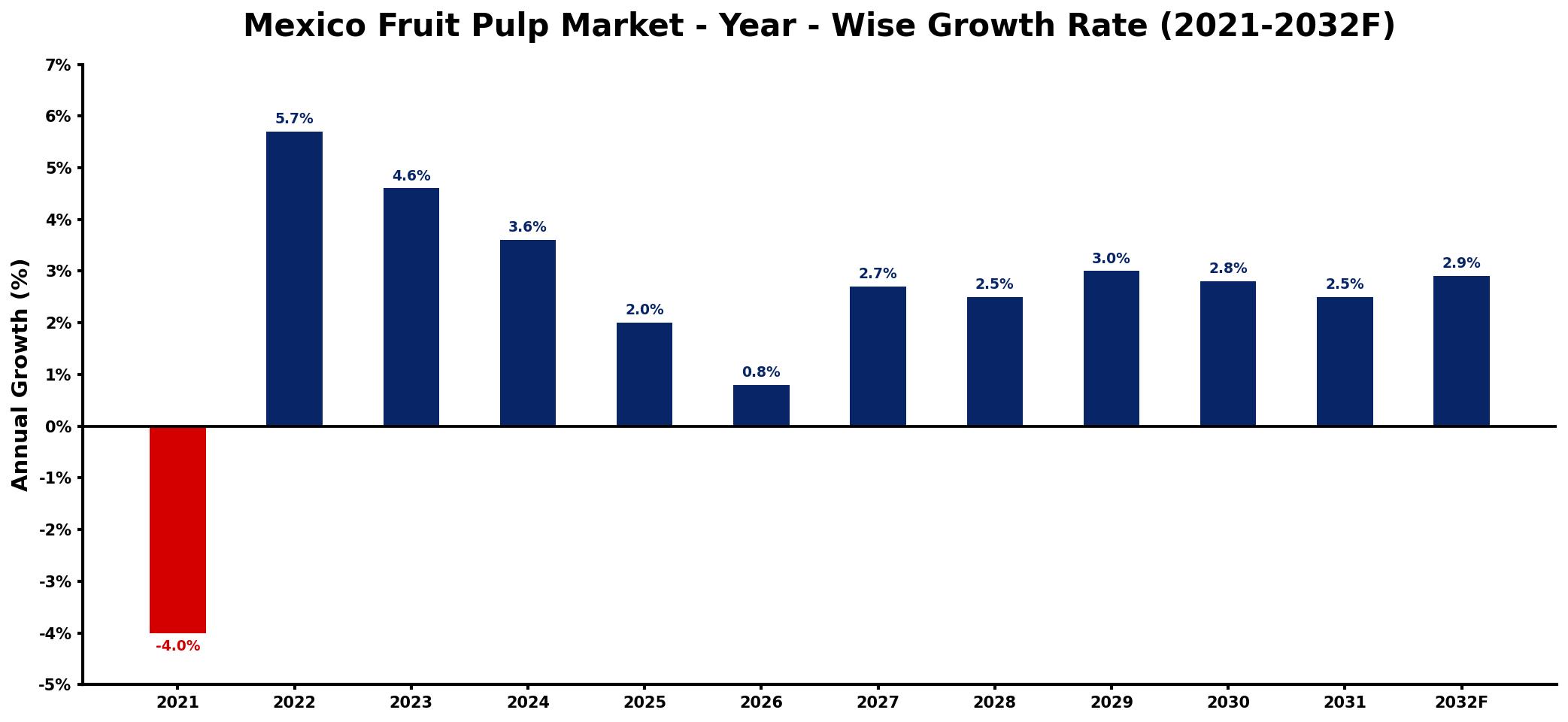
The table below presents the year‑wise growth rates along with the key drivers influencing the market
| Year | Growth Rate | Major Drivers |
| 2021 | -4.0% | lower consumer spending patterns |
| 2022 | 5.7% | rising demand for beverages |
| 2023 | 4.6% | increased investment in processing |
| 2024 | 3.6% | growing health consciousness trend |
| 2025 | 2.0% | expansion of retail distribution channels |
| 2026 | 0.8% | increased export opportunities available |
| 2027 | 2.7% | emerging trends in food innovation |
| 2028 | 2.5% | diversification of product offerings |
| 2029 | 3.0% | growing popularity of organic products |
| 2030 | 2.8% | rising consumer preference for convenience |
| 2031 | 2.5% | increased focus on sustainability initiatives |
| 2032 | 2.9% | increased production capacity utilization |
Note: Market size estimations and growth projections presented in this report are based on 6Wresearch's proprietary forecasting methodology, utilizing the latest available industry data, government publications, and primary research inputs.
Mexico Fruit Pulp Market Synopsis
The Mexico Fruit Pulp Market has experienced significant momentum in recent years, driven largely by the rising health-consciousness among consumers. As the food and beverage sector innovates, the demand for high-quality fruit pulp is anticipated to surge, aligning with the growing trend towards functional foods. However, as the market matures, it faces challenges that will need strategic management to sustain its growth.
While recent trends indicate robust expansion, the future will require adaptation to shifting consumer preferences and market dynamics. The competition from alternative ingredients and fruit-based products presents both a challenge and an opportunity for differentiation. In this evolving landscape, focusing on quality and sustainability will be key for stakeholders in the Mexico Fruit Pulp Market.
Mexico Fruit Pulp Market Key Takeaways
- Growing demand for natural and organic food ingredients drives market expansion.
- The rise in consumption of fruit-based beverages, dairy, and bakery products boosts fruit pulp usage.
- Maintaining high-quality standards remains critical amidst supply chain challenges.
- Opportunities for innovation exist as the market explores new applications and product formulations.
- Government initiatives aim to enhance local agriculture and promote food safety in the industry.
Evaluation of Restraints in Mexico Fruit Pulp Market
The Mexico Fruit Pulp Market faces several key restraints that could impact growth. Supply chain management is a significant hurdle, as it involves coordinating with growers to ensure a consistent supply of quality pulp. Seasonal variations and unpredictable climatic conditions can disrupt this supply chain, leading to potential shortages. Additionally, the market must contend with stringent quality control regulations, which, while necessary, add layers of complexity and cost to production. These challenges are compounded by increasing competition from alternative fruit products and other natural ingredients, necessitating a strategic approach to maintain market position.
Mexico Fruit Pulp Market Trends
Current trends in the Mexico Fruit Pulp Market reveal a clear shift towards health and wellness products. Consumers are increasingly seeking out fruit pulp that is organic, minimally processed, and rich in nutrients. Moreover, there is a rising interest in functional foods that provide additional health benefits, further spurring the demand for high-quality fruit pulp. Technologically, innovations in processing methods are enhancing the preservation of flavor and nutrients, making fruit pulp more appealing to manufacturers aiming to differentiate their products in a competitive landscape.
Mexico Fruit Pulp Market Opportunities
The Mexico Fruit Pulp Market presents numerous growth opportunities for businesses willing to innovate. The increasing trend of health-conscious eating opens avenues for product diversification, particularly in the development of functional beverages and snacks. Additionally, as more consumers gravitate towards organic options, there is significant potential for growth within this segment. Investments in advanced processing technologies can further enhance product quality and shelf life, which could attract a broader customer base. Collaborations with local farmers to promote sustainable practices will not only strengthen supply chains but also enhance brand loyalty among environmentally conscious consumers.
Government Initiatives in the Mexico Fruit Pulp Market
The Mexican government has implemented several initiatives aimed at bolstering the fruit pulp market. Policies focused on supporting local agriculture seek to ensure that growers can meet the increasing demand for high-quality fruit pulp while adhering to strict food safety regulations. Furthermore, programs designed to provide training and financial assistance to farmers and producers are fostering a more robust agricultural sector. These initiatives reflect a commitment to enhancing food quality and safety standards while promoting the export potential of Mexican fruit pulp, positioning it favorably in the global market.
Future Insights of the Mexico Fruit Pulp Market
Looking ahead to 2026-2032, the Mexico Fruit Pulp Market is expected to evolve significantly, driven by ongoing consumer trends favoring health and sustainability. The market is likely to witness a surge in demand for innovative, functional fruit-based products that resonate with health-conscious consumers. Additionally, the integration of technology in production processes may yield higher quality and better-preserved fruit pulp, ultimately enhancing its appeal in diverse applications. With continuous support from government initiatives and the adoption of sustainable practices, the market is poised for a promising trajectory.
Mexico Fruit Pulp Market Latest Developments (2025 - 2026)
Recent industry developments indicate a strong focus on sustainability and innovation within the Mexico Fruit Pulp Market. Various stakeholders are investing in research and development to improve processing techniques that retain the nutritional value of fruit pulp. Additionally, there has been a notable increase in partnerships between local producers and international distributors aimed at enhancing market reach. Furthermore, the trend towards organic fruit pulp is prompting many companies to re-evaluate their sourcing and production strategies to align with consumer preferences.
Mexico Fruit Pulp Market - Key Attractiveness of the Report
- 10 Years of Market Numbers
- Historical Data Starting from 2022 to 2025
- Base Year: 2025
- Forecast Data until 2032
- Key Performance Indicators Impacting the Market
- Major Upcoming Developments and Projects
Key Highlights of the Report:
- Mexico Fruit Pulp Market Outlook
- Market Size of Mexico Fruit Pulp Market, 2025
- Forecast of Mexico Fruit Pulp Market, 2032
- Historical Data and Forecast of Mexico Fruit Pulp Revenues & Volume for the Period 2022-2032F
- Mexico Fruit Pulp Market Trend Evolution
- Mexico Fruit Pulp Market Drivers and Challenges
- Mexico Fruit Pulp Price Trends
- Mexico Fruit Pulp Porter's Five Forces
- Mexico Fruit Pulp Industry Life Cycle
- Historical Data and Forecast of Mexico Fruit Pulp Market Revenues & Volume By Fruit Type for the Period 2022-2032F
- Historical Data and Forecast of Mexico Fruit Pulp Market Revenues & Volume By Mango for the Period 2022-2032F
- Historical Data and Forecast of Mexico Fruit Pulp Market Revenues & Volume By Strawberry for the Period 2022-2032F
- Historical Data and Forecast of Mexico Fruit Pulp Market Revenues & Volume By Apple for the Period 2022-2032F
- Historical Data and Forecast of Mexico Fruit Pulp Market Revenues & Volume By Guava for the Period 2022-2032F
- Historical Data and Forecast of Mexico Fruit Pulp Market Revenues & Volume By Berries for the Period 2022-2032F
- Historical Data and Forecast of Mexico Fruit Pulp Market Revenues & Volume By Citrus Fruits for the Period 2022-2032F
- Historical Data and Forecast of Mexico Fruit Pulp Market Revenues & Volume By Others for the Period 2022-2032F
- Historical Data and Forecast of Mexico Fruit Pulp Market Revenues & Volume By Form for the Period 2022-2032F
- Historical Data and Forecast of Mexico Fruit Pulp Market Revenues & Volume By Liquid for the Period 2022-2032F
- Historical Data and Forecast of Mexico Fruit Pulp Market Revenues & Volume By Powder for the Period 2022-2032F
- Historical Data and Forecast of Mexico Fruit Pulp Market Revenues & Volume By Application for the Period 2022-2032F
- Historical Data and Forecast of Mexico Fruit Pulp Market Revenues & Volume By Food and Beverages for the Period 2022-2032F
- Historical Data and Forecast of Mexico Fruit Pulp Market Revenues & Volume By Distribution for the Period 2022-2032F
- Historical Data and Forecast of Mexico Fruit Pulp Market Revenues & Volume By E-Commerce for the Period 2022-2032F
- Historical Data and Forecast of Mexico Fruit Pulp Market Revenues & Volume By Convenience Stores for the Period 2022-2032F
- Historical Data and Forecast of Mexico Fruit Pulp Market Revenues & Volume By Supermarkets/Hypermarkets for the Period 2022-2032F
- Historical Data and Forecast of Mexico Fruit Pulp Market Revenues & Volume By Specialty Stores for the Period 2022-2032F
- Historical Data and Forecast of Mexico Fruit Pulp Market Revenues & Volume By Others for the Period 2022-2032F
- Mexico Fruit Pulp Import Export Trade Statistics
- Market Opportunity Assessment By Fruit Type
- Market Opportunity Assessment By Form
- Market Opportunity Assessment By Application
- Market Opportunity Assessment By Distribution
- Mexico Fruit Pulp Top Companies Market Share
- Mexico Fruit Pulp Competitive Benchmarking By Technical and Operational Parameters
- Mexico Fruit Pulp Company Profiles
- Mexico Fruit Pulp Key Strategic Recommendations






































