Venezuela Fruit Pulp Market Size, Share & Growth Rate
The Venezuela Fruit Pulp Market was estimated at USD 342 Million in 2025 and is projected to reach USD 447 Million by 2032, growing at a CAGR of 3.9% from 2026 to 2032. This growth trajectory is primarily fueled by the rising consumer inclination toward natural food products and the increasing use of fruit pulps in various culinary applications. Moreover, the demand for ready-to-use fruit pulp as a convenient ingredient for smoothies, beverages, and desserts enhances market prospects.
Venezuela Fruit Pulp Market Year-wise Growth Rate and Key Drivers
This graph highlights how the Venezuela Fruit Pulp Market has steadily grown over the years, supported by major growth factors.
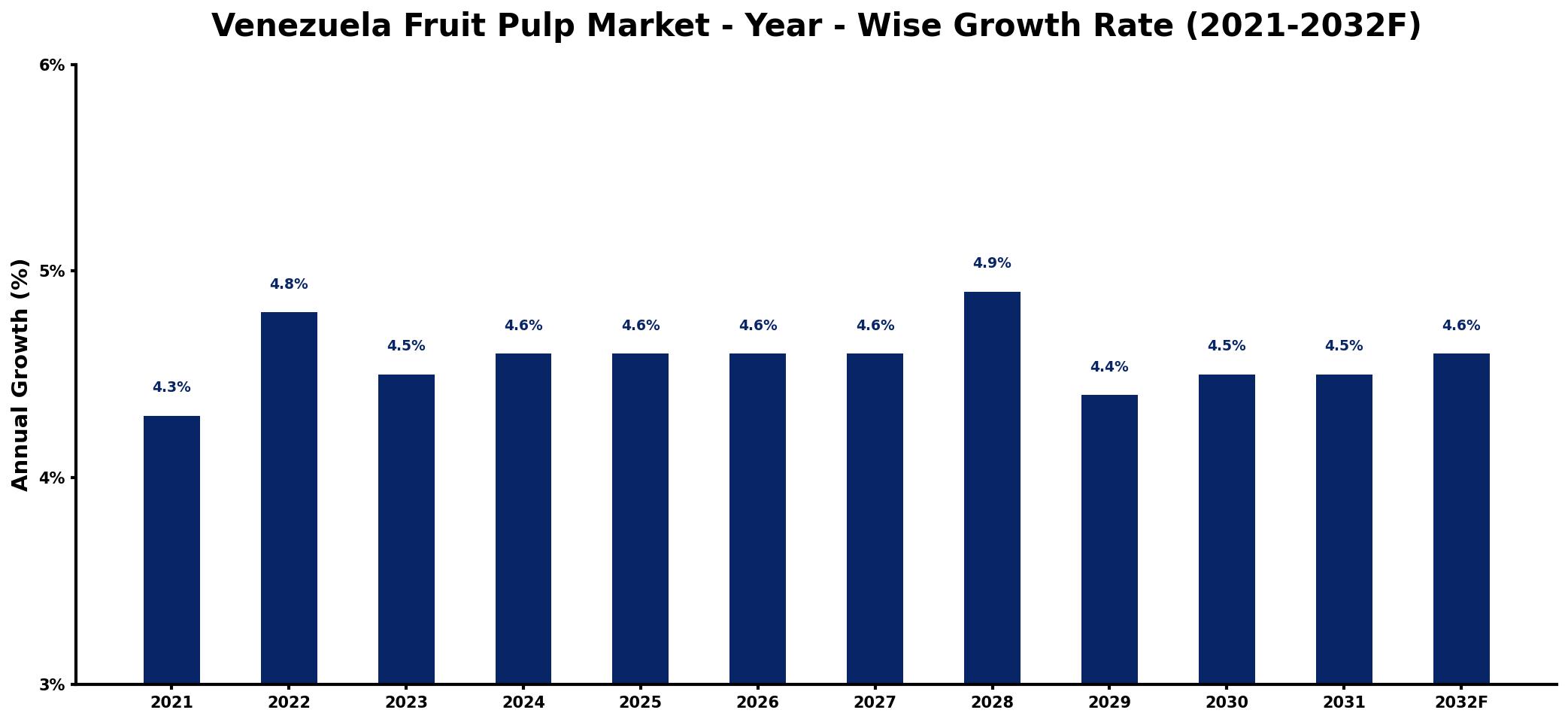
The table below presents the year‑wise growth rates along with the key drivers influencing the market
| Year | Growth Rate | Major Drivers |
| 2021 | 4.3% | Rising health consciousness among consumers |
| 2022 | 4.8% | Increased demand for natural ingredients |
| 2023 | 4.5% | increased overall sector activity |
| 2024 | 4.6% | Growth in export opportunities emerging |
| 2025 | 4.6% | Investment in processing technologies rising |
| 2026 | 4.6% | Diversification of product offerings increasing |
| 2027 | 4.6% | Sustainable sourcing practices gaining traction |
| 2028 | 4.9% | Rising popularity of organic options |
| 2029 | 4.4% | Enhanced distribution networks evolving rapidly |
| 2030 | 4.5% | Consumer preference for convenience products |
| 2031 | 4.5% | Innovations in packaging technologies advancing |
| 2032 | 4.6% | Collaboration with local farmers expanding |
Note: Market size estimations and growth projections presented in this report are based on 6Wresearch's proprietary forecasting methodology, utilizing the latest available industry data, government publications, and primary research inputs.
Venezuela Fruit Pulp Market Synopsis
In Venezuela, the availability of diverse tropical fruits such as mango, guava, and passion fruit establishes a robust foundation for the fruit pulp sector. The growing awareness among consumers about the health benefits of natural fruit products is significantly influencing purchasing behavior.
Local manufacturers hold a considerable share of the market, responding adeptly to evolving consumer preferences. The shift towards organic and preservative-free products is prompting producers to innovate and diversify their offerings.
Venezuela Fruit Pulp Market Key Takeaways
- The market is experiencing a notable increase in demand for healthy and convenient food options.
- Local production is crucial, with tropical fruits serving as primary raw materials.
- Increasing consumer awareness about nutrition is driving the preference for natural fruit pulps.
- Investment opportunities exist in processing facilities and partnerships with local farmers.
- Government policies aimed at supporting domestic production are influencing market dynamics.
Evaluation of Restraints in Venezuela Fruit Pulp Market
The Venezuela Fruit Pulp Market is hindered by significant economic and political challenges. Hyperinflation and currency instability have created an unpredictable financial environment, complicating pricing strategies for producers. Additionally, a lack of infrastructure, consistent electricity supply, and modern processing technology limits production efficiency. These factors collectively contribute to supply chain disruptions that further constrain market growth.
Venezuela Fruit Pulp Market Trends
A key trend within the Venezuela Fruit Pulp Market is the increasing use of fruit pulp as a base for various culinary applications, particularly smoothies, juices, and desserts. Consumers are gravitating towards products that are devoid of additives, reinforcing the demand for high-quality, natural fruit pulps. Furthermore, the rising global interest in exotic fruits is encouraging local producers to diversify their product portfolios, thus enhancing market vitality.
Venezuela Fruit Pulp Market Opportunities
Investment opportunities in the Venezuela Fruit Pulp Market are promising, particularly in processing facilities that can leverage the country's rich array of tropical fruits. Establishing strong partnerships with local fruit farmers can ensure a steady supply of quality raw materials. Additionally, focusing on innovative packaging solutions and unique marketing strategies will allow businesses to differentiate themselves in a competitive landscape, potentially leading to increased market share and profitability.
Government Initiatives in the Venezuela Fruit Pulp Market
Government policies in Venezuela focus on enhancing food security and promoting local production within the Fruit Pulp Market. To this end, various price controls and subsidies are in place to assist both producers and consumers. Furthermore, regulations are designed to support small-scale farmers, thereby fostering a more resilient agricultural sector. These initiatives aim to bolster domestic production and reduce reliance on imports, although their effectiveness is often challenged by the prevailing political and economic climate.
Future Insights of the Venezuela Fruit Pulp Market
Looking ahead to 2026-2032, the Venezuela Fruit Pulp Market is set for continued growth driven by increasing consumer demand for healthy options. Despite the ongoing challenges posed by economic instability and infrastructure shortcomings, strategic investments in innovation and distribution will be critical for market players. By aligning with consumer trends and ensuring quality supply chains, businesses can capitalize on the latent potential within this vibrant market.
Venezuela Fruit Pulp Market Latest Developments (2025 - 2026)
Recent developments in the Venezuela Fruit Pulp Market indicate a surge in innovation, particularly in product offerings that cater to health-conscious consumers. Companies are increasingly exploring eco-friendly packaging solutions to align with growing consumer preferences for sustainability. Efforts to improve supply chain logistics have also been emphasized as producers seek to mitigate the impacts of ongoing economic challenges. The landscape is evolving, and stakeholders are adapting to ensure competitive positioning.
Venezuela Fruit Pulp Market - Key Attractiveness of the Report
- 10 Years of Market Numbers
- Historical Data Starting from 2022 to 2025
- Base Year: 2025
- Forecast Data until 2032
- Key Performance Indicators Impacting the Market
- Major Upcoming Developments and Projects
Key Highlights of the Report:
- Venezuela Fruit Pulp Market Outlook
- Market Size of Venezuela Fruit Pulp Market, 2025
- Forecast of Venezuela Fruit Pulp Market, 2032
- Historical Data and Forecast of Venezuela Fruit Pulp Revenues & Volume for the Period 2022-2032F
- Venezuela Fruit Pulp Market Trend Evolution
- Venezuela Fruit Pulp Market Drivers and Challenges
- Venezuela Fruit Pulp Price Trends
- Venezuela Fruit Pulp Porter's Five Forces
- Venezuela Fruit Pulp Industry Life Cycle
- Historical Data and Forecast of Venezuela Fruit Pulp Market Revenues & Volume By Fruit Type for the Period 2022-2032F
- Historical Data and Forecast of Venezuela Fruit Pulp Market Revenues & Volume By Mango for the Period 2022-2032F
- Historical Data and Forecast of Venezuela Fruit Pulp Market Revenues & Volume By Strawberry for the Period 2022-2032F
- Historical Data and Forecast of Venezuela Fruit Pulp Market Revenues & Volume By Apple for the Period 2022-2032F
- Historical Data and Forecast of Venezuela Fruit Pulp Market Revenues & Volume By Guava for the Period 2022-2032F
- Historical Data and Forecast of Venezuela Fruit Pulp Market Revenues & Volume By Berries for the Period 2022-2032F
- Historical Data and Forecast of Venezuela Fruit Pulp Market Revenues & Volume By Citrus Fruits for the Period 2022-2032F
- Historical Data and Forecast of Venezuela Fruit Pulp Market Revenues & Volume By Others for the Period 2022-2032F
- Historical Data and Forecast of Venezuela Fruit Pulp Market Revenues & Volume By Form for the Period 2022-2032F
- Historical Data and Forecast of Venezuela Fruit Pulp Market Revenues & Volume By Liquid for the Period 2022-2032F
- Historical Data and Forecast of Venezuela Fruit Pulp Market Revenues & Volume By Powder for the Period 2022-2032F
- Historical Data and Forecast of Venezuela Fruit Pulp Market Revenues & Volume By Application for the Period 2022-2032F
- Historical Data and Forecast of Venezuela Fruit Pulp Market Revenues & Volume By Food and Beverages for the Period 2022-2032F
- Historical Data and Forecast of Venezuela Fruit Pulp Market Revenues & Volume By Distribution for the Period 2022-2032F
- Historical Data and Forecast of Venezuela Fruit Pulp Market Revenues & Volume By E-Commerce for the Period 2022-2032F
- Historical Data and Forecast of Venezuela Fruit Pulp Market Revenues & Volume By Convenience Stores for the Period 2022-2032F
- Historical Data and Forecast of Venezuela Fruit Pulp Market Revenues & Volume By Supermarkets/Hypermarkets for the Period 2022-2032F
- Historical Data and Forecast of Venezuela Fruit Pulp Market Revenues & Volume By Specialty Stores for the Period 2022-2032F
- Historical Data and Forecast of Venezuela Fruit Pulp Market Revenues & Volume By Others for the Period 2022-2032F
- Venezuela Fruit Pulp Import Export Trade Statistics
- Market Opportunity Assessment By Fruit Type
- Market Opportunity Assessment By Form
- Market Opportunity Assessment By Application
- Market Opportunity Assessment By Distribution
- Venezuela Fruit Pulp Top Companies Market Share
- Venezuela Fruit Pulp Competitive Benchmarking By Technical and Operational Parameters
- Venezuela Fruit Pulp Company Profiles
- Venezuela Fruit Pulp Key Strategic Recommendations






































